
With the rapid development of power electronics, silicon carbide (SiC) has emerged as a promising material for next-generation devices due to its wide bandgap, high thermal conductivity, and excellent electrical performance. Compared with traditional silicon, SiC enables devices with higher voltage tolerance, lower switching losses, and better high-temperature stability.
However, the surface preparation of SiC wafers remains a critical challenge. The widely used RCA cleaning process, originally developed for silicon wafers, may not be directly applicable to SiC due to fundamental differences in surface chemistry and bonding structure.
This study investigates the limitations of RCA cleaning for SiC and introduces a novel HF-free cleaning method based on transition metal complex-activated hydrogen peroxide.
Limitations of RCA Cleaning for SiC
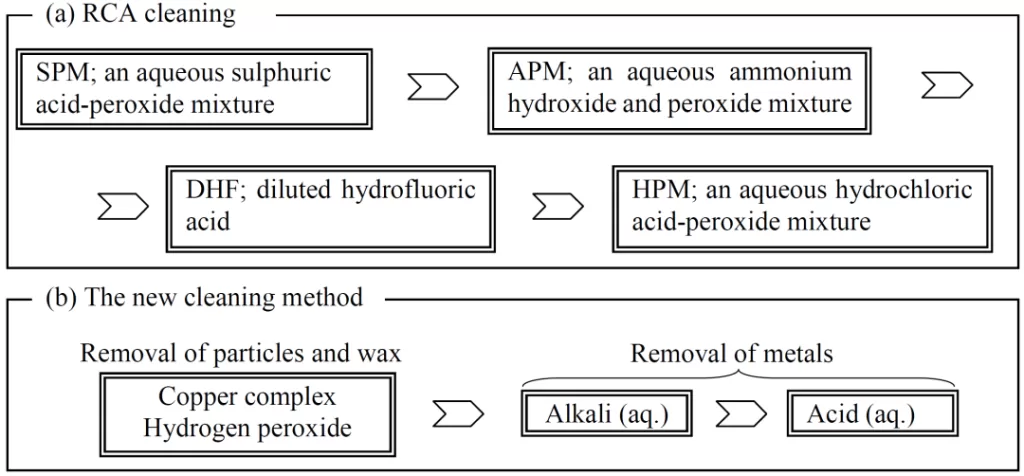
The RCA cleaning process typically involves hydrofluoric acid (HF) to remove native oxides and contaminants from silicon surfaces. However, when applied to SiC:
- X-ray Photoelectron Spectroscopy (XPS) analysis reveals that fluorine reacts with carbon atoms in SiC, forming undesirable chemical bonds.
- Computational simulations further indicate that such interactions can narrow the bandgap of SiC, potentially degrading its electronic properties.
These findings suggest that HF-based treatments can damage the intrinsic properties of SiC, making conventional RCA cleaning unsuitable for high-performance applications.
Development of a New Cleaning Method
To address these limitations, a new cleaning approach was developed with the following characteristics:
- HF-free process, eliminating fluorine-induced damage
- Use of transition metal complexes (e.g., copper complexes)
- Activation of hydrogen peroxide (H₂O₂) to generate reactive radicals
- Reduction of cleaning steps to three simplified stages
Unlike conventional approaches that avoid metals, this method intentionally introduces controlled metal complexes to catalyze radical formation, enhancing contaminant removal efficiency.

Experimental Evaluation Methods
To evaluate the cleaning performance, multiple characterization techniques were employed:
- Atomic Force Microscopy (AFM): Surface morphology and particle detection
- Water Contact Angle Measurement: Surface wettability and organic residue assessment
- Candela Surface Inspection System: Defect inspection on 3-inch wafers
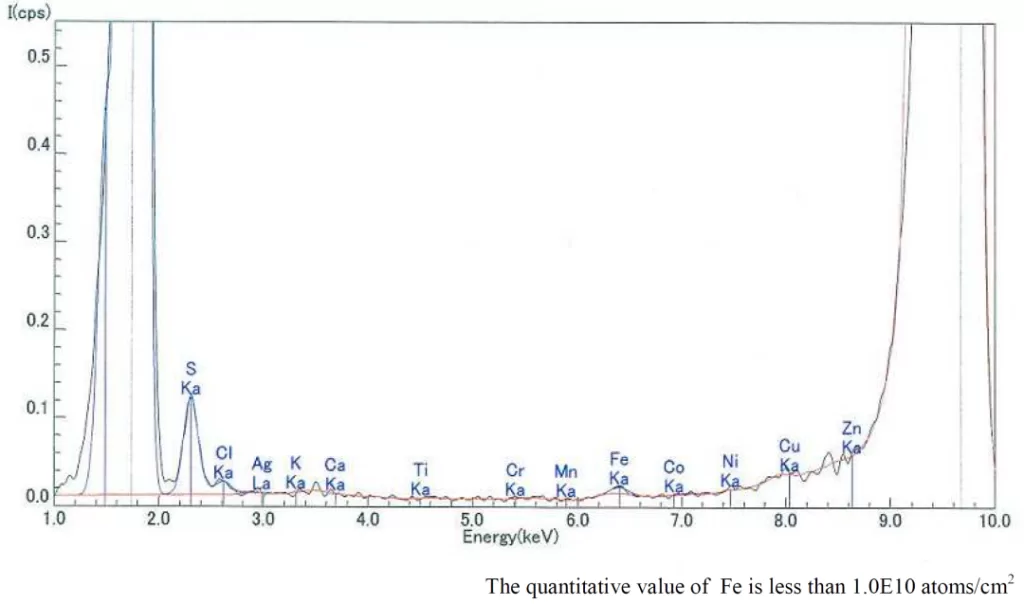
- Total Reflection X-ray Fluorescence (TXRF): Trace metal contamination analysis
Results and Discussion
Surface Morphology and Cleanliness
AFM images show that:
- Before cleaning, the SiC surface contains numerous particles and organic residues (contact angle ~70°, indicating hydrophobic contamination).
- After RCA cleaning, residual particles remain on the surface.
- After the new cleaning method, no visible particles are detected, and the contact angle decreases to ~42°, indicating improved surface hydrophilicity.
These results confirm the effective removal of both particles and organic contaminants (e.g., wax residues).
Defect Reduction on Wafer
Candela inspection of 3-inch SiC wafers demonstrates a significant reduction in particle counts after applying the new method. This observation is consistent with AFM results and validates the process at wafer scale.
The mechanism is attributed to:
- Catalytic action of copper complexes
- Controlled generation of reactive oxygen radicals from hydrogen peroxide
- Enhanced removal of surface particles through oxidative reactions
Metal Contamination Analysis
Despite the use of copper complexes:
- TXRF analysis detects no residual copper on the wafer surface
- No other metallic contaminants are observed after cleaning
This indicates that the process achieves high cleaning efficiency without introducing secondary contamination, addressing a key concern in semiconductor processing.
Advantages of the New Cleaning Method
- Eliminates HF-induced damage to SiC
- Achieves low defect density and high surface cleanliness
- Removes both particles and organic residues
- Reduces process complexity (fewer steps)
- Avoids residual metal contamination
- Compatible with industrial wafer-scale processing

Conclusion
This study demonstrates that conventional RCA cleaning is not fully suitable for SiC wafers due to the damaging effects of HF on the material’s surface and electronic properties.
The proposed HF-free cleaning method, based on transition metal complex-activated hydrogen peroxide, provides an effective alternative. It enables:
- Efficient particle and contaminant removal
- Preservation of SiC material properties
- Improved surface wettability and cleanliness
- Scalable application for semiconductor manufacturing
This approach offers a promising pathway for advanced SiC wafer processing, supporting the continued development of high-performance power and RF devices.