
1. Introduction
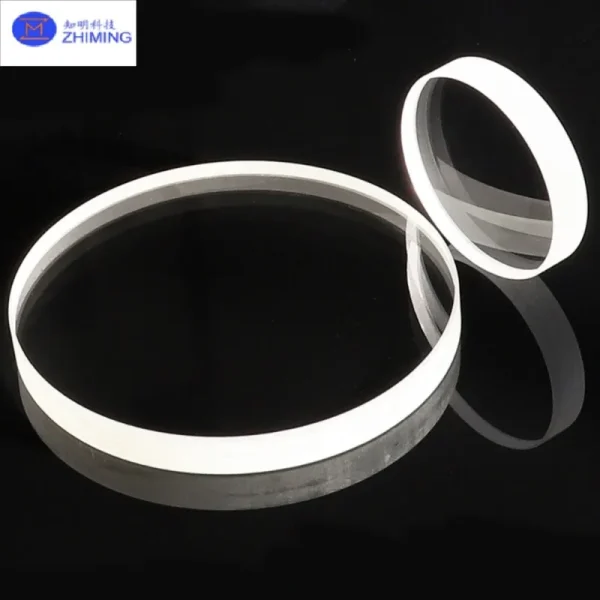
A furnace sapphire window with mounting holder is a specialized engineered assembly that integrates a single-crystal sapphire optical element with a mechanically stable support structure. This design ensures reliable sealing, precise alignment, and long-term durability in harsh thermal environments exceeding 1000°C in certain configurations.
In high-temperature industrial environments such as crystal growth furnaces, chemical vapor deposition (CVD) systems, and vacuum sintering equipment, optical access components must withstand extreme thermal, mechanical, and chemical stresses while maintaining stable transmission performance. Among available materials, sapphire-based optical components have emerged as a leading solution due to their exceptional thermo-mechanical stability.
2. Material Basis: Why Sapphire?
Sapphire is a single-crystal form of aluminum oxide (Al₂O₃). It is widely used in optical and high-temperature systems due to its combination of physical and chemical properties:
- Extremely high hardness (Mohs 9)
- High melting point (~2050°C)
- Excellent thermal conductivity
- Strong resistance to thermal shock
- Broad optical transmission range (UV to mid-IR)
In industrial optics, sapphire is preferred over fused silica or borosilicate glass when both high temperature and mechanical stress are present simultaneously.
sapphire (single-crystal Al2O3)
3. Structural Design: Window + Mounting Holder System
A furnace sapphire window assembly is not simply an optical disk; it is a mechanically engineered interface system consisting of:
3.1 Sapphire Optical Window
The window serves as the optical transmission medium. Key design parameters include:
- Surface flatness (typically λ/10 for precision optics)
- Thickness optimized for pressure differential resistance
- Polished surfaces to reduce scattering and thermal stress concentration
3.2 Mounting Holder
The holder is equally critical and typically made from:
- Stainless steel (high-temperature grades such as 316L or Inconel)
- Titanium alloys (for reduced thermal expansion mismatch)
- Ceramic-based supports (for ultra-high temperature systems)
The mounting system must accommodate thermal expansion mismatch between sapphire and metal without inducing stress fractures.
3.3 Sealing Mechanism
Common sealing approaches include:
- Metal gaskets (gold, copper)
- Graphite seals
- Compression flange designs
- Elastomer-free vacuum sealing systems
4. Thermal Stress and Mechanical Engineering Considerations
One of the most critical engineering challenges is thermal expansion mismatch.
Sapphire has a relatively low coefficient of thermal expansion compared to most metals. During heating cycles, differential expansion can generate tensile stress at the interface.
To mitigate this, engineering strategies include:
- Flexible compression mounting
- Radial stress-relief gaps
- Multi-layer buffer rings
- Controlled preload torque systems
These methods allow the system to maintain integrity during repeated thermal cycling.
5. Optical Performance in Furnace Environments
Despite harsh conditions, sapphire windows maintain excellent optical performance:
- High transmission from ~200 nm to 5 μm
- Minimal refractive index drift under temperature changes
- Resistance to plasma etching and chemical attack
- Stable birefringence characteristics in controlled crystal orientation
This makes them suitable for in-situ monitoring systems in industrial furnaces, including:
- Pyrometry
- Laser-based temperature measurement
- Real-time process diagnostics
6. Industrial Applications
Furnace sapphire windows with mounting holders are widely used in:
6.1 Semiconductor Equipment
- CVD and PECVD reactors
- Annealing furnaces
- Wafer epitaxy systems
6.2 Crystal Growth Systems
- LED sapphire crystal growth furnaces
- SiC crystal growth equipment
6.3 High-Temperature Research Systems
- Vacuum thermal analysis chambers
- Plasma research reactors
6.4 Optical Diagnostic Systems
- Laser interferometry
- High-temperature spectroscopy
- Industrial process monitoring
7. Technical Specification Overview (Typical Ranges)
| Parameter | Typical Value |
|---|---|
| Material | Single-crystal sapphire |
| Optical transmission range | 200 nm – 5 μm |
| Operating temperature | up to 1000–1600°C (system-dependent) |
| Hardness | Mohs 9 |
| Thermal conductivity | ~25–35 W/m·K |
| Mounting type | Flange / compression / sealed holder |
| Sealing method | Metal gasket / graphite / rigid compression |
8. Engineering Advantages
The integration of sapphire with a mounting holder provides several system-level advantages:
- Enhanced mechanical stability under thermal cycling
- Reduced risk of micro-cracking at interface edges
- Improved alignment accuracy for optical diagnostics
- Extended service life in corrosive furnace atmospheres
- Compatibility with vacuum and plasma environments
9. Limitations and Design Constraints
Despite its advantages, sapphire window systems also face limitations:
- High cost compared to fused silica
- Brittleness under point loading
- Complex machining and polishing requirements
- Sensitivity to improper torque during installation
Therefore, correct mechanical design of the mounting holder is as important as the optical quality of the sapphire itself.
10. Conclusion
Furnace sapphire windows with mounting holders represent a high-performance engineering solution for extreme thermal and optical environments. By combining the superior physical properties of single-crystal sapphire with carefully designed mechanical support systems, these assemblies enable reliable optical access in some of the most demanding industrial processes.
As semiconductor manufacturing and high-temperature research continue to advance, the role of sapphire-based optical interfaces will become increasingly critical in ensuring precision, stability, and long-term operational reliability.