
Single crystal sapphire ingot’s abstrtact
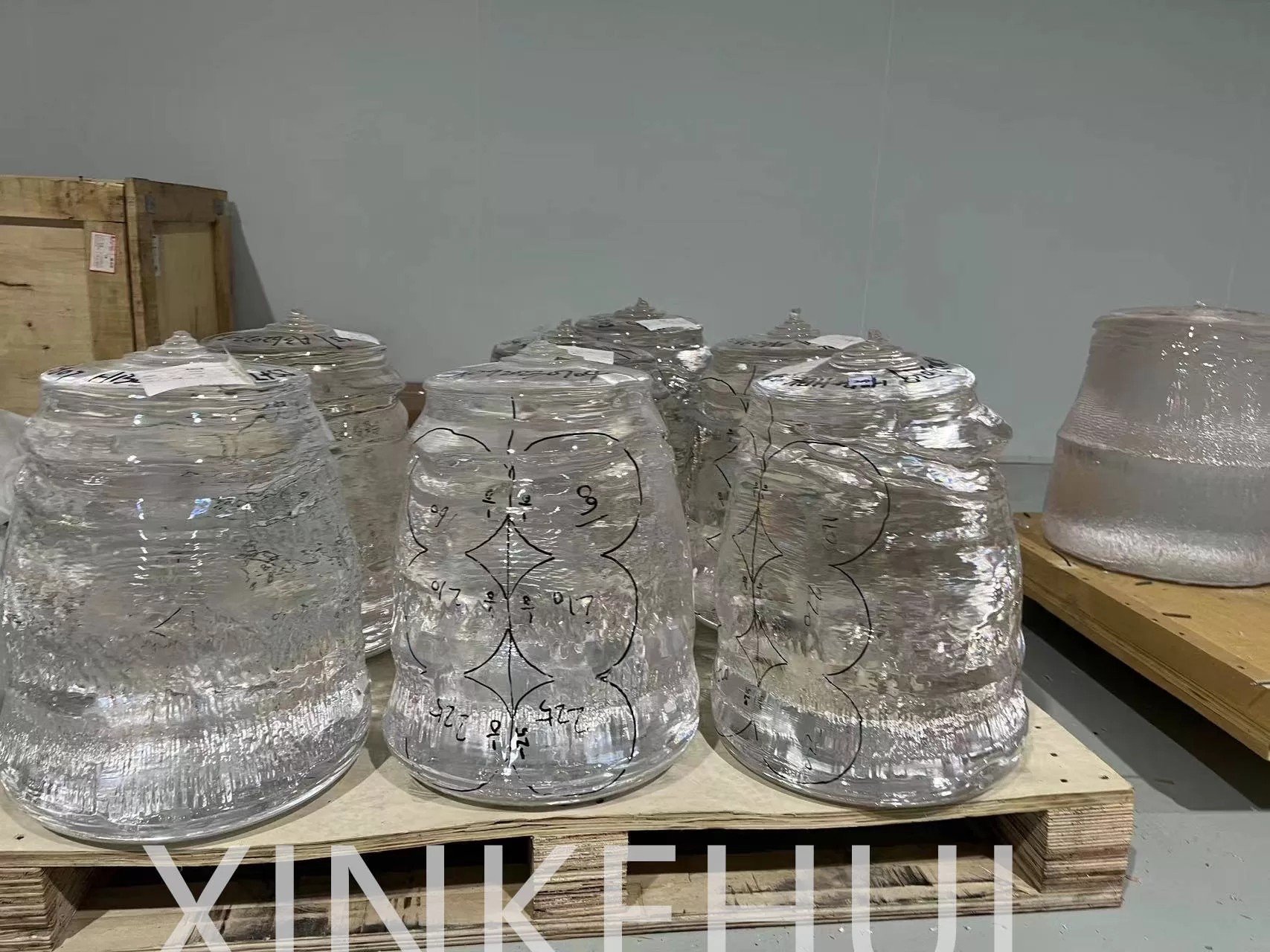
XINKEHUI offers high-quality Single crystal sapphire ingot, a product of their expertise as one of the leading manufacturers in the industry. These ingots boast a chemical composition primarily consisting of alumina, with three oxygen atoms and two aluminum atoms covalently bonded together.
Single crystal sapphire ingot‘s crystal structure adopts a hexagonal lattice arrangement, with commonly utilized orientations including A, C, and R. Renowned for its exceptional properties, sapphire exhibits high sound velocity, remarkable temperature resistance, corrosion resistance, superior hardness, excellent light transmittance, and an exceptionally high melting point (2050°C).
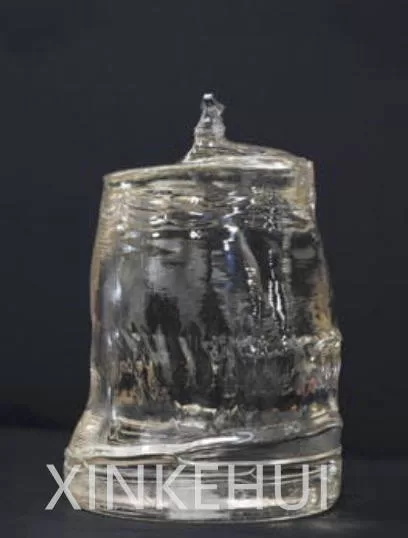
These qualities make pure sapphire boules ideal for producing sapphire substrates crucial in semiconducting circuits, lasers, and endoprostheses. Furthermore, sapphire serves as an integral material in optical components, infrared devices, high-intensity radiation materials, and mask materials, showcasing its versatility and importance across various industries. With XINKEHUI’s commitment to quality, customers can rely on their sapphire ingots for superior performance and reliability in their
Single crystal sapphire ingot’s properties
- Chemical Composition: Single crystal sapphire ingots primarily consist of aluminum oxide (Al2O3), with a high purity level ensuring minimal impurities.
- 晶體結構: Single crystal sapphire ingot exhibit a hexagonal lattice crystal structure, providing exceptional mechanical and optical properties.
- 導覽: The ingots are available in various orientations, including A, C, and R orientations, each tailored for specific applications in optical, mechanical, and electronic devices.
- Physical Properties:
- High Hardness: Single crystal sapphire ingot ranks 9 on the Mohs scale of hardness, making it extremely resistant to scratches and abrasions.
- High Melting Point: With a melting point of approximately 2050°C, sapphire ingots can withstand high-temperature processing and operating conditions.
- 高透明度: Sapphire ingots exhibit excellent optical transparency across a broad spectrum, ranging from ultraviolet (UV) to infrared (IR) wavelengths.
- 高導熱性: Exceptional thermal conductivity ensures efficient heat dissipation, making sapphire ingots suitable for high-power laser and electronic applications.
- 低熱膨脹係數: Minimal thermal expansion coefficient enables sapphire ingots to maintain dimensional stability across a wide temperature range.
- 機械特性:
- High Strength: Single crystal sapphire ingots possess high mechanical strength, allowing for precision machining and fabrication of intricate components.
- Brittle Behavior: Sapphire exhibits brittle fracture behavior under certain conditions, necessitating careful handling and machining techniques.
- 電氣特性:
- Dielectric Properties: Sapphire ingots demonstrate excellent dielectric properties, making them suitable for insulating applications in electronics and optoelectronics.
- 電氣絕緣: High electrical resistivity ensures minimal electrical leakage, contributing to the reliability of electronic devices.
- 耐化學性: Single crystal sapphire ingot exhibit exceptional chemical resistance to acids, alkalis, and other corrosive substances, ensuring long-term stability in harsh environments.
- 光學特性:
- 雙折射: Single crystal sapphire ingot exhibit birefringent behavior, enabling polarization-sensitive applications in optics and photonics.
- High Refractive Index: With a refractive index of approximately 1.77, sapphire ingots facilitate efficient light transmission and optical performance.
- 應用:
- Single crystal sapphire ingotserve as the precursor material for producing sapphire substrates used in various applications, including:
- Semiconductor manufacturing for electronic devices and integrated circuits.
- Optoelectronics for LEDs, laser diodes, and optical windows.
- Mechanical components such as bearings, watch crystals, and precision instruments.
- Medical implants and prosthetics due to biocompatibility and inertness.
- High-temperature and harsh environment sensors and instrumentation.
- Single crystal sapphire ingotserve as the precursor material for producing sapphire substrates used in various applications, including:
- Quality Assurance: Stringent quality control measures ensure uniformity in crystal orientation, purity, and mechanical properties across sapphire ingots, meeting the stringent requirements of diverse industries and applications.
| 化學式 | Al2O3 |
| Crystal class | Hexagonal system, rhomboidal class 3m |
| Lattice constants, A | a=4.785, c=12.991 |
| Density, g/cm3 | 3.98 |
| Melting point, °K | 2303 |
| 硬度 | Knoop(daN/mm2): 1800 parallel to C-axis, 2200 perpendicular to C-axis, Mohs: 9 |
| 光學傳輸範圍,微米 | 0.17 - 5.5 |
| 0.532 µm 時的折射率 | n0=1.7717, ne=1.76355 |
| 吸水性 | 無 |
| 楊模量,Gpa | 345 |
| 剪切模數,Gpa | 145 |
| 體積模數,Gpa | 240 |
| 彎曲模量(破裂模量),Mpa | 20°C 時為 420,500°C 時為 280 |
| 彈性係數 | C11=496, C12=164, C13=115, C33=498, C44=148 |
| 泊松比 | 0.25-0.30 |
| 摩擦係數 | 精鋼上為 0.15,藍寶石上為 0.10 |
| 拉伸強度,MPa | 25° 時為 400,500° 時為 275,1000° 時為 345 |
| 抗彎強度,daN/mm2 | 35 至 39 |
| 抗壓強度,GPa | 2.0 |
| 楊氏模數 E,daN/mm2 | 3.6 x 10⁴ 至 4.4 x 10⁴ |
| 比熱,J/(kg x K) | 91°K 時為 105,291°K 時為 761 |
| 線性膨脹熱系數,K-1,為 323K | 6.66 x 10⁻⁶ 平行於光軸,5 x 10-6 垂直於光軸 |
| 300K 時的熱傳導率,W/(m x K) | 23.1 平行於光軸,25.2 垂直於光軸 |
| 電阻率,歐姆 x 厘米 | 1016 (25°), 1011 (500°), 106 (1000°) |
| 介電常數 | 11.5 (103 - 109 Hz,25°)平行於 C 軸,9.3 (103 - 109 Hz,25°)垂直於 C 軸 |
| 介電強度,V/cm | 4 x 10⁵ |
| 損失正切 | 1 x 10⁻⁴ |
| 可溶性 -在水中 -在 HNO3,H2SO4, HCl, HF -in alcalis -in melts of metals Mg, Al, Cr, Co, Ni, Na, K, Bi, Zn, Cs | insoluble insoluble to 300°C insoluble to 800°C insoluble to 800-1000°C |
| g -radiation stability | No change in transmission above 2.5 mm after exposure to 107 Rads. No visible coloration after exposure to 108 Rads/hr for 60 minutes at – 195°C |
| Proton radiation stability | No change in transmission below 0.3 µm after exposure to 1012 proton/cm2 total dose |
| 耐化學性 | Sapphire is highly inert and resistant to attack in most process environments including hydrofluoric acid and the fluorine plasma applications commonly found in semiconductor wafer processing (NF3, CF4) |
Single crystal sapphire ingot’s growth method
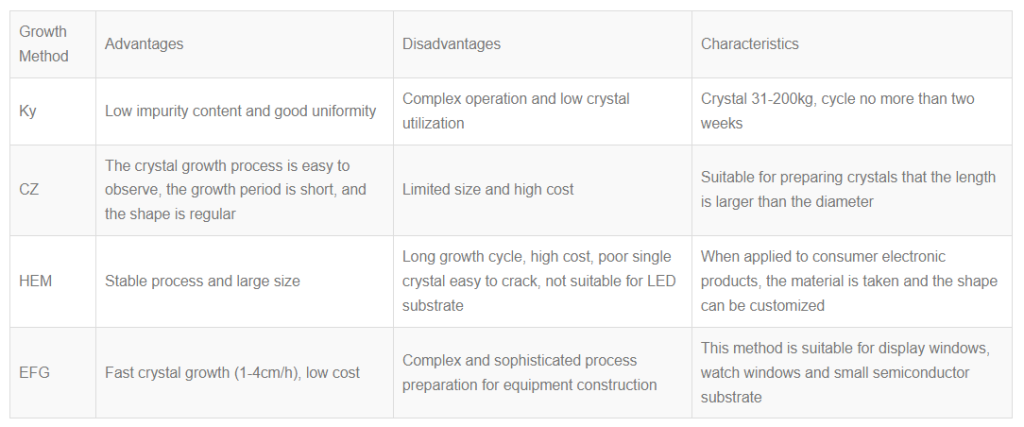
- Kyropoulos 方法:
- 優勢:
- Produces high-quality, large-size ingots.
- Low impurity incorporation.
- Disadvantages:
- Slow growth rate.
- Equipment costs are relatively high.
- 優勢:
- Czochralski Method (Cz):
- 優勢:
- Versatile method for growing a variety of crystal materials.
- Well-established and widely used.
- Disadvantages:
- Moderate impurity incorporation.
- Limited to smaller-sized ingots compared to Kyropoulos.
- 優勢:
- Heat Exchanger Method (HEM):
- 優勢:
- Can produce relatively large and high-quality crystals.
- Faster growth rate compared to Kyropoulos.
- Disadvantages:
- Higher equipment complexity and cost compared to Cz method.
- Challenges in controlling temperature gradients.
- 優勢:
- Edge-defined Film-fed Growth (EFG):
- 優勢:
- Continuous process, suitable for mass production.
- Can produce complex shapes.
- Disadvantages:
- Typically lower crystal quality compared to other methods.
- Higher susceptibility to defects.
- 優勢:
- Verneuil Method (Flame Fusion):
- 優勢:
- Simple and low-cost equipment.
- Fast growth rate.
- Disadvantages:
- Lower crystal quality with higher impurity incorporation.
- Limited to smaller-sized ingots.
- 優勢:
- Horizontal Directional Solidification (HDS):
- 優勢:
- Can produce large ingots with good crystalline quality.
- Suitable for high-temperature applications.
- Disadvantages:
- Complex process requiring precise control of temperature gradients.
- Limited to certain crystal orientations.
- 優勢:
Each method has its own niche and is chosen based on factors like desired crystal quality, size, production volume, and cost considerations.
Single crystal sapphire ingot’s applications
Single crystal sapphire ingots find applications across various industries due to their exceptional properties. Some common applications include:
- Optical Components: Sapphire’s optical clarity, high hardness, and scratch resistance make it ideal for use in optical windows, lenses, and substrates for a wide range of devices, including lasers, cameras, and medical equipment.
- 半導體產業: Sapphire is used as a substrate material for manufacturing gallium nitride (GaN) semiconductors, which are employed in high-power and high-frequency electronics, including LEDs, RF devices, and power electronics.
- Watch Crystals: Sapphire’s hardness and scratch resistance make it a preferred material for watch crystals, ensuring durability and long-lasting clarity in luxury watches.
- 航太與國防: Sapphire is used in aerospace and defense applications for its high strength, thermal stability, and resistance to harsh environments. It’s used in windows, domes, and sensors for aircraft, missiles, and satellites.
- 醫療設備: Sapphire is utilized in medical devices such as endoscopes and surgical instruments due to its biocompatibility, optical transparency, and sterilization resistance.
- High-Temperature and High-Pressure Applications: Sapphire’s high melting point and thermal conductivity make it suitable for use in extreme conditions, such as in furnace tubes, high-pressure chambers, and specialized sensors.
- MEMS (Micro-Electro-Mechanical Systems): Sapphire is used as a substrate material in MEMS devices for its excellent mechanical properties, thermal stability, and insulating properties.
- 科學研究: Sapphire is utilized in various scientific instruments and research applications, including spectroscopy, microscopy, and x-ray crystallography, due to its optical transparency and chemical inertness.
- 珠寶: High-quality synthetic sapphire is sometimes used as a gemstone in jewelry, especially in engagement rings and pendants, due to its durability and attractive blue coloration (in the case of blue sapphire).
These are just a few examples of the diverse applications of single crystal sapphire ingots across industries. Its unique combination of properties makes it a versatile material for a wide range of technological and commercial purposes.