
With the rapid development of electric vehicles, 5G base stations, and renewable energy power electronics, substrate selection has become a critical factor in high-power device design. The substrate not only affects electrical performance but also influences thermal management, reliability, and manufacturing costs. Silicon carbide (SiC) and gallium nitride (GaN) are currently the two most prominent semiconductor substrate materials for high-power applications. This article provides a comprehensive comparison of SiC and GaN substrates, focusing on material properties, thermal management, electrical performance, and application scenarios, helping engineers make informed choices.
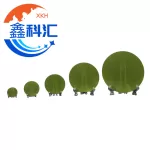
1. Material Properties
كربيد السيليكون (SiC)
SiC is a wide-bandgap semiconductor, with a bandgap of approximately 3.26 eV (for 4H-SiC) and a high thermal conductivity of 3–4.9 W/cm·K. Its high breakdown field and chemical stability allow SiC devices to operate reliably under high voltage and high temperature, making it suitable for high-power and high-frequency applications.
Gallium Nitride (GaN)
GaN has a bandgap of 3.4 eV and a high electron mobility (~1500 cm²/V·s), allowing efficient operation at high frequencies with low conduction losses. GaN is often grown on silicon (Si) substrates but can also be grown on SiC. While GaN substrates alone offer excellent performance, they are more expensive and technically challenging to produce.
Comparison:
- SiC substrates are optimal for high-power, high-voltage, and high-current applications.
- GaN substrates excel in high-frequency, high-efficiency, and compact devices.
2. Thermal Management
Thermal management is crucial in high-power devices, as heat buildup can reduce performance and reliability.
- SiC substrates have high thermal conductivity, which efficiently reduces temperature rise, supporting high-power density operations.
- GaN-on-Si substrates have relatively lower thermal conductivity (~1.5 W/cm·K for Si), requiring additional thermal management in high-power applications. GaN-on-SiC substrates improve thermal performance but increase costs.
الخلاصة: For applications with high power density and continuous operation, SiC substrates are generally preferable, whereas GaN substrates perform well in high-frequency, lower-power applications.
3. Electrical Performance and Device Efficiency
High-power applications require careful consideration of on-resistance, breakdown voltage, and switching speed.
- SiC devices provide low on-resistance, high breakdown voltage, and wide-bandgap characteristics, making them capable of handling hundreds to thousands of volts while maintaining stability at high temperatures.
- GaN devices offer ultra-low switching losses and high electron mobility, providing superior efficiency in high-frequency switching, particularly in DC-DC converters and RF power devices.
الخلاصة: SiC is suited for high-voltage, high-current applications, while GaN is advantageous in high-frequency, high-efficiency use cases.
4. Application Scenarios
Based on material properties and electrical performance, typical applications include:
- SiC substrates:
- EV inverters
- High-voltage power modules (>600V)
- Industrial motor drives
- Renewable energy power converters
- GaN substrates:
- High-frequency switching power supplies
- RF power devices
- Data center power modules
- Compact adapters and chargers
Practical Recommendation: Substrate selection should consider voltage rating, operating frequency, thermal management requirements, and cost. For high-voltage, high-current scenarios, SiC is preferred; for high-frequency, smaller-scale applications, GaN is optimal.
5. Cost and Manufacturing Considerations
SiC wafers remain relatively expensive, but 8-inch wafer mass production and process optimization are gradually reducing costs. GaN substrates are costly, which is why many applications use GaN-on-Si wafers to reduce expense, although this requires careful thermal management to maintain reliability.
Summary: Choosing the right substrate for high-power applications involves balancing multiple factors. SiC offers superior high-temperature and high-voltage performance, dominating industrial and automotive sectors. GaN excels in high-frequency, high-efficiency electronics, particularly in communications and power conversion.
الخاتمة
Substrate selection is a critical factor in the performance and reliability of high-power semiconductor devices. By systematically comparing SiC and GaN in terms of material properties, thermal management, electrical performance, and application scenarios, engineers can make informed decisions tailored to specific applications. As manufacturing techniques advance and costs decrease, both SiC and GaN substrates will continue to play increasingly important roles in high-power electronics.
For the latest updates on SiC and GaN substrate specifications, market trends, and supplier information, stay tuned for our weekly technical insights and procurement guides.