
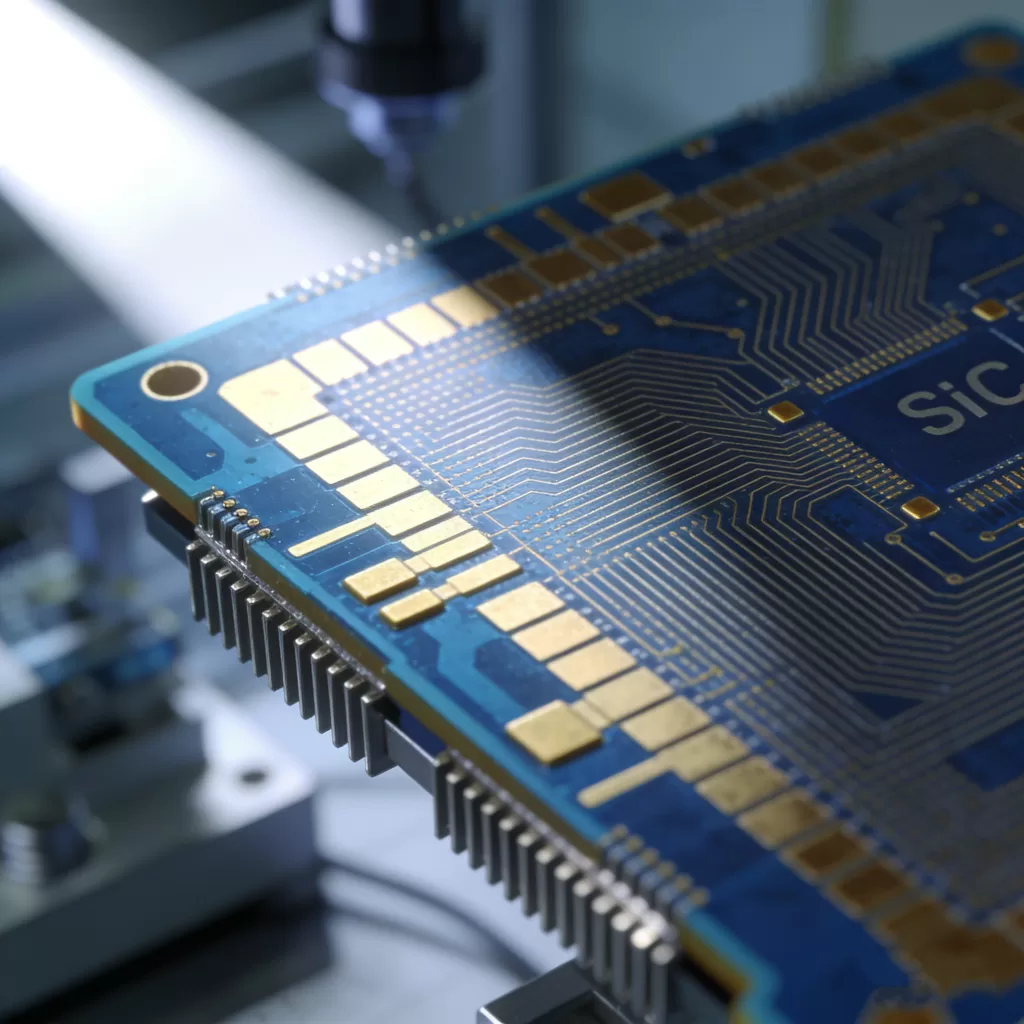
Silicon carbide (SiC) has emerged as a cornerstone material for high-voltage and high-power electronic applications. Over the past two decades, SiC has transitioned from a laboratory curiosity to a commercially mature semiconductor platform that is now widely adopted in power electronics, electric vehicles, renewable energy systems, and industrial power conversion. This dominance is not incidental; it is rooted in the fundamental physical properties of SiC and its inherent advantages over conventional silicon and even other wide-bandgap semiconductors.
Wide Bandgap as the Foundation of High-Voltage Capability
The most important reason SiC excels in high-voltage applications is its wide bandgap. While silicon has a bandgap of approximately 1.12 eV, 4H-SiC exhibits a bandgap of about 3.26 eV. This wider bandgap directly translates into a much higher critical electric field strength. In practical terms, SiC can withstand electric fields nearly ten times stronger than silicon before undergoing breakdown.
A higher critical electric field allows SiC power devices to block much higher voltages using significantly thinner drift layers. As a result, SiC devices achieve lower on-resistance at high voltages, which is a decisive advantage in power electronics. For voltage classes above 600 V, and especially beyond 1200 V, silicon devices face fundamental physical limitations, whereas SiC continues to scale efficiently.
Low On-Resistance and High Efficiency
In high-voltage power devices, conduction losses are often dominated by the resistance of the drift region. Because SiC can sustain high electric fields, its drift region can be both thinner and more heavily doped than that of silicon. This leads to a dramatic reduction in specific on-resistance.
Lower on-resistance directly improves energy efficiency, reduces heat generation, and allows for higher current density. These characteristics are particularly critical in applications such as electric vehicle inverters, high-voltage DC transmission, and fast-charging systems, where efficiency gains translate into reduced cooling requirements and smaller system footprints.
Superior Thermal Properties
Another key factor behind SiC’s dominance is its exceptional thermal performance. Silicon carbide has a thermal conductivity of approximately 3 to 4.9 W/cm·K, which is more than three times that of silicon. This high thermal conductivity enables more efficient heat dissipation from the device junction to the package and cooling system.
High-voltage devices often operate under extreme thermal stress due to high power densities. SiC’s ability to operate reliably at junction temperatures exceeding 200 °C makes it especially well suited for harsh environments. This thermal robustness reduces the need for oversized cooling systems and increases overall system reliability.
High-Temperature and High-Frequency Operation
SiC devices maintain stable electrical performance at temperatures where silicon devices begin to degrade rapidly. This high-temperature capability stems from both the wide bandgap and the low intrinsic carrier concentration of SiC.
In addition, SiC supports faster switching speeds due to its lower parasitic capacitances and higher electron saturation velocity. High-frequency switching reduces the size of passive components such as inductors and capacitors, enabling more compact and lightweight power systems. This advantage is especially valuable in aerospace, rail traction, and high-power industrial converters.
Radiation and Harsh Environment Resistance
SiC exhibits excellent resistance to radiation-induced damage, making it a preferred material for high-voltage electronics in space, nuclear, and defense applications. The strong covalent bonding and wide bandgap reduce susceptibility to displacement damage and ionizing radiation effects.
In environments involving high temperature, high voltage, and strong radiation fields, SiC devices demonstrate superior stability and longer operational lifetimes compared to silicon-based counterparts.
Maturity of 4H-SiC Material Platform
Among the various polytypes of silicon carbide, 4H-SiC has become the dominant commercial standard for power electronics. It offers a favorable combination of high electron mobility, wide bandgap, and stable crystal structure.
Advancements in bulk crystal growth, wafer processing, and epitaxial technology have significantly improved material quality, reduced defect densities, and enabled large-diameter wafers. These developments have been critical in transitioning SiC from niche applications to high-volume industrial adoption.
Comparison with Other Wide-Bandgap Semiconductors
While gallium nitride (GaN) is also a wide-bandgap semiconductor with excellent high-frequency performance, SiC holds a clear advantage in high-voltage and high-power regimes. GaN devices typically dominate at lower voltage ranges, whereas SiC excels in applications requiring robust voltage blocking, high current handling, and extreme thermal stability.
This complementary relationship further reinforces SiC’s role as the material of choice for high-voltage power systems.
Závěr
Silicon carbide dominates high-voltage applications because its fundamental material properties align perfectly with the demands of modern power electronics. Its wide bandgap, high breakdown field, low on-resistance, superior thermal conductivity, and high-temperature stability collectively enable performance levels that silicon cannot achieve.
As global demand for efficient energy conversion continues to rise, SiC is positioned not merely as an alternative material, but as the technological foundation for the next generation of high-voltage and high-power electronic systems.