
Silicon carbide (SiC) is increasingly used for custom components in chemical processing systems where conventional metals, glass, and oxide ceramics may struggle with corrosion, wear, thermal shock, or contamination.
For equipment manufacturers and process engineers, however, selecting SiC is only the first step. The actual performance of a custom SiC component also depends on material grade, geometry, machining tolerances, surface finish, joining method, operating temperature, chemical exposure, and inspection requirements.
This guide explains how custom silicon carbide components are used in chemical processing, what engineers should consider during design, and what information buyers should provide when requesting a quotation.
Why Silicon Carbide Is Used in Chemical Processing
Chemical processing equipment often operates under a combination of demanding conditions:
- Corrosive acids or alkalis
- High process temperatures
- Abrasive particles or slurries
- Rapid temperature changes
- High-purity process environments
- Continuous mechanical wear
- Tight dimensional requirements
Silicon carbide combines several properties that make it suitable for these environments.
High Corrosion Resistance
SiC has excellent chemical stability against many corrosive process media. Compared with many metallic materials, silicon carbide does not rely on a metallic protective coating to provide corrosion resistance.
This makes it attractive for components exposed to aggressive chemicals, particularly where corrosion products could contaminate the process.
Typical applications may include:
- Chemical pumps
- Mechanical seals
- Valve components
- Nozzles
- Process tubes
- Heat exchanger components
- Reactor parts
- Wear liners
- Fluid-handling components
The exact chemical resistance still depends on SiC grade, temperature, chemical concentration, exposure time, and process conditions.
SiC Material Types for Custom Components
Not every silicon carbide component is manufactured from exactly the same type of SiC.
Material selection should therefore be confirmed before machining or production begins.
Reaction-Bonded Silicon Carbide
Reaction-bonded silicon carbide is commonly used for larger or structurally complex components.
Advantages can include:
- Good mechanical strength
- Excellent wear resistance
- Good thermal conductivity
- Ability to manufacture relatively large shapes
- Cost advantages for certain complex geometries
However, residual silicon in the material should be considered when the component will be exposed to highly aggressive chemicals or extremely high-purity processes.
Sintered Silicon Carbide
Sintered SiC is often selected when chemical resistance, purity, wear resistance, and high-temperature performance are particularly important.
Typical advantages include:
- High SiC purity
- Excellent corrosion resistance
- High hardness
- Good high-temperature stability
- Low contamination potential
For critical chemical-processing components, sintered SiC is often an important candidate.
CVD Silicon Carbide
Chemical vapor deposited SiC can provide extremely high purity and excellent surface properties.
It is particularly relevant where contamination control is a major requirement, although cost and component size must also be considered.
When sending an RFQ, buyers should specify whether a particular SiC grade is mandatory or whether the supplier may recommend the most suitable material.
Corrosion Resistance Considerations
Although SiC is generally recognized for excellent corrosion resistance, engineers should avoid specifying only “corrosion-resistant SiC.”
The actual working environment should be clearly defined.
Important information includes:
- Chemical type
- Chemical concentration
- Operating temperature
- Maximum temperature
- Operating pressure
- Exposure duration
- Continuous or intermittent operation
- Presence of abrasive particles
- Cleaning chemicals
- Steam or thermal cycling conditions
For example, a SiC component operating in a room-temperature chemical bath may have very different requirements from a component continuously exposed to high-temperature corrosive gas.
Providing actual operating conditions allows the manufacturer to evaluate whether the proposed SiC material and manufacturing process are appropriate.
Wear Resistance in Slurry and Particle Handling
Many chemical processes involve abrasive particles, powders, crystals, or slurry.
In these applications, corrosion resistance alone is not enough.
Pumps, seals, nozzles, liners, and fluid-handling components can suffer from continuous erosion.
Because silicon carbide has very high hardness, it is frequently selected for components exposed to sliding contact or abrasive flow.
Common examples include:
- Pump seal rings
- Bearing components
- Valve seats
- Nozzles
- Bushings
- Guide rings
- Slurry-handling parts
- Wear plates
Component geometry remains important because even a highly wear-resistant material can fail if local stress concentration, improper assembly, or excessive mechanical shock occurs.
Machining Custom SiC Components
One important difference between SiC and conventional metals is machinability.
Silicon carbide is extremely hard and brittle. After sintering, machining generally requires diamond grinding and other precision ceramic-processing techniques.
This means that tolerance requirements have a direct influence on manufacturing difficulty and price.
Engineers should therefore avoid applying unnecessarily tight tolerances to every feature.
Instead, drawings should distinguish between:
Critical dimensions
Dimensions directly affecting sealing, alignment, assembly, flow, or mechanical performance.
Non-critical dimensions
Features where broader ceramic manufacturing tolerances are acceptable.
This approach can significantly improve manufacturability and reduce component cost.
Dimensional Tolerances
Custom SiC components can be manufactured with relatively tight tolerances, but achievable values depend heavily on:
- Component diameter
- Length
- Wall thickness
- Geometry
- Material grade
- Machining accessibility
- Surface finish
- Flatness requirement
- Quantity
Features such as deep internal holes, thin walls, small grooves, sharp internal corners, and large flat surfaces may require additional manufacturing consideration.
For precision components, drawings should specify critical tolerances individually rather than using an unnecessarily restrictive general tolerance.
Typical dimensions that may require special control include:
- Outside diameter
- Inside diameter
- Thickness
- Hole diameter
- Concentricity
- Parallelism
- Perpendicularity
- Flatness
- Cylindricity
- Runout
For mating or sealing surfaces, geometric tolerances can sometimes be more important than simple dimensional tolerance.
Surface Finish Requirements
Surface roughness can strongly affect component performance, particularly for sealing, sliding, vacuum, and fluid-contact surfaces.
A custom SiC component may require:
- As-fired surface
- Ground surface
- Fine-ground surface
- Lapped surface
- Polished surface
The correct finish should be specified only where functionally necessary.
For example, a mechanical seal face may require a significantly better surface finish than an external non-contact surface.
Buyers should specify surface roughness using parameters such as Ra where possible.
A drawing stating only “polished” may not provide enough information for accurate quotation.
Designing SiC Components for Manufacturability
Several design practices can make custom SiC components easier and more economical to manufacture.
Avoid Extremely Sharp Internal Corners
Sharp corners can create stress concentration and may be difficult to manufacture in brittle ceramic materials.
Reasonable radii are generally preferred where the design permits.
Control Wall Thickness
Very thin sections combined with large overall dimensions can increase the risk of breakage and deformation during manufacturing and handling.
Define Critical Surfaces
Indicate clearly which surfaces perform sealing, alignment, optical, wear, or fluid-contact functions.
This helps the manufacturer focus precision processing where it adds value.
Avoid Unnecessary Precision
A ±0.01 mm tolerance may be achievable on certain features, but it should not be specified where ±0.1 mm would provide identical functional performance.
The tighter the requirement, the more grinding, inspection, and yield control may be required.
Thermal Considerations
Chemical processing components may experience both corrosive chemicals and high temperature.
Silicon carbide offers:
- High thermal conductivity
- Low thermal expansion
- Good thermal shock resistance
- High-temperature mechanical stability
These properties make SiC attractive for heat-related chemical-processing applications.
However, component design still needs to consider temperature gradients.
Large differences in temperature across a component can generate thermal stress, especially around abrupt changes in section thickness.
Designs intended for rapid heating and cooling should therefore be reviewed specifically for thermal cycling conditions.
Typical Custom SiC Components
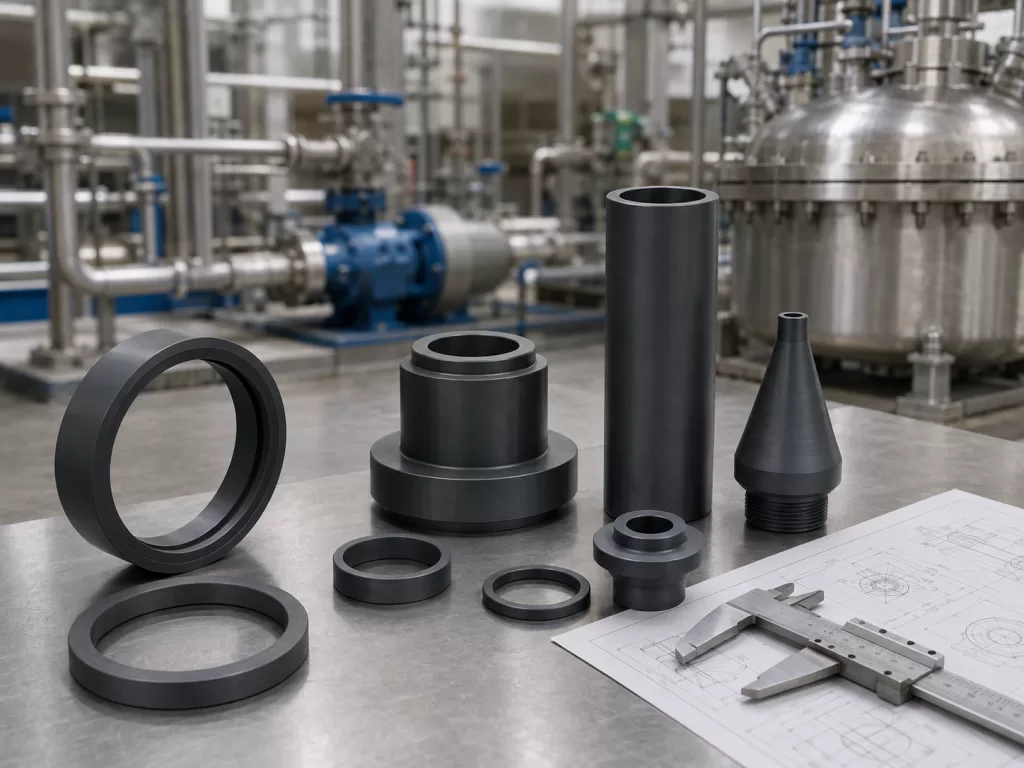
Silicon carbide can be manufactured into many specialized geometries for chemical-processing equipment.
Common examples include:
SiC Seal Rings
Used in mechanical sealing systems where wear resistance, flatness, and corrosion resistance are important.
SiC Bushings and Bearings
Suitable for fluid-handling systems and applications requiring resistance to abrasive wear.
SiC Nozzles
Used for corrosive gases, liquids, spraying, or abrasive process streams.
SiC Tubes and Sleeves
Used for chemical transport, process protection, furnace environments, or equipment isolation.
SiC Valve Seats
Provide wear-resistant and corrosion-resistant sealing surfaces.
SiC Pump Components
Custom impellers, seal elements, sleeves, and wear parts may be produced according to equipment requirements.
SiC Reactor Components
High-purity or corrosion-resistant SiC components can be used in specialized process chambers and chemical reaction systems.
Inspection Requirements
Inspection requirements should be agreed before production.
Depending on component function, inspection may include:
- Dimensional inspection
- Surface roughness measurement
- Flatness measurement
- Parallelism inspection
- Visual inspection
- Density verification
- Material certification
- CMM measurement
- Leak testing
- Microscopic surface inspection
For high-value precision components, buyers may also request an inspection report with the shipment.
The RFQ should specify these requirements in advance because additional inspection can affect both cost and lead time.
What to Include in a Custom SiC RFQ
A complete RFQ allows the supplier to evaluate manufacturability more quickly and reduces unnecessary communication.
For custom SiC components, buyers should ideally provide the following information.
1. Drawing
Preferred formats may include:
- STEP
- STP
- IGES
- DWG
- DXF
A dimensional PDF drawing combined with a 3D model is particularly useful for complex parts.
2. SiC Material Grade
Specify whether you require:
- Sintered SiC
- Reaction-bonded SiC
- CVD SiC
- Another specified grade
If uncertain, describe the application and allow the manufacturer to recommend a suitable material.
3. Dimensions and Tolerances
Clearly identify critical dimensions and avoid unnecessarily tight tolerances on non-functional features.
4. Surface Finish
Specify Ra values for critical surfaces.
For example:
Sealing surface: Ra ≤ specified value
This is clearer than simply writing “fine polished.”
5. Operating Environment
Provide:
- Chemical
- Concentration
- Temperature
- Pressure
- Abrasive particle exposure
- Vacuum conditions if applicable
- Thermal cycling conditions
6. Quantity
Specify both prototype and expected production volume where possible.
For example:
- Prototype: 5 pieces
- Initial order: 50 pieces
- Annual demand: 500 pieces
This helps determine the most appropriate production route.
7. Inspection Requirements
Indicate whether certificates, dimensional reports, material reports, or special inspection documentation are required.
Prototype Before Volume Production
For a new SiC component, prototype production is often recommended before moving to larger quantities.
A prototype allows engineers to confirm:
- Fit
- Assembly
- Sealing performance
- Dimensional compatibility
- Chemical resistance
- Thermal performance
- Wear behavior
Design adjustments can then be made before mass production.
This is especially useful for components converted from metal, quartz, alumina, or another material into SiC.
Cost Factors for Custom SiC Components
The price of a custom silicon carbide component is usually determined by more than material weight.
Major cost factors include:
- SiC grade
- Overall dimensions
- Geometry complexity
- Amount of machining
- Tight tolerances
- Surface finish
- Hole and groove complexity
- Inspection requirements
- Production quantity
- Yield risk
Two components with similar weight may therefore have very different prices.
A relatively simple component with reasonable tolerances can often be manufactured much more economically than a component requiring precision grinding on every surface.
Choosing a Custom SiC Component Supplier
When evaluating a supplier, buyers should look beyond whether the company can simply provide silicon carbide material.
Important capabilities include:
- SiC material selection
- Ceramic forming
- Sintering
- Precision grinding
- Diamond machining
- Lapping and polishing
- Dimensional inspection
- Surface measurement
- Prototype development
- Production consistency
For complex chemical-processing components, early communication between the design engineer and SiC manufacturer can often reduce both cost and technical risk.
Conclusion
Custom silicon carbide components provide an effective solution for chemical-processing environments requiring a combination of corrosion resistance, wear resistance, thermal stability, and dimensional precision.
However, successful SiC component development depends on matching the correct material grade and manufacturing process to the actual operating environment.
For the fastest and most accurate quotation, buyers should provide a detailed drawing together with material requirements, dimensions, critical tolerances, surface finish, chemical exposure conditions, operating temperature, quantity, and inspection requirements.
A well-defined RFQ not only speeds up quotation—it can also help the manufacturer identify opportunities to improve manufacturability, reduce unnecessary machining, and optimize the component for long-term service.
FAQ
Can silicon carbide components be customized from customer drawings?
Yes. SiC components can be manufactured according to customer drawings, including custom diameters, holes, grooves, sealing surfaces, tubes, rings, nozzles, bushings, and other complex geometries. Manufacturability depends on dimensions, material grade, tolerances, and geometry.
Is SiC suitable for corrosive chemical environments?
Silicon carbide offers excellent resistance to many corrosive chemicals and is widely used in chemical-processing applications. However, suitability should always be evaluated according to chemical type, concentration, temperature, pressure, and exposure conditions.
What information is required to quote a custom SiC component?
The most useful RFQ package includes a technical drawing or 3D model, SiC grade, dimensions, tolerances, surface roughness, operating temperature, chemical environment, quantity, and inspection requirements.