
The transition from 200mm to 300mm silicon wafers represents one of the most significant structural upgrades in the semiconductor manufacturing ecosystem. Beyond a simple increase in substrate size, 300mm wafers enable profound improvements in production efficiency, process uniformity, device performance, and cost scalability. This article examines the scientific and technological rationale behind large-diameter silicon wafers, analyzing their impact on manufacturing economics, materials science, and advanced device integration.
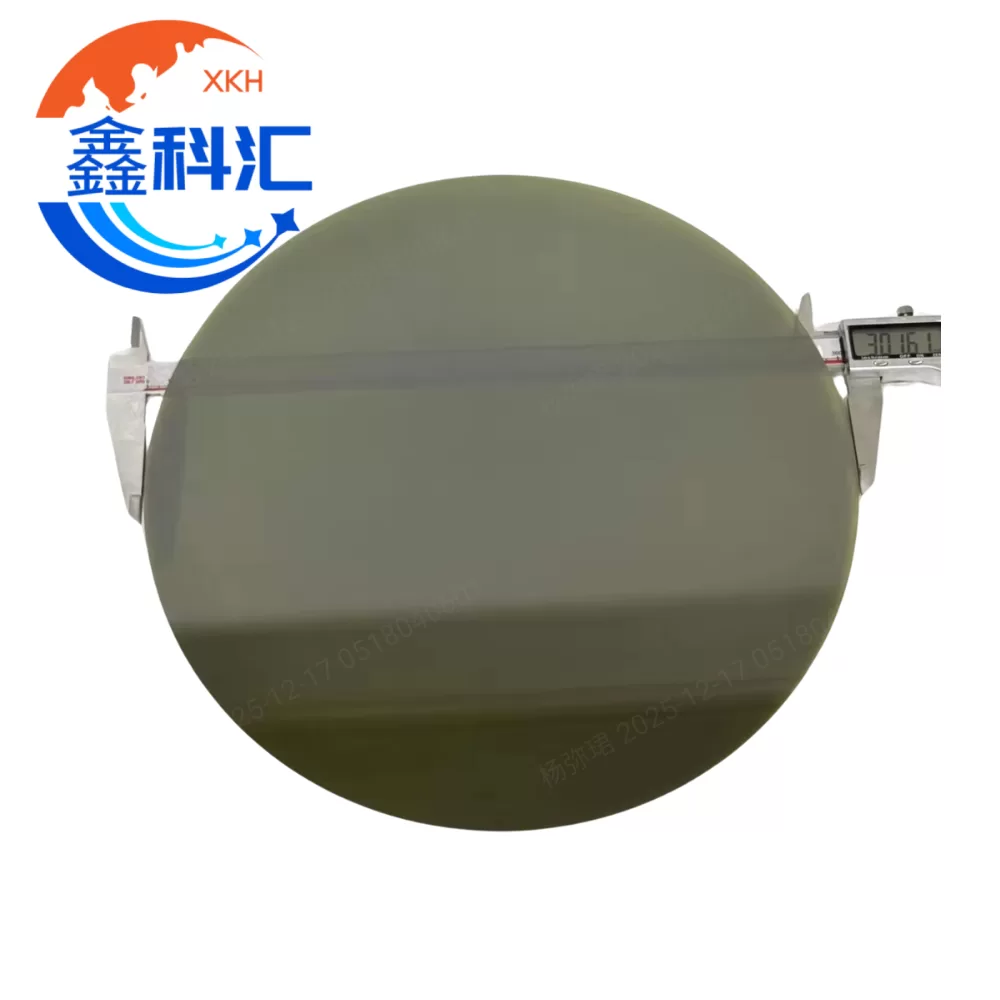
1. Wafer Scaling as a Fundamental Driver of Semiconductor Progress
In semiconductor fabrication, wafer diameter directly influences the number of integrated circuits that can be produced per manufacturing cycle. However, wafer scaling is not merely an exercise in maximizing surface area. It fundamentally alters the statistical behavior of defects, thermal management, lithographic precision, and process repeatability.
The adoption of 300 mm silicon wafers marked a transition from incremental optimization to systemic efficiency enhancement. By increasing wafer surface area by approximately 2.25× compared to 200mm wafers, manufacturers achieved a step-change in throughput while maintaining—or improving—device yield.
2. Manufacturing Efficiency: More Dies, Fewer Process Steps
2.1 Throughput and Cost per Die
A single 300 mm wafer can accommodate thousands of dies, depending on device node and chip size. Importantly, most fabrication steps—oxidation, deposition, etching, implantation—are performed per wafer, not per die. This creates a powerful economic advantage:
- Higher die count per wafer
- Reduced processing cost per functional chip
- Improved capital equipment utilization
As a result, 300 mm wafers enable lower cost per transistor, even as device complexity continues to rise.
2.2 Automation and Contamination Control
The shift to 300 mm wafers coincided with the widespread adoption of fully automated wafer handling systems (FOUPs). These closed-environment logistics systems significantly reduce particle contamination, which is critical for advanced technology nodes where nanometer-scale defects can impact yield.
3. Materials Science Challenges and Solutions
3.1 Crystal Growth and Defect Control
Producing high-quality 300 mm monocrystalline silicon wafers requires extreme control over crystal growth processes such as the Czochralski (CZ) method. Maintaining uniform dopant distribution, low oxygen concentration, and minimal dislocation density across such a large diameter is a non-trivial materials science challenge.
Advances in thermal field modeling, magnetic field control, and real-time process monitoring have enabled:
- High resistivity uniformity across the wafer
- Reduced micro-defects and slip lines
- Improved mechanical stability during high-temperature processing
3.2 Wafer Flatness and Surface Precision
As wafer diameter increases, so do mechanical stresses and warpage risks. Modern 300 mm wafers require ultra-tight specifications for:
- Total thickness variation (TTV)
- Bow and warp
- Surface roughness at the atomic scale
These parameters are essential for maintaining lithographic focus and overlay accuracy in multi-layer device structures.
4. Performance Enhancement Through Process Uniformity
Advanced semiconductor devices demand highly uniform electrical characteristics across the entire wafer. The larger process window enabled by 300 mm wafers allows for:
- More stable thermal gradients during processing
- Improved uniformity in thin-film deposition and etching
- Reduced device-to-device variability
This uniformity directly translates into improved transistor performance, tighter parametric distributions, and higher overall yield—especially critical for logic, memory, and high-speed ICs.
5. Enabling Advanced Device Integration
300 mm silicon wafers serve as the foundation for many cutting-edge technologies, including:
- Advanced CMOS logic nodes
- High-density DRAM and NAND flash memory
- Silicon photonics platforms
- MEMS and sensor integration
Furthermore, heterogeneous integration techniques such as 3D stacking, wafer-level packaging, and system-in-package (SiP) rely heavily on the mechanical stability and dimensional precision of large-diameter wafers.
6. Strategic Importance in the Global Semiconductor Supply Chain
From a strategic perspective, 300 mm wafer capability represents a high barrier to entry. The capital investment, process expertise, and quality control required to manufacture and process these wafers effectively define the technological leadership of semiconductor foundries.
As the industry continues to pursue higher performance, lower power consumption, and greater functional density, 300 mm silicon wafers remain the standard platform upon which future innovations are built.
7. Schlussfolgerung
The 300 mm silicon wafer is not simply a larger substrate—it is a critical enabler of modern semiconductor manufacturing. By improving efficiency, enhancing process control, and supporting advanced device architectures, large-diameter wafers have reshaped the economics and technical boundaries of the industry.
As semiconductor technologies evolve toward greater complexity and integration, the role of 300 mm silicon wafers will remain central, underpinning the next generation of electronic systems that define the digital age.