
Introduction: The Optical Module is Accelerating Toward 1.6T
If an optical module is a racing car, then:
- The laser is the engine
- The photodetector is the brake
- The modulator is the transmission system
The modulator determines how fast an electrical signal can be converted into an optical signal—and how far the system can push performance limits.
Now, the industry is rapidly moving from 800G to 1.6T, and the “transmission system” is reaching its physical limits.
The core question becomes:
Which material will power the next generation of optical modulators?
Three competing technologies define the battlefield:
- Silicon Photonics (SiPh)
- Indium Phosphide (InP)
- Thin-Film Lithium Niobate (TFLN)
Each represents a completely different physical approach—and each has its own strengths and fatal constraints.
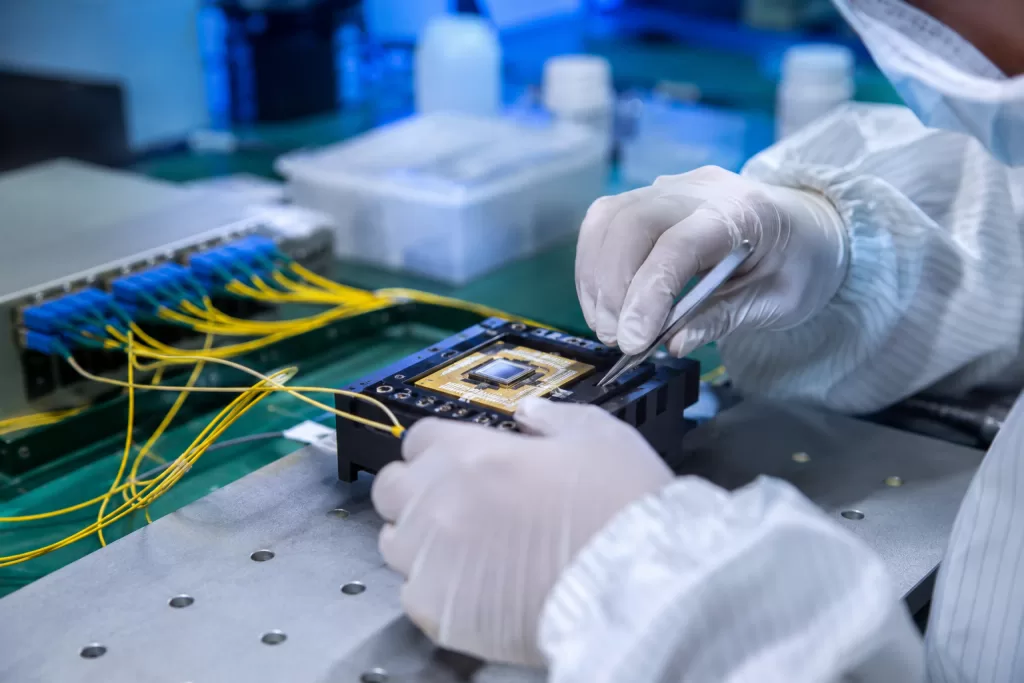
1. Silicon Photonics (SiPh): The Ecosystem King with Physical Limits
Silicon photonics wins not because it is the best performer—but because it is the most scalable.
Why SiPh dominates:
Silicon photonics leverages decades of CMOS semiconductor manufacturing infrastructure, making it highly cost-efficient and scalable.
In the 1.6T market:
SiPh is expected to account for 60%–80% of total shipments
Key advantages:
- Fully compatible with CMOS process technology
- Low cost and high scalability
- CW light sources reduce reliance on traditional EML lasers
- Eliminates TEC thermal control components
- Reduces system cost by ~20%
- Reduces power consumption by nearly ~40%
The fundamental limitation:
Silicon is an indirect bandgap semiconductor, meaning:
- It cannot efficiently emit light
- Electro-optic efficiency is extremely low (≈1% of TFLN)
Performance ceilings:
- Bandwidth limit: ~60–70 GHz
- Single-lane speed limit: ~200G
- Future 400G per lane is a physical barrier
Even more critical:
- Silicon photonics cannot generate light internally
- External laser integration is required
- Heterogeneous integration yield remains below ~70%
- For every 3 units produced, 1 fails
👉 Conclusion:
Silicon photonics is the cost and scale leader, but it is hitting a hard physical ceiling.
2. Indium Phosphide (InP): The Mature All-in-One Workhorse Under Supply Pressure
Indium Phosphide has long been the backbone of 800G optical modules, especially in EML-based designs.
Why InP is widely used:
InP is a direct bandgap material, meaning:
- It can both emit light and modulate signals in a single chip
This makes it highly attractive for integrated optical devices.
Key strengths:
- Laser + modulator integration in one device
- Mature and highly reliable technology
- Industry standard in 800G systems
- Strong performance in short- and medium-reach links
Key limitations:
As the industry moves toward 1.6T:
- Bandwidth ceiling: ~110 GHz
- Single-lane limit: ~250G
- Power consumption: ~18W at 800G
- Scaling beyond 1.6T becomes extremely difficult
Supply chain bottleneck:
The biggest problem is not performance—it is supply:
- High-end InP substrates are globally scarce
- Market controlled by a few suppliers
- Price has nearly doubled in one year
- Lead times extend to 2–3 years
- Expansion capacity is limited
👉 Conclusion:
InP remains reliable, but it is becoming a constrained legacy backbone technology.
3. Thin-Film Lithium Niobate (TFLN): The Performance Ceiling Technology
TFLN is widely regarded as the highest-performance electro-optic modulation platform.
Why TFLN stands out:
Lithium niobate has an extremely strong electro-optic effect:
- r₃₃ ≈ 30.9 pm/V
- ~100× higher than silicon photonics
When converted into thin-film form, performance is fully unlocked.
Key performance advantages:
- Bandwidth: ≥110 GHz, lab results up to 170 GHz
- Driving voltage: < 2V
- 800G module power consumption: ~11W
- Excellent thermal stability (up to 1100°C without drift)
- Extremely low bit error rate over long distances
System-level advantages:
- Lower power consumption
- Better signal integrity
- Near-zero drift in harsh environments
- Excellent for high-speed, long-distance AI interconnects
Challenges:
- Unit cost is currently 3–4× higher than silicon photonics
- 8-inch wafer yield is still improving
- Industrial ecosystem is still in early scaling phase
However, a key turning point is emerging:
2026 is widely recognized as the beginning of TFLN mass production scaling.
4. 1.6T Market Reality: Who is Winning?
The 1.6T optical module market is not a single-winner scenario.
Current structure:
- Silicon Photonics: 60%–80% (volume leader)
- InP: stable in short-reach applications
- TFLN: emerging in high-end and long-distance scenarios
Why SiPh leads today:
- Severe shortage of EML-based InP capacity
- SiPh fills the supply gap efficiently
- Lower cost and faster scalability
Why InP is retreating:
- High cost pressure from SiPh and TFLN
- Supply chain limitations
- Still important in short-reach applications
Why TFLN is rising:
- Solves system-level power and signal integrity issues
- Especially suitable for AI clusters and long-distance links
- Expected penetration:
- >20% in 1.6T high-end applications
- Much higher in future generations
5. Toward 3.2T: The Physical Law Becomes the Limit
At 3.2T (400G per lane), physics—not engineering—becomes the final constraint.
Technology reality:
- Silicon Photonics:
- Bandwidth ceiling too low (60–70 GHz)
- Cannot support 400G per lane
- Indium Phosphide:
- Reaches physical boundary (~110 GHz)
- Power consumption becomes prohibitive
- TFLN:
- Naturally supports 400G per lane operation
- No fundamental bandwidth bottleneck
Architecture evolution:
- 1.6T: 4 × TFLN modulators
- 3.2T: 8 × TFLN modulators
Industry consensus (OFC-level direction):
TFLN will exceed 40% penetration in 3.2T systems, and approach 100% in CPO optical engines.
6. Final Competitive Landscape: No Single Winner
The optical module industry will not be dominated by one material.
Instead, it will follow a multi-material coexistence model:
Silicon Photonics
- Dominates volume production
- Cost-efficient scaling platform
Indium Phosphide
- Stable short-reach solution
- Still essential in legacy and mid-range systems
Thin-Film Lithium Niobate
- High-performance frontier technology
- Critical for AI, HPC, and CPO architectures
7. Final Insight: The Real Winner Is Integration
The future winner is not the best single material.
The real winner is the company that can integrate all three technologies into a unified optical system.
Today:
- SiPh engineers fight coupling and alignment challenges
- TFLN teams struggle with yield and scaling
- InP suppliers expand capacity under pressure
But ultimately:
These three technological paths are converging into a single photonic integration ecosystem.
Päätelmä
The competition between Silicon Photonics, Indium Phosphide, and Thin-Film Lithium Niobate is not just a material war—it is a fundamental physics and system architecture evolution.
- SiPh wins scale
- InP wins integration maturity
- TFLN wins performance ceiling
And in the 1.6T and 3.2T era, performance ceilings will decide everything.