
Moving a custom fenêtre en saphir from prototype approval to stable volume production involves more than increasing the order quantity.
The prototype stage proves that a design can be manufactured. Volume production must demonstrate that the same dimensions, surface quality, optical performance, coating and documentation can be reproduced across multiple parts and future production lots.
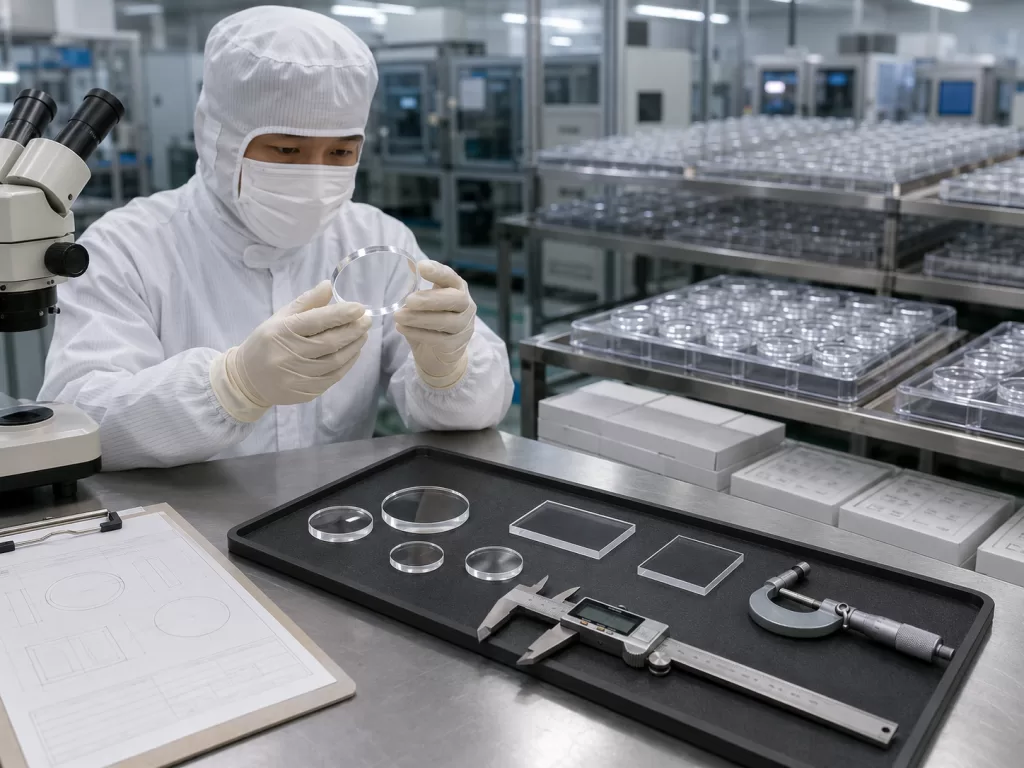
This transition can affect:
- Minimum order quantity
- Unit price
- Engineering and tooling charges
- Production lead time
- Raw-material planning
- Inspection frequency
- Coating batch control
- First article approval
- Packaging
- Lot traceability
- Change management
Buyers should therefore evaluate the complete production process rather than comparing only the prototype price with the volume unit price.
This guide explains how MOQ, lead time, inspection planning and traceability should be managed when purchasing custom sapphire windows from prototype through regular production.
Why Prototype Success Does Not Automatically Guarantee Volume Consistency
A supplier may successfully manufacture one or two sapphire window samples through additional manual adjustment, repeated polishing or 100% engineering attention.
That does not necessarily mean the same result can be reproduced economically across hundreds or thousands of pieces.
Volume production requires a controlled process for:
- Sapphire raw-material selection
- Crystal orientation
- Slicing and blank preparation
- Grinding and lapping
- Optical polishing
- Edge finishing
- Hole or profile machining
- Nettoyage
- Optical coating
- Inspection
- Packaging
- Record retention
Before approving production, the buyer should determine whether the prototype was manufactured using the intended production process.
A prototype produced through a special laboratory route may need to be requalified when the supplier moves to production equipment, different fixtures or a new coating batch.
The Main Production Stages
A custom sapphire window project can be divided into several stages.
1. Feasibility Review
The supplier reviews the drawing, application and required quantity to determine whether the part can be manufactured and inspected.
Important topics include:
- Overall dimensions
- Épaisseur
- Aspect ratio
- Crystal orientation
- Clear aperture
- Surface quality
- Planéité
- Parallelism or wedge
- Rugosité de la surface
- Coating
- Edge geometry
- Special holes or steps
- Required documentation
2. Prototype Production
A small quantity is manufactured to verify:
- Geometry
- Optical performance
- Assembly fit
- Coating performance
- Sealing
- Environmental compatibility
- Inspection methods
3. First Article Approval
The customer reviews controlled samples and inspection records before authorizing regular production.
4. Pilot Production
A larger but still limited batch is used to evaluate process repeatability, inspection capacity, yield, packaging and assembly performance.
5. Volume Production
The supplier manufactures repeat orders using approved materials, processes, fixtures, inspection methods and quality records.
Not every project requires a separate pilot batch. However, it can be valuable when the part has tight tolerances, a complex coating or a high cost of failure.
What Is the MOQ for Custom Sapphire Windows?
MOQ means minimum order quantity.
There is no single standard MOQ that applies to all sapphire windows. The practical minimum depends on the part design and the manufacturing route.
A supplier may consider several different minimum quantities.
Prototype MOQ
The prototype MOQ is the smallest quantity the supplier is willing to manufacture for engineering verification.
It may be only a few pieces when:
- Raw-material blanks are available
- The geometry is simple
- No dedicated tooling is required
- The part is uncoated
- Standard inspection methods can be used
Prototype pricing is usually higher per piece because engineering, programming, setup, cleaning and inspection costs are distributed across a small quantity.
Production MOQ
The production MOQ is the quantity needed to operate the approved manufacturing process economically.
It may be influenced by:
- Raw-material cutting layout
- Grinding and polishing fixture capacity
- Coating batch capacity
- Inspection setup
- Packaging configuration
- Expected manufacturing yield
- Supplier production scheduling
A production MOQ should not be interpreted as the smallest quantity that can physically be made. It is often the smallest quantity that can be produced using a commercially reasonable process.
Coating MOQ
A coating supplier may have its own minimum charge or minimum coating-run quantity.
A customer ordering ten coated sapphire windows may therefore pay for:
- A full coating-chamber setup
- Witness samples
- Spectral testing
- Nettoyage
- Masking
- Batch documentation
In some cases, increasing the quantity within the same coating run may reduce the coating cost per piece substantially.
Raw-Material MOQ
Large, thick or specially oriented sapphire windows may require dedicated material preparation.
The minimum material purchase may be influenced by:
- Required boule diameter
- Crystal orientation
- Thickness allowance
- Cutting loss
- Defect-free area
- Quantity of usable blanks
- Supplier stock availability
Annual MOQ or Blanket Order
For recurring demand, the buyer may place an annual blanket order with scheduled releases.
For example, the buyer may commit to an annual quantity while receiving smaller monthly or quarterly shipments.
This can help the supplier plan:
- Raw material
- Production capacity
- Coating batches
- Inspection resources
- Safety stock
The purchase agreement should clearly define whether the annual quantity is a forecast or a firm commitment.
Why Small Orders Can Have High Unit Prices
A custom sapphire window quotation may include costs that do not change significantly with the number of finished pieces.
These may include:
- Drawing review
- Process development
- Tooling and fixtures
- CNC programming
- Coating design
- Chamber setup
- Inspection programming
- First article documentation
- Export packaging
If these costs are divided among five parts, the cost per part is high. If they are divided among 500 parts, their contribution to each unit is much lower.
Buyers should therefore ask the supplier to separate:
- One-time engineering charge
- Tooling charge
- Sample unit price
- Production unit price
- Coating setup charge
- Inspection-report charge
- Packaging charge
This makes prototype and production quotations easier to compare.
Can the MOQ Be Reduced?
In some projects, the MOQ can be reduced by changing how the order is structured.
Possible approaches include:
Use a Standard Sapphire Blank
A standard diameter or thickness may avoid purchasing a dedicated raw-material size.
Combine Multiple Releases
The buyer can authorize one production batch but request staged deliveries.
Share a Coating Run
A supplier may combine compatible parts in one coating run when the coating design, substrate preparation and process requirements are equivalent.
However, the supplier should maintain clear lot identification and should not combine parts when doing so could compromise traceability or coating uniformity.
Accept a Separate Setup Charge
Some suppliers may accept a smaller quantity when the buyer pays the full setup and engineering cost separately.
Simplify Noncritical Tolerances
Removing unnecessary tight tolerances may improve yield and make smaller production runs more practical.
Order Uncoated Samples First
Uncoated sapphire samples can be used for initial fit and assembly checks before committing to a coating batch.
The buyer should not reduce the quantity by accepting uncontrolled leftover material or an untraceable coating batch when consistency is important.
What Determines Prototype Lead Time?
Prototype lead time begins after the technical requirements are sufficiently clear to start production.
It may include:
- Drawing and contract review
- Raw-material sourcing
- Sapphire orientation and cutting
- Blank preparation
- Grinding and lapping
- Optical polishing
- Edge or profile machining
- Nettoyage
- Coating
- Final inspection
- Documentation
- Packaging
A simple uncoated circular window made from available material may have a much shorter lead time than a large rectangular window with tight flatness, custom holes and a multi-band coating.
Prototype lead time is often measured in weeks rather than days, and highly specialized projects can require longer development cycles.
What Determines Volume-Production Lead Time?
Volume-production lead time depends on more than the time required to process one window.
The supplier must consider:
- Batch size
- Machine and fixture capacity
- Raw-material availability
- Polishing cycle
- Coating schedule
- Inspection throughput
- Manufacturing yield
- Rework
- Documentation
- Packaging
- Shipping
For example, a polishing fixture may hold multiple windows at one time. Increasing the order from 20 to 40 pieces may require another complete polishing cycle rather than simply doubling the processing hours.
The buyer should ask for a stage-based production schedule instead of only one final delivery date.
Recommended Lead-Time Breakdown
A useful quotation may separate the schedule into the following stages:
| Production stage | Supplier should confirm |
|---|---|
| Engineering review | Time required to approve the drawing and resolve questions |
| Raw material | Stocked, reserved or made to order |
| Tooling | Existing, modified or newly manufactured |
| Sapphire machining | Cutting, grinding, shaping and edge finishing |
| Optical polishing | Flatness, roughness and surface-quality requirements |
| Coating | Coating design, scheduling, witness samples and testing |
| Inspection | Dimensional, cosmetic, interferometric and spectral testing |
| Documentation | FAI, material certificate and inspection reports |
| Packaging | Standard, individual or cleanroom packaging |
| Shipping | Incoterm, destination and transportation method |
This breakdown helps identify which stage is controlling the schedule.
Lead Time Should Start from a Defined Approval Point
A purchase order alone may not be enough to start production.
The supplier may still require:
- Approved drawing
- Final drawing revision
- Coating specification
- Technical clarification approval
- Deposit
- Customer-supplied mating-part drawing
- Approved inspection plan
- Approved packaging specification
The quotation should define the lead-time starting point.
Par exemple :
Lead time begins after receipt of the purchase order, deposit and approved final drawing.
Without this definition, the buyer and supplier may calculate the delivery date from different starting points.
Why Coatings Often Control the Schedule
Coating can become the longest or least flexible production stage because it may require:
- Finalized optical performance
- Dedicated coating design
- Cleaned and accepted substrates
- Chamber availability
- Masking fixtures
- Witness coupons
- Spectral measurement
- Environmental testing
- Recoating if the run fails
The ISO 9211 series provides a framework for specifying optical coatings. ISO 9211-2:2024 addresses the specification and graphical representation of coating optical properties, while ISO 9211-3:2024 addresses environmental durability.
The coating requirement should be frozen before coated prototype production begins.
Changing the wavelength band, angle of incidence or reflection requirement after coating design can restart part of the engineering process.
Freeze the Drawing Before Volume Production
A controlled drawing should be approved before the supplier begins a repeatable production batch.
The drawing should include:
- Part number
- Drawing number
- Revision level
- Matériau
- Crystal orientation
- Dimensions
- Tolérances
- Clear aperture
- Surface requirements
- Edge geometry
- Coating
- Marking
- Packaging notes
- Required reports
ISO 10110-1:2019 specifies the general layout of optical drawings and is part of the ISO 10110 series used to communicate requirements for manufacturing and inspection of optical elements and systems.
For surface imperfections, ISO 10110-7:2017 provides methods for indicating acceptable imperfections, including localized imperfections, edge chips and long scratches, within a defined test region.
The buyer and supplier may use another agreed drawing system, but the requirements must remain measurable and unambiguous.
Prototype Approval Versus First Article Inspection
Prototype approval and first article inspection are related but not identical.
Prototype Approval
Prototype approval may confirm:
- Physical fit
- Optical function
- Appearance
- Assembly
- Environmental performance
The customer may approve the sample after testing it in the actual equipment.
First Article Inspection
A first article inspection compares a representative production part against the complete controlled drawing and purchase-order requirements.
A formal FAI package may include:
- Ballooned drawing
- Characteristic list
- Actual measured values
- Material certificate
- Crystal-orientation record
- Flatness interferogram
- Surface inspection
- Coating curve
- Certificate of conformance
AS9102C, revised in June 2023, establishes first article inspection requirements for aerospace applications. It does not automatically apply to every commercial sapphire window, but buyers can use its structured approach when contractually appropriate.
A simpler customer-specific first article report may be sufficient for general industrial projects.
Use Production-Representative First Articles
A first article should be manufactured using the process intended for regular production.
The buyer should confirm whether the first article used:
- The approved sapphire source
- The production orientation method
- Production grinding equipment
- Production polishing fixtures
- The approved coating process
- The intended cleaning process
- Production inspection equipment
- Final packaging
If the supplier uses a special process only for the sample, the FAI may not prove that volume production will be consistent.
What Is a Production Lot?
A production lot is a defined group of parts manufactured under specified common conditions.
A sapphire window lot may be based on:
- Raw-material lot
- Boule or ingot
- Manufacturing work order
- Polishing batch
- Coating run
- Inspection batch
- Shipment batch
The buyer and supplier should agree on what the lot number represents.
One customer purchase order does not always equal one manufacturing lot.
For example, 200 sapphire windows may be divided into:
- Two raw-material lots
- Four polishing batches
- Two coating runs
- One final shipment
The traceability records should show these relationships.
Recommended Sapphire Window Traceability Chain
A practical traceability chain may connect:
Customer purchase order → drawing revision → production work order → sapphire raw-material lot → boule or ingot → blank number → machining batch → polishing batch → coating batch → inspection report → packaging lot → shipment
This allows a supplier to determine which delivered parts may be affected if a problem is later identified.
For example, if one coating run develops an adhesion problem, the supplier should be able to identify which finished windows came from that run without recalling every related shipment.
Lot Traceability Versus Individual Serialisation
Lot-Level Traceability
Lot-level identification is often appropriate for:
- Commercial protective windows
- Regular production batches
- Lower-value components
- Parts that cannot be marked easily
- Applications without individual lifecycle records
The lot number may appear on:
- Individual packaging
- Tray label
- Inspection report
- Certificate of conformance
- Packing list
Individual Serialisation
Individual serialisation may be appropriate for:
- Aerospace windows
- High-value laser windows
- Vacuum pressure-boundary components
- Medical equipment
- Qualification samples
- Parts with individual interferograms
- Windows requiring service-history records
When direct marking is required, specify:
- Marking location
- Marking method
- Character size
- Maximum depth
- Clear-aperture exclusion
- Orientation
- Durabilité
Direct marking should not damage the optical area or create an unacceptable stress concentration.
Documents That Should Accompany Production Lots
Depending on the application, a production shipment may include:
- Certificate of conformance
- Sapphire material certificate
- Crystal-orientation certificate
- Dimensional inspection report
- Surface-quality report
- Flatness interferogram
- Transmitted wavefront report
- Surface-roughness data
- Coating transmission curve
- Coating reflection curve
- Coating batch certificate
- Environmental test report
- First article report
- Deviation approval
- Packaging record
- Lot-traceability record
ISO 10013:2021 provides guidance for developing and maintaining documented information needed to support an effective quality management system.
The required records should be specified before quotation because generating additional reports can affect both price and lead time.
Inspection Planning for Volume Production
Inspecting every characteristic on every sapphire window may be unnecessary or economically impractical.
A production inspection plan can combine:
100% Inspection
Appropriate for characteristics such as:
- Overall size
- Critical thickness
- Visible edge damage
- Surface cleanliness
- Part identification
- Critical sealing dimensions
Sample Inspection
May be appropriate for stable, lower-risk characteristics after the process has demonstrated capability.
Batch-Level Testing
Often used for:
- Coating spectral performance
- Material certification
- Environmental durability
- Witness-sample testing
- Destructive testing
Periodic Qualification
May be used to reconfirm:
- Coating durability
- Laser-damage performance
- Environmental cycling
- Long-term process stability
ISO 2859-1:2026 provides AQL-indexed sampling schemes for lot-by-lot inspection by attributes. Its use should be agreed contractually and matched to the risk and inspection characteristic.
An AQL-based plan does not mean that a specified number of defective sapphire windows is automatically acceptable. It is a statistical lot-acceptance tool, and critical requirements may still require zero acceptance or 100% inspection.
Maintain Golden Samples Carefully
A customer-approved prototype is sometimes retained as a golden sample.
It may help compare:
- Appearance
- Edge finish
- Coating color
- Packaging
- General workmanship
However, a physical golden sample should not replace the controlled drawing.
Its limitations include:
- It may age or become contaminated
- Coating color can depend on viewing angle
- Dimensions may not be obvious
- Internal specifications cannot be seen
- It may not represent specification limits
The drawing and inspection criteria should remain the primary acceptance references.
Production Yield and Delivery Quantity
Sapphire manufacturing may experience losses during:
- Cutting
- Grinding
- Polissage
- Edge finishing
- Nettoyage
- Coating
- Final inspection
The supplier should plan enough starting material to deliver the confirmed accepted quantity.
The purchase order should state whether the quantity means:
- Quantity started
- Quantity submitted for inspection
- Quantity shipped
- Minimum accepted quantity
The supplier should not assume that rejected parts can count toward the ordered quantity.
For development projects, the buyer and supplier may agree to accept a limited quantity from the first run if the full quantity cannot be produced. This arrangement should be documented before shipment.
Managing Partial Deliveries
Partial deliveries can help when the customer needs early samples while the remaining quantity is still in production.
The agreement should define:
- Minimum first-shipment quantity
- Final delivery date
- Whether all parts come from one lot
- Whether separate coating runs are allowed
- Which documents accompany each shipment
- Whether the first shipment requires customer approval
- Additional freight charges
A partial delivery may shorten the time to initial assembly testing but can create more traceability and logistics work.
Blanket Orders and Scheduled Releases
For stable recurring demand, a blanket purchase order can reduce repeated setup and material delays.
The agreement may include:
- Total annual quantity
- Release quantity
- Release schedule
- Forecast period
- Firm order window
- Material commitment
- Safety stock
- Maximum inventory
- Price validity
- Cancellation terms
- End-of-life purchase
The buyer should determine who owns:
- Unused raw material
- Dedicated tooling
- Finished safety stock
- Work in process
These terms are especially important for unusual dimensions or custom coatings that cannot easily be used for another customer.
Safety Stock
Safety stock may be stored as:
- Raw sapphire blanks
- Ground parts
- Polished uncoated windows
- Finished coated windows
Each level has different advantages.
Raw Blanks
Provide flexibility but still require the full manufacturing cycle.
Polished Uncoated Windows
Can shorten lead time while allowing the final coating to be selected later.
Finished Coated Windows
Provide the fastest shipment but create a risk of coating aging, specification changes or unused inventory.
Storage requirements should protect optical surfaces from:
- Dust
- Moisture
- Chemical vapors
- Abrasion
- Packaging residue
- Excessive temperature
Change Control During Production
Once the supplier and customer approve the production process, important changes should be controlled.
Changes that may require notification include:
- Sapphire raw-material source
- Crystal-growth source
- Crystal orientation
- Manufacturing location
- Grinding or polishing process
- Polishing fixture
- Coating supplier
- Coating design
- Cleaning process
- Inspection method
- Packaging material
- Subcontractor
The supplier should not assume that two technically similar processes are automatically interchangeable.
When Is Requalification Required?
A complete or partial requalification may be needed after:
- Drawing revision
- Material-source change
- Manufacturing-site transfer
- New coating design
- New coating supplier
- New tooling
- Major equipment change
- Long interruption in production
- Significant quality failure
- Change in inspection method
- Change in a critical subcontractor
The scope should be based on the affected characteristics.
A packaging change may require packaging validation but not necessarily a complete optical FAI. A coating-design change may require spectral, environmental and laser-performance requalification.
How to Compare Prototype and Production Quotations
Ask each supplier to provide separate information for:
| Cost or term | Prototype | Volume production |
|---|---|---|
| Minimum quantity | ||
| Unit price | ||
| Engineering charge | ||
| Tooling charge | ||
| Coating setup | ||
| Inspection reports | ||
| Lead time | ||
| Yield assumption | ||
| Packaging | ||
| Shipping | ||
| Price validity |
Also ask whether the production price assumes:
- One shipment or multiple releases
- One coating run
- Annual volume commitment
- Fixed drawing revision
- Standard packaging
- Standard documentation
- A particular payment term
A low unit price may be based on assumptions that do not match the actual purchasing plan.
Custom Sapphire Window Production RFQ Template
Part Information
- Part name:
- Part number:
- Drawing number:
- Drawing revision:
- Application :
- Sapphire orientation:
- Finished dimensions:
- Clear aperture:
- Surface quality:
- Surface roughness:
- Flatness:
- Parallelism or wedge:
- Edge geometry:
- Coating specification:
Quantity Information
- Prototype quantity:
- Pilot quantity:
- Production quantity per release:
- Estimated annual quantity:
- Expected number of releases:
- Required safety stock:
- Expected project duration:
Schedule
- Prototype delivery date:
- First article approval date:
- Pilot-production date:
- Volume-production start:
- Required shipment frequency:
- Partial deliveries acceptable:
- Shipping destination:
Quality Requirements
- Material certificate:
- Crystal-orientation report:
- Ballooned drawing:
- FAI report:
- Dimensional report:
- Surface inspection:
- Interferogram:
- Coating curve:
- Environmental test:
- Certificate of conformance:
- Inspection sampling plan:
- Record-retention period:
Traceability
- Raw-material lot traceability:
- Boule or ingot traceability:
- Polishing batch:
- Coating batch:
- Individual serial number:
- Packaging lot:
- Shipment traceability:
Change Control
- Customer notification required:
- Material-source changes:
- Process changes:
- Subcontractor changes:
- Coating changes:
- Requalification requirements:
Example of a Complete Production Inquiry
Please quote custom C-plane sapphire windows according to the attached controlled drawing.
Prototype quantity: 5 pieces
Pilot quantity: 30 pieces
Expected production quantity: 200 pieces per release
Estimated annual demand: 1,000 piecesBoth major surfaces must be optically polished. Surface quality, flatness, parallelism, clear aperture, edge geometry and coating performance must meet the drawing.
Please quote separately:
- One-time engineering charge
- Tooling charge
- Prototype unit price
- Pilot-production unit price
- Production unit price
- Coating setup charge
- FAI documentation
- Standard production inspection reports
The prototype and first article parts must be manufactured using the intended production material, polishing process and coating design.
Each production shipment must include a certificate of conformance, material-lot identification, coating-batch identification and dimensional inspection results.
Please provide:
- Prototype lead time
- Lead time after first article approval
- Maximum monthly capacity
- Production MOQ
- Recommended release quantity
- Lot definition
- Change-notification procedure
Questions to Ask a Sapphire Window Manufacturer
Before placing a production order, ask:
- What determines the prototype MOQ?
- What determines the production MOQ?
- Is coating performed internally or subcontracted?
- Does the coating supplier have a separate MOQ?
- Is raw sapphire material currently available?
- Will production use the same process as the approved sample?
- Which tooling charges are one-time?
- Who owns dedicated tooling?
- How is the manufacturing lot defined?
- Can finished parts be traced to the sapphire raw-material lot?
- Can parts be traced to the polishing and coating batches?
- Which characteristics receive 100% inspection?
- Which characteristics are sampled?
- What records accompany each shipment?
- How long are records retained?
- Which changes require customer notification?
- When is a new FAI required?
- What is the maximum stable monthly capacity?
- Can annual demand be supplied through scheduled releases?
- How are rejected parts and corrective actions managed?
Common Buyer Mistakes
Comparing Only Unit Prices
One supplier may include tooling, inspection and coating setup while another lists them separately.
Approving a Handmade Prototype
The approved sample should represent the intended volume-production process whenever possible.
Changing the Drawing After Tooling
Late changes can create additional tooling, scrap and schedule delays.
Ignoring the Coating MOQ
A small sapphire quantity may still require a full coating run.
Assuming the Purchase Order Equals One Lot
One order may contain several raw-material, polishing or coating batches.
Requesting Traceability After Production
Traceability requirements must be established before material is released to manufacturing.
Using a Golden Sample Instead of a Drawing
A physical sample cannot communicate every dimensional, optical and material requirement.
Accepting Pass/Fail Reports Only
Actual measurement values provide more information about process stability and results near tolerance limits.
Failing to Control Supplier Changes
An unapproved material, polishing or coating change can affect optical and mechanical performance.
Ordering the Exact Consumption Quantity
Production schedules should consider inspection losses, handling damage and future replacement requirements.
Frequently Asked Questions
What Is a Normal MOQ for Custom Sapphire Windows?
There is no universal MOQ.
It depends on the dimensions, orientation, tooling, polishing fixture, coating run, inspection requirements and available raw material.
Why Is the Prototype Unit Price Higher?
Prototype costs include engineering, setup, programming, tooling and inspection distributed across a small number of parts.
Will Production Lead Time Be Shorter Than Prototype Lead Time?
It can be shorter after the material, tooling, coating design and inspection methods are approved.
However, a large production quantity may require multiple machining, polishing or coating cycles.
Can I Order One Prototype Before Committing to Production?
Possibly, but one piece may not be enough for destructive testing, assembly validation and process evaluation.
The buyer should determine how many samples are needed for engineering, quality and reliability testing.
Should the Prototype Use the Final AR Coating?
Use the final coating when optical and environmental validation is required.
For early mechanical fit testing, uncoated samples may reduce cost and avoid premature coating commitment.
Does Every Production Lot Need an FAI?
No.
A full FAI is usually associated with initial production or significant changes. Routine production lots should follow the approved inspection plan unless the purchase order requires otherwise.
Is AQL Sampling Suitable for Optical Surfaces?
It can be used for agreed attribute inspections, but the inspection method, defect classification and acceptance criteria must be clearly defined.
Critical optical or safety characteristics may require stricter controls or 100% inspection.
What Is the Difference Between a Lot Number and a Serial Number?
A lot number identifies a group of parts produced under common conditions. A serial number identifies one individual component.
Can Multiple Coating Runs Be Included in One Shipment?
Yes, but each coating batch should remain identifiable when coating traceability is required.
How Long Should Inspection Records Be Retained?
The required period depends on the contract, application, regulatory requirements and expected product service life.
It should be stated in the purchase order or quality agreement.
Conclusion
Moving custom sapphire windows from prototype to volume production requires coordinated control of commercial, manufacturing and quality requirements.
Buyers should define:
- Prototype and production quantities
- MOQ assumptions
- One-time engineering and tooling costs
- Lead-time starting point
- Production-representative first articles
- Approved drawing revision
- Inspection plan
- Production lot definition
- Material and coating traceability
- Required shipment documents
- Change-notification requirements
- Requalification conditions
The most reliable supplier is not necessarily the company offering the lowest prototype price. It is the supplier that can demonstrate a repeatable process, realistic capacity, controlled records and consistent performance across future production lots.
For a custom sapphire window production quotation, send the drawing, prototype quantity, expected annual demand, release schedule, coating requirements and required quality documents. A complete RFQ allows the supplier to propose an appropriate MOQ, lead time, inspection plan and traceability structure