
Silicon Carbide (SiC) is widely known as a third-generation semiconductor material used in electric vehicles and power electronics. However, in high-end optical systems, SiC plays a very different and increasingly critical role.
Rather than serving as a transparent lens material, SiC is emerging as a structural and reflective optical material for extreme environments, including space telescopes, infrared systems, high-power lasers, and precision opto-mechanical platforms.
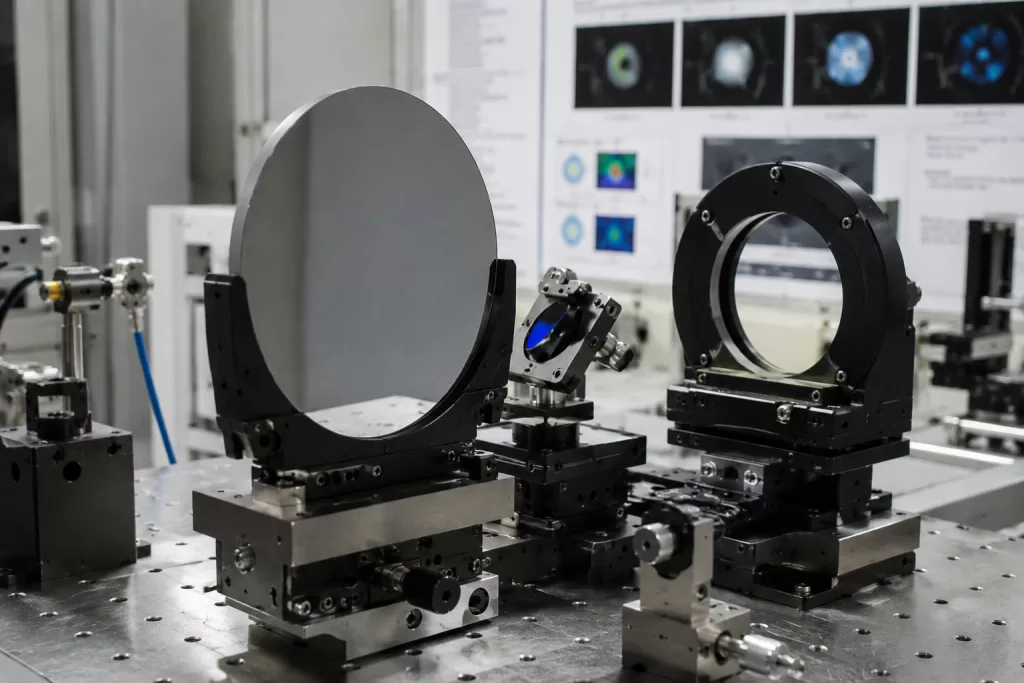
1. SiC in Optics: Not a Lens Material, But a Structural Optical Backbone
It is important to clarify that SiC is not a replacement for conventional optical glass lenses such as BK7, fused silica, or fluoride materials.
These materials are primarily used for:
- Transmission optics (imaging lenses, microscopes, cameras)
- Visible-light systems
In contrast, SiC is mainly used in:
- Space reflective mirrors
- Large-aperture lightweight primary mirrors
- Infrared optical systems
- High-power laser mirrors
- Precision opto-mechanical structures
- Extreme environment optical platforms
In other words, SiC is not about “transmitting light,” but about maintaining optical stability under extreme conditions.
2. Why High-End Optical Systems Need SiC
In advanced optical systems, the biggest challenge is not optical clarity, but structural deformation during operation.
Even micro- or nano-scale deformation can lead to:
- Image blur
- Resolution degradation
- Focus drift
- Wavefront distortion
- Reduced system accuracy
This is especially critical in:
- Space environments with extreme temperature cycles
- High-power laser systems
- Long-duration remote sensing missions
SiC is attractive because it combines properties that are difficult to achieve simultaneously:
- High stiffness
- Conductivité thermique élevée
- Low thermal expansion
- Lightweight structure potential
- Résistance aux hautes températures
- Environmental durability
3. Core Advantages of SiC in Optical Systems
3.1 High Stiffness: Enables Large Lightweight Mirrors
For space telescopes and large-aperture optical systems, mirror weight is a critical limitation.
Traditional glass mirrors:
- Are heavier at large sizes
- Require stronger support structures
- Increase launch cost and vibration risk
SiC offers:
- High structural rigidity
- Lightweight potential
- Excellent dimensional stability
This makes it ideal for spaceborne large-aperture reflective optics.
3.2 High Thermal Conductivity: Reduces Thermal Distortion
In high-power laser and infrared systems, absorbed energy generates heat.
If heat cannot be quickly dissipated:
- Local thermal gradients form
- Mirror surface deforms
- Beam quality degrades
SiC’s high thermal conductivity allows heat to spread rapidly, reducing localized deformation and improving system stability.
3.3 Low Thermal Expansion: Ensures Optical Stability
Many optical systems operate under fluctuating temperatures, such as:
- Spacecraft moving between sunlight and shadow
- Long-duration laser operation
- Cryogenic infrared systems
If the material expands or contracts significantly:
- Optical alignment shifts
- Focus drifts
- Imaging accuracy decreases
SiC’s low thermal expansion ensures stable optical geometry across temperature changes.
4. Key Applications of Matériaux optiques SiC
4.1 Space Telescopes and Remote Sensing Systems
Le SiC est largement utilisé dans :
- Spaceborne primary mirrors
- Satellite imaging systems
- Large-aperture reflective optics
Key benefits:
- Lightweight design
- High stiffness
- Thermal stability in orbit
In space applications, reducing weight directly improves:
- Launch cost
- System reliability
- Payload efficiency
4.2 High-Power Laser Systems
In laser applications, optical components must withstand:
- High energy density
- Continuous thermal loading
- Beam scanning operations
SiC is used in:
- Laser mirrors
- Beam steering optics
- High-power optical control systems
- Laser communication pointing systems
Its stability helps maintain beam quality under thermal stress.
4.3 Infrared and Cryogenic Optical Systems
Infrared systems are extremely sensitive to thermal drift.
SiC is used in:
- Infrared telescope mirrors
- Cryogenic optical platforms
- Space infrared sensors
- Structural optical components
It improves long-term stability and reduces thermal distortion.
4.4 Semiconductor and Precision Optics Equipment
Advanced semiconductor manufacturing equipment requires:
- Nanometer-level precision
- High-speed scanning
- Extremely stable optical platforms
SiC is increasingly used in:
- Precision scanning mirrors
- Optical support structures
- Metrology systems
- High-stability opto-mechanical platforms
5. Why SiC Is Not Used in Consumer Lenses
Despite its excellent properties, SiC is not widely used in consumer camera lenses or imaging optics.
This is because consumer optical systems prioritize:
- High transparency
- Optical dispersion control
- Faible coût
- Mass manufacturability
SiC, on the other hand, is optimized for:
- Reflective optics
- Structural stability
- Extreme environments
Therefore, SiC belongs to high-end engineering optical systems rather than consumer imaging optics.
6. Comparaison avec d'autres matériaux optiques
- Glass (BK7): general imaging transmission material
- Fused silica: UV and precision optics
- Germanium: infrared transmission optics
- Sapphire: protective, high-hardness optics
- Silicon Carbide (SiC): structural backbone for extreme optical systems
7. Industrial Opportunities for SiC Optics
SiC optical materials are still a specialized market, but they are becoming increasingly important in advanced engineering systems.
7.1 Commercial Space and Remote Sensing
- Lightweight satellite mirrors
- Space telescope structures
- Systèmes d'imagerie infrarouge
- High-stability optical platforms
7.2 High-Power Laser and Laser Communication
- Laser scanning mirrors
- Beam steering systems
- Optical pointing assemblies
- Thermal-resistant reflective optics
7.3 Infrared and Cryogenic Applications
- Space infrared telescopes
- Systèmes d'imagerie thermique
- Deep-space observation platforms
7.4 Semiconductor Advanced Equipment
- Optical metrology systems
- Lithography support optics
- High-precision scanning mirrors
- Ultra-stable opto-mechanical platforms
8. Conclusion: SiC Solves the Stability Problem in Optics
Silicon Carbide optical materials are not designed to replace traditional lenses.
Instead, they function as the structural backbone of high-end optical systems, enabling:
- Lightweight large-aperture mirrors
- Stable space optical platforms
- Thermally robust laser systems
- Low-drift infrared imaging systems
- High-precision industrial optical equipment
In simple terms:
Traditional optics ensure light passes through.
SiC ensures optical systems remain accurate under extreme conditions.
This is why SiC is rapidly entering aerospace, infrared, laser, remote sensing, and semiconductor equipment industries.