
Artificial intelligence is often associated with algorithms, GPUs, neural networks, and massive datasets. But behind the breakthroughs in computer vision, robotics, autonomous driving, advanced displays, and high-precision sensing lies a quiet material hero: sapphire.
This engineered crystal—chemically known as aluminum oxide—has become essential to many AI-related technologies. It is not a semiconductor like silicon, nor a flashy new chip material. Yet sapphire’s durability, transparency, and stability make it a foundation for reliable AI systems.
Here is a clear look at how sapphire is shaping the future of AI, one optical window and one substrate at a time.
A Material Built for Harsh Environments
Sapphire is grown as a single crystal through highly controlled thermal methods. Its natural qualities include:
- hardness second only to diamond
- excellent optical clarity
- wide-spectrum transmission from visible to infrared
- strong resistance to chemicals and heat
- minimal optical distortion
These features allow sapphire to perform reliably in environments where ordinary glass or polymers fail.
1. Sapphire Windows for AI Vision Systems
AI depends heavily on perception—cameras, sensors, and embedded optical modules. Whether in robots, drones, industrial inspection systems, or autonomous vehicles, these sensors must stay clean, clear, and scratch-free over thousands of hours.
Sapphire is widely used as:
- protective windows for machine-vision cameras
- cover glass for smart security devices
- lens covers in industrial or outdoor AI equipment
- protective plates for autonomous-driving perception modules
Because sapphire resists scratching and chemical wear, the optical signals feeding AI algorithms remain consistent over time. Stable input leads to more accurate detection, classification, and tracking.
2. Enabling 3D Sensing: LiDAR and Depth Cameras
Many AI systems require depth perception—robot navigation, face recognition, warehouse automation, or mixed-reality headsets. These rely on technologies such as:
- LiDAR
- time-of-flight (ToF) sensors
- structured-light projectors
- infrared depth cameras
Sapphire performs extremely well in these modules because it transmits infrared light efficiently and withstands high-energy laser pulses. It serves as:
- laser windows
- scanning-system covers
- protective optics for depth-sensing modules
The result is cleaner, more precise depth data for AI processing.
3. Sapphire Substrates for Micro-LED and Optical Components
Sapphire is also a critical substrate in the growth of GaN-based optoelectronic devices. This includes:
- micro-LED displays used in AR/VR/MR
- high-brightness LEDs
- laser diodes for optical communication
- indicators and sensors used in AI hardware
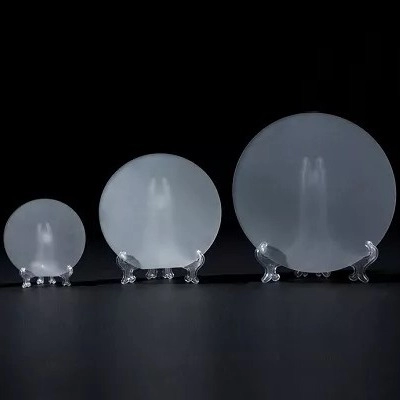
Micro-LEDs are especially important to future wearables and spatial-computing devices. They require high brightness, tiny pixel sizes, and long lifetime—capabilities made possible by GaN grown on sapphire.
As AI expands into next-generation displays and optical interconnects, sapphire remains an anchor in this ecosystem.
4. Sapphire Components in AI Chip Manufacturing
Producing advanced AI chips involves extreme temperatures, plasma environments, and high-precision optics. Sapphire is used throughout semiconductor tools as:
- high-temperature windows in etching and deposition systems
- observation windows for plasma chambers
- protective elements in laser-based lithography
Its resistance to heat, corrosion, and particle contamination helps maintain the reliability of the manufacturing process. Even though sapphire is not part of the AI chip itself, it is essential in producing these chips at scale.
5. Reliable Performance in AI-Driven Medical Devices
Modern medical diagnostics increasingly rely on AI to interpret optical signals such as:
- blood-oxygen measurements
- heart-rate monitoring
- optical coherence tomography
- imaging sensors for digital diagnostics
Many of these devices use sapphire windows because they withstand continuous cleaning, alcohol wipes, bodily fluids, and mechanical wear. This durability ensures stable input data for AI algorithms that depend on high-quality signals.
6. Future Possibilities: Sapphire for High-Power Packaging and Cooling
Researchers are exploring sapphire for roles in next-generation AI hardware, including:
- heat-spreading materials for high-power accelerators
- insulating layers in advanced packaging
- optical communication channels on chip
With AI models demanding more power, thermal stability and optical integration are becoming increasingly important—areas where sapphire could play a growing part.
Conclusion: The Invisible Backbone of AI Systems
While AI breakthroughs are often credited to computation and algorithms, many of these innovations rely on robust physical components working behind the scenes. Sapphire provides stability, clarity, and resilience to devices that acquire data, generate light, sense the environment, and operate under pressure.
From robot eyes to micro-LED displays to advanced semiconductor equipment, sapphire quietly supports the infrastructure that makes modern AI possible. It is a reminder that the future of intelligence is built not only on code, but also on the materials that protect, illuminate, and enable it.