
Sapphire glass is famous for its incredible hardness, scratch resistance, and optical clarity. It protects luxury watches, smartphone cameras, infrared sensors, and even spacecraft windows. But despite its name, sapphire glass is not glass at all—it is a crystalline material grown with precision rather than melted like traditional glass.
Understanding how sapphire glass is made reveals why this material is so strong, so durable, and so valuable in modern technology.
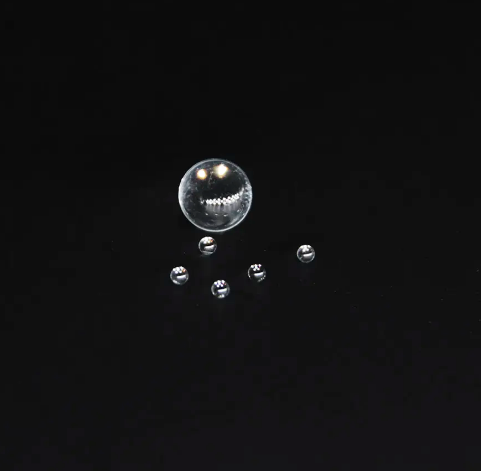
Sapphire Glass Starts as Pure Aluminum Oxide
The journey begins with high-purity aluminum oxide powder (Al₂O₃). When heated to extreme temperatures, these particles transform into a single, continuous crystal known as monocrystalline sapphire.
This is the same material found in natural gemstones, but grown artificially for consistency and performance.
The key is not the chemistry—Al₂O₃ is simple—but the way it is crystallized.
Growing a Crystal: The Heart of Sapphire Production
To make sapphire glass, manufacturers grow large sapphire boules using specialized crystal-growth techniques:
1. The Kyropoulos Method
One of the most widely used techniques for sapphire glass production.
The alumina is heated above 2000°C, and a small seed crystal is dipped into the melt. As the seed is slowly lifted and cooled, the sapphire boule grows atom by atom into a massive, defect-controlled crystal.
2. The Czochralski Method
Similar to pulling a silicon crystal, but at a higher temperature.
The resulting sapphire boule is long and cylindrical, ideal for optical windows and wafers.
3. The Edge-Defined Film-Fed Growth (EFG) Method
Used to create sapphire sheets and strips.
Molten alumina rises through a shaped die, forming flat or tubular sapphire directly during crystallization.
Each method controls temperature, pulling speed, and thermal gradients with extreme precision to ensure a perfect, uniform crystal.
From Crystal Boule to Sapphire Glass
Once the sapphire crystal is grown, it undergoes a long mechanical transformation:
Cutting
Diamond-coated saws slice the sapphire boule into thin wafers or plates. Sapphire’s hardness—second only to diamond—makes this step slow and technically challenging.
Grinding
Surfaces are flattened and shaped using diamond abrasives.
This step gives the sapphire its final thickness and geometry.
Polírozás
To achieve optical clarity, sapphire is polished at the microscopic level until both sides are perfectly smooth.
The final surface can be so refined that even a wavelength of visible light cannot detect irregularities.
Coating or Strengthening (Optional)
Some sapphire glass receives:
- anti-reflective coatings
- scratch-resistant layers
- infrared or UV filters
depending on the final application.
Why Sapphire Glass Is So Tough
The secret lies in its crystalline structure.
Aluminum and oxygen atoms form a rigid, three-dimensional lattice with strong ionic-covalent bonds. This network gives sapphire:
- exceptional hardness
- excellent thermal stability
- high optical transparency
- resistance to chemicals and abrasion
Unlike ordinary glass, sapphire must be grown like a gemstone, not melted like silica.
Where Sapphire Glass Is Used Today
Thanks to its mechanical and optical advantages, sapphire glass appears in:
- smartphone camera lenses
- luxury watch covers
- high-end optical windows
- biometric sensors
- LED substrates
- aerospace and defense viewing ports
- infrared and UV optical systems
Its durability makes it the material of choice for environments where traditional glass would crack or degrade.
A Crystal Crafted for Modern Technology
Sapphire glass is a remarkable example of how precision manufacturing can transform a simple compound into a high-performance material. From the intense heat of crystal growth to the microscopic accuracy of polishing, every step is engineered to create a surface that can survive scratches, shocks, and extreme conditions.
In a world that demands stronger, clearer, and more reliable optics, sapphire glass continues to shine—not because it is a gemstone, but because it is a crystal built with science.