
With the rapid development of artificial intelligence, renewable energy, advanced computing, and wireless communication technologies, the global semiconductor industry is entering a new stage of technological transformation. Continuous innovation in materials, device structures, and computing architectures is reshaping the semiconductor ecosystem and creating new growth opportunities.
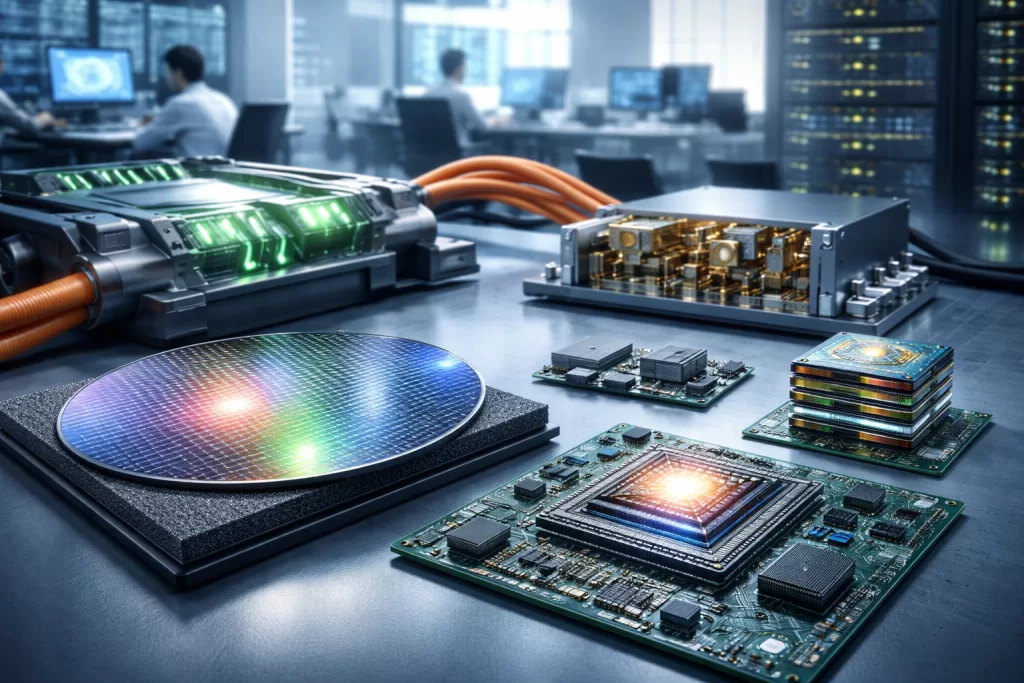
Currently, four major technological directions are widely considered the key drivers of the semiconductor industry’s future development. These include third-generation semiconductor materials, computing chips for artificial intelligence, radio-frequency communication chips, and high-bandwidth memory technologies. Together, these sectors form the foundation for next-generation electronic systems and digital infrastructure.
Third-Generation Semiconductor Materials
The evolution of semiconductor materials has progressed through multiple stages over the past decades.
The first generation of semiconductor materials is represented by silicon. Silicon technology is mature, cost-effective, and widely used in low-voltage and medium-frequency electronic applications. It remains the dominant material in the global semiconductor industry.
The second generation includes compound semiconductors such as gallium arsenide. These materials offer superior high-frequency performance and radiation resistance, enabling their use in optoelectronics, microwave devices, and communication systems.
The third generation of semiconductor materials is based on wide bandgap semiconductors such as silicon carbide and gallium nitride. These materials have wider bandgaps, stronger breakdown electric fields, higher thermal conductivity, and better efficiency in high-power applications. As a result, they are becoming essential for modern energy systems and high-performance electronics.
Carburo di silicio
Silicon carbide is a compound semiconductor composed of silicon and carbon. One of its most widely used crystal structures is 4H-SiC, which offers significant advantages in high-power and high-voltage applications.
Compared with traditional silicon devices, silicon carbide devices can operate at higher voltages, higher temperatures, and higher switching frequencies while maintaining lower energy losses. These characteristics make silicon carbide particularly suitable for power electronics.
Key application areas include electric vehicles, renewable energy systems, industrial motor drives, smart grids, and high-efficiency power conversion systems.
The production of silicon carbide semiconductor devices typically involves two key stages. First, high-quality silicon carbide substrates are manufactured. These substrates serve as the structural foundation for semiconductor devices. Second, epitaxial layers are grown on the substrate surface to form the active semiconductor structures required for device fabrication.
As the demand for electric vehicles, photovoltaic systems, and energy storage solutions continues to grow, the market for silicon carbide substrates and epitaxial wafers is expanding rapidly. In addition, the industry is gradually transitioning from six-inch wafer production to eight-inch wafer manufacturing in order to improve production efficiency and reduce costs.
Gallium Nitride
Gallium nitride is another important wide bandgap semiconductor material. It is a compound formed by gallium and nitrogen and is characterized by a direct bandgap structure.
Gallium nitride offers several advantages, including high electron mobility, low conduction resistance, high breakdown voltage, and strong efficiency in high-frequency switching. These properties make it highly suitable for high-frequency and high-efficiency electronic systems.
Compared with silicon carbide, gallium nitride devices are often used in applications that require high switching frequency and compact system design. Typical applications include fast chargers, data center power supplies, renewable energy systems, and power management circuits.
The global gallium nitride semiconductor device market has been experiencing rapid growth in recent years. Consumer electronics currently represent the largest application segment, particularly in fast charging technologies. However, applications in electric vehicles, renewable energy systems, industrial electronics, and data centers are also expanding steadily.
As power electronics continue to evolve toward higher efficiency and smaller system size, gallium nitride is expected to play an increasingly important role in the next generation of power semiconductor devices.
Computing Chips
Artificial intelligence has become one of the most powerful drivers of semiconductor innovation. Modern AI systems rely heavily on massive computing power to process large volumes of data and train complex machine learning models.
Deep learning models typically operate in two main stages: training and inference. During the training phase, large datasets are used to build and optimize neural networks. Once the model is trained, the inference phase allows the system to analyze new data and generate predictions or decisions.
To support these computational requirements, specialized computing chips have become essential components of modern computing infrastructure.
Graphics processing units were originally designed to accelerate image and graphics processing. However, their highly parallel architecture also makes them ideal for large-scale numerical computations required by artificial intelligence training.
These processors contain thousands of parallel computing cores that can process multiple data streams simultaneously. This architecture significantly improves the efficiency of deep learning training and high-performance computing tasks.
Another important type of computing chip is the application-specific integrated circuit designed specifically for machine learning workloads. These chips are optimized for neural network operations and can deliver high computational efficiency while reducing energy consumption.
In recent years, demand for AI computing hardware has grown rapidly. The development of large-scale AI models, cloud computing platforms, and data centers has significantly increased the need for high-performance computing chips.
At the same time, edge computing is becoming increasingly important. Unlike centralized data centers, edge devices process data locally to reduce latency and improve real-time responsiveness. In such environments, highly efficient specialized chips are critical for enabling AI applications in areas such as autonomous systems, smart manufacturing, and intelligent infrastructure.
RF Communication Chips
Radio-frequency communication technology plays a vital role in modern wireless communication systems. RF signals are electromagnetic waves used for transmitting information through wireless channels, typically covering frequencies from several kilohertz to hundreds of gigahertz.
RF communication technologies are widely used in mobile networks, satellite communication systems, radar equipment, wireless internet, and Internet of Things devices.
RF integrated circuits integrate multiple radio-frequency functions into a single chip. These functions typically include amplification, signal filtering, frequency conversion, and modulation or demodulation.
A typical RF communication system consists of several key components, including antennas, RF transceivers, baseband processors, and RF front-end modules. The RF front-end is particularly important because it directly affects signal quality and communication performance.
The RF front-end usually contains several functional modules such as power amplifiers, low-noise amplifiers, filters, antenna switches, and antenna tuning components. Each module plays a specific role in optimizing signal transmission and reception.
With the continued deployment of advanced communication technologies such as 5G and future 6G networks, demand for high-performance RF communication chips is expected to grow steadily. These chips are also critical for emerging applications such as smart cities, connected vehicles, industrial automation, and satellite communication networks.
High-Bandwidth Memory
Memory devices are fundamental components of modern computing systems. They store data and program instructions that allow computers to perform complex operations.
Memory technologies are generally divided into two main categories: volatile memory and non-volatile memory. Volatile memory, such as dynamic random-access memory and static random-access memory, loses stored data when power is removed. Non-volatile memory, such as NAND flash and NOR flash, retains stored information even without power.
Among these technologies, dynamic random-access memory plays a dominant role in modern computing systems due to its balance between speed, capacity, and cost.
However, the rapid development of artificial intelligence and high-performance computing has significantly increased the demand for memory bandwidth. Traditional graphics memory technologies are no longer sufficient to support the massive data processing requirements of modern AI accelerators.
High-bandwidth memory has emerged as an important solution to this challenge. This technology uses three-dimensional stacking techniques to vertically integrate multiple memory chips. Through advanced packaging and interconnect technologies, it provides extremely high data transfer rates and large memory bandwidth.
Compared with conventional memory technologies, high-bandwidth memory offers several advantages, including higher bandwidth, lower latency, improved energy efficiency, and greater memory density.
These characteristics make it particularly suitable for high-performance computing systems, artificial intelligence accelerators, advanced graphics processors, and data center infrastructure.
Since its introduction, high-bandwidth memory technology has undergone several generations of development, with each generation offering higher bandwidth, larger capacity, and improved performance. As artificial intelligence models continue to grow in size and complexity, demand for high-bandwidth memory is expected to increase significantly in the coming years.
Conclusione
The semiconductor industry is undergoing rapid transformation driven by technological innovation and increasing demand for digital infrastructure. Third-generation semiconductor materials are improving power efficiency and enabling next-generation energy systems. Advanced computing chips are providing the processing power required for artificial intelligence and large-scale data analysis. RF communication chips are supporting the expansion of wireless connectivity, while high-bandwidth memory technologies are addressing the growing need for faster data access and processing.
Together, these four technological directions represent the core foundation of future semiconductor development. As research and manufacturing capabilities continue to advance, they will play a central role in shaping the global digital economy and enabling the next generation of intelligent technologies.