
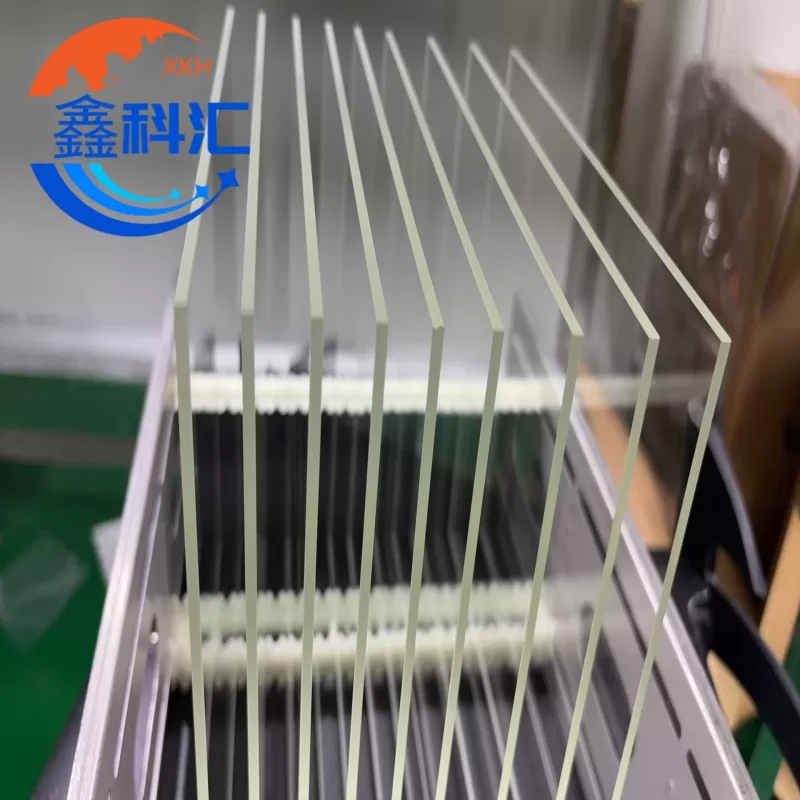
Optical quartz glass, commonly known as fused silica, is a highly pure, amorphous form of silicon dioxide (SiO₂). Due to its exceptional optical, thermal, and chemical properties, it is widely used in ultraviolet (UV), visible, and infrared (IR) optical systems. This article explores the synthesis, physical and optical properties, classification, and applications of optical quartz glass, supported by quantitative data.
1. Introduzione
Quartz (SiO₂) is one of the most abundant minerals on Earth. When melted into a glassy, amorphous state, it forms fused silica o optical quartz glass, a material that is chemically identical to quartz crystals but lacks long-range crystallinity. Its isotropic structure results in uniform optical and mechanical properties, making it indispensable in modern optics, photonics, and semiconductor industries.
Optical quartz glass is distinguished from ordinary glass by its extremely high purity (>99.99% SiO₂), low thermal expansion, and broad optical transmission from deep UV (185 nm) to infrared (~3500 nm), depending on the type.
2. Classification of Optical Quartz Glass
Based on raw material and manufacturing method, optical quartz glass is typically divided into three grades:
| Grado | Materia prima | OH Contenuto | Gamma di trasmissione | Main Applications |
|---|---|---|---|---|
| JGS1 (Far UV) | SiCl sintetico₄ | ~2000 ppm | 185-2500 nm | Ottica UV profonda, laser, litografia |
| JGS2 (UV) | Cristallo di quarzo naturale | 100-200 ppm | 220-2500 nm | General UV-visible optics, microscope slides, sight glasses |
| JGS3 (Infrared) | Cristallo di quarzo naturale | Estremamente basso | 260-3500 nm | IR windows, thermal imaging, multi-spectral systems |
Hydroxyl (OH) content plays a key role: high OH content improves UV transmission but introduces strong absorption near 2730 nm, reducing IR performance. JGS1 is optimized for deep UV (<200 nm), JGS2 balances UV-visible performance and cost, while JGS3 is almost OH-free for superior IR transmission.
3. Physical and Chemical Properties
| Proprietà | Valore tipico |
|---|---|
| Densità | 2.20 g/cm³ |
| Coefficiente di espansione termica | 0.5 × 10⁻⁶ /K (20–300°C) |
| Softening Point | ~1687°C |
| Refractive Index (nD) | 1.4585 at 589 nm |
| Young’s Modulus | 72 GPa |
| Durezza (Mohs) | 6–7 |
| Laser Damage Threshold | >5 J/cm² for 355 nm, 10 ns pulse |
| Resistenza chimica | Insoluble in acids (except HF), alkali resistant up to ~400°C |
These properties make optical quartz glass highly resistant to thermal shock and chemical attack. Its low thermal expansion minimizes optical distortions under temperature variations, critical for high-precision optical instruments.
4. Optical Properties
4.1 Ultraviolet Transmission
- JGS1: ≥90% at 185 nm
- JGS2: ~85% at 220 nm
- JGS3: Poor transmission below 260 nm due to low OH content
UV absorption edge is primarily determined by impurities and defects. OH groups and trace metals (Fe, Al, Ti) contribute to absorption peaks near 1400 nm and 2730 nm.
4.2 Visible and Near-Infrared Transmission
- Typical transmission in 400–2000 nm: 90–92% for high-quality fused silica
- Low birefringence (<10⁻⁷) ensures minimal polarization distortion
- Refractive index is highly uniform: Δn < 5×10⁻⁶ over 100 mm optical path
4.3 Infrared Transmission
- JGS3 exhibits excellent IR transparency: 260–3500 nm
- Absorption in 2.73 μm region negligible (<0.05 cm⁻¹)
- Ideal for thermal imaging, IR spectroscopy, and sensor windows
5. Manufacturing Techniques
- Flame Fusion (Verneuil Method): Produces synthetic high-purity SiO₂ (JGS1) with excellent UV performance, bubble-free, isotropic.
- Gas Refining (Hydrogen-Oxygen Flame Melting): Converts natural quartz to high-quality UV glass (JGS2), slightly higher impurities.
- Vacuum Electric Fusion: Used for low-OH infrared fused silica (JGS3); high homogeneity, suitable for IR applications.
Note: Manufacturing determines hydroxyl content, bubble and striation density, and ultimately optical performance.
6. Applications
6.1 Deep UV Optics
- Lithography lenses and windows
- Laser beam delivery for 193 nm and 248 nm excimer lasers
- UV photolithography systems in semiconductor fabrication
6.2 General UV and Visible Optics
- Microscope slides and objective windows
- Optical flats, prisms, and sight glasses
- Laboratory and analytical instruments
6.3 Infrared Optics
- IR windows for sensors and thermal cameras
- Multi-spectral imaging systems
- Spaceborne and high-temperature optical devices
7. Scientific Insights
- OH Content and UV Transmission: The OH content is intentionally controlled. For instance, at 185 nm, JGS1 transmits ≥90%, while JGS3, with extremely low OH, transmits <60%.
- Stabilità termica: With a thermal expansion coefficient of 0.5×10⁻⁶ /K, fused silica can withstand rapid heating from room temperature to >1000°C with minimal stress.
- Laser Resistance: Fused silica is widely used in high-power laser systems; damage thresholds can exceed 5 J/cm² for 355 nm, 10 ns pulses.
- Purity vs. Transmission: Metal impurities (Fe, Al, Ti < tens of ppm) reduce scattering and absorption, crucial for optical homogeneity in DUV and IR systems.
8. Conclusione
Optical quartz glass is a versatile, high-purity material critical for modern optical systems. Its unique combination of broad spectral transmission, low thermal expansion, chemical inertness, and mechanical stability makes it indispensable in applications ranging from deep ultraviolet lithography to infrared imaging. Understanding the differences between JGS1, JGS2, and JGS3 allows engineers and researchers to select the optimal material for their specific wavelength range and system requirements.