
Selecting the right optical window material is a critical engineering decision that directly affects system performance, durability, and long-term reliability. Among the most commonly compared materials are sapphire (single-crystal Al₂O₃) and quartz (fused silica, SiO₂).
While both are widely used in optics, they are not interchangeable. This article provides a rigorous, application-oriented explanation of when sapphire should be chosen instead of quartz, based on material science, mechanical engineering, and real-world constraints.
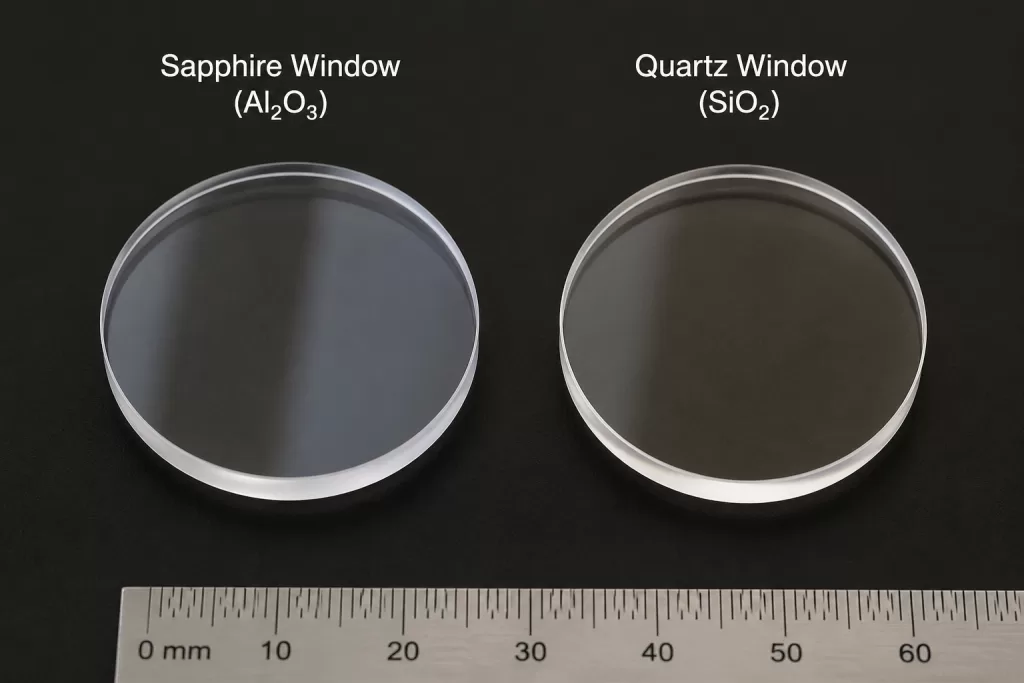
1. Material Overview: Fundamental Differences
| Eigendom | Sapphire (Al₂O₃) | Quartz (SiO₂) |
|---|---|---|
| Structure | Single crystal | Amorphous glass |
| Hardheid (Mohs) | 9 | ~5.5-6 |
| Modulus van Young | ~345 GPa | ~72 GPa |
| Thermische geleidbaarheid | Hoog | Laag |
| UV transmission | Goed | Uitstekend |
| IR transmission | Up to ~5.5 µm | Limited (~3.5 µm typical) |
| Kosten | Hoger | Lower |
Key insight:
Sapphire is mechanically superior; quartz is optically purer in the deep UV and more cost-effective.
2. When Sapphire Is the Better Choice
2.1 High-Pressure Environments
Saffier should be selected when systems involve extreme mechanical loads.
Why:
- High compressive strength
- Superior fracture resistance (in practice, defect-controlled)
- Higher modulus reduces deformation
Typical applications:
- High-pressure reactors
- Deep-sea observation systems
- Oil & gas inspection windows
Quartz is more likely to fracture under equivalent stress conditions.
2.2 Abrasive or Harsh Environments
Sapphire excels in environments with:
- Dust, الرمال, or particle erosion
- Mechanical wear
- Chemical exposure
Why:
- Extreem hoge hardheid (Mohs 9)
- Excellent chemical inertness
Toepassingen:
- Industrial sensors
- Mining or desert equipment
- Chemical processing plants
Quartz scratches easily and degrades faster.
2.3 High-Temperature Applications
Sapphire is preferred when operating temperatures are high or fluctuating.
Why:
- Higher melting point (~2030°C vs ~1670°C for quartz)
- Better thermal conductivity (reduces thermal gradients)
- Lower thermal deformation under load
Toepassingen:
- Furnace observation windows
- Combustion diagnostics
- Aerospace thermal systems
Quartz performs well in thermal shock but deforms more easily at high temperatures.
2.4 Infrared (IR) Optical Systems
Sapphire is advantageous in near-IR and mid-IR applications.
Why:
- Broad transmission up to ~5–5.5 µm
- Better IR performance than quartz
- Toepassingen:
- IR sensors
- Lasersystemen
- Gas detection
Quartz transmission drops earlier (~3–3.5 µm).
2.5 Thin, High-Strength Optical Windows
Sapphire is ideal when you need:
- Reduced thickness
- High structural reliability
Why:
- Higher modulus and strength allow thinner designs
- Better resistance to deformation under pressure
📌 Applications:
- Compact optical systems
- Aerospace weight-sensitive designs
- MEMS or micro-optics
3. When Quartz Is Still the Better Choice
To make a scientifically balanced decision, sapphire should not always replace quartz.
Quartz is preferred when:
3.1 Deep UV performance is critical
- Quartz transmits better below ~200 nm
3.2 Cost is a major constraint
- Quartz is significantly cheaper
3.3 Thermal shock resistance is required
- Quartz has a lower thermal expansion coefficient
3.4 Ultra-high optical homogeneity is needed
- Quartz has no birefringence (amorphous structure)
4. Engineering Decision Framework
A simplified decision logic:
| Vereiste | Recommended Material |
|---|---|
| High pressure | Saffier |
| Abrasive environment | Saffier |
| High temperature | Saffier |
| Infrared optics | Saffier |
| Deep UV optics | Kwarts |
| Lage kosten | Kwarts |
| Weerstand tegen thermische schokken | Kwarts |
5. Key Scientific Insight
The choice between sapphire and quartz is fundamentally a trade-off between:
mechanical performance (sapphire) vs optical purity and cost efficiency (quartz)
Sapphire dominates in extreme environments, while quartz remains optimal in controlled optical systems.
6. Conclusie
Sapphire should be used instead of quartz when the application demands:
- High mechanical strength
- Resistance to wear and harsh environments
- Elevated temperature stability
- Broad IR transmission
- Reduced thickness with structural integrity
In contrast, quartz remains the material of choice for:
- Deep UV optics
- Kostengevoelige toepassingen
- Systems requiring minimal birefringence
7. Final Takeaway
If your system is limited by mechanical, thermal, or environmental constraints, sapphire is the superior choice.
If your system is limited by optical purity in UV or cost, quartz is more appropriate.
In practice, the optimal material selection should always be based on a comprehensive evaluation of operating conditions, wavelength requirements, and long-term reliability targets.