
Sapphire (Al₂O₃) has long been recognized for its exceptional combination of optical clarity, mechanical strength, and chemical stability. Among various forms of sapphire, optical grade sapphire substrates stand out for their purity, defect control, and uniform crystallographic orientation, making them indispensable in advanced optical and high-pressure applications. From aerospace optics to high-pressure scientific experiments, these substrates serve as reliable platforms that maintain structural integrity under extreme conditions.
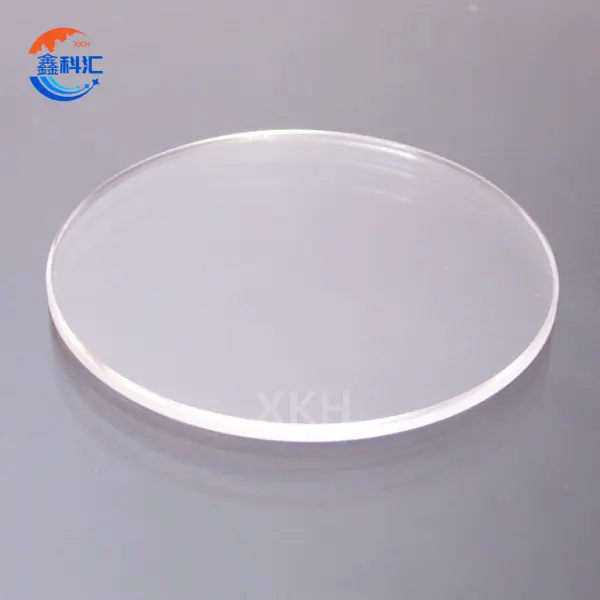
Crystallographic and Physical Properties
Optical grade sapphire substrates are typically single-crystal, with a hexagonal (trigonal) crystal structure. This atomic arrangement provides remarkable hardness—measured at 9 on the Mohs scale, second only to diamond—which contributes to their wear resistance and scratch resistance in optical systems. Key physical properties include:
| Property | Typical Value |
|---|---|
| Density | 3.98 g/cm³ |
| Melting Point | 2030 °C |
| Thermal Conductivity | 25–46 W/m·K (anisotropic) |
| Coefficient of Thermal Expansion | 5–8 × 10⁻⁶ /K |
| Hardness | 9 Mohs |
The optical transparency of sapphire spans a wide spectral range from approximately 150 nm (ultraviolet) to 5500 nm (mid-infrared), which makes it suitable for visible, UV, and IR optics. Its high refractive index (~1.76 at 590 nm) and low birefringence allow precise optical performance, especially for lenses, windows, and substrates in laser systems.
Chemical and Mechanical Stability
Sapphire exhibits outstanding chemical inertness. It resists corrosion from acids, bases, and most solvents, enabling use in harsh chemical environments. Mechanically, its extreme hardness combined with high fracture toughness (~4–6 MPa·m¹/²) allows it to withstand significant stress without catastrophic failure. This combination of chemical and mechanical robustness is crucial for high-pressure experiments and industrial applications.
High-Pressure Applications
One of the most demanding environments for optical substrates is high-pressure research and industrial processes. Sapphire substrates are commonly employed in:
- Diamond Anvil Cells (DACs)
In DACs, sapphire serves as a window or substrate to compress small samples between diamond tips. Its transparency allows in-situ optical measurements such as spectroscopy, Raman scattering, and fluorescence under pressures exceeding several hundred gigapascals. Compared to other materials like quartz or fused silica, sapphire maintains structural integrity without deformation or birefringence-induced optical distortion. - High-Pressure Gas and Chemical Chambers
Sapphire windows in high-pressure reactors or gas chambers provide visual observation of reactions while enduring high pressures and temperatures. Its chemical inertness prevents reaction with corrosive gases or liquids, ensuring long-term stability. - Aerospace and Defense Optics
In aerospace sensors and high-altitude instruments, sapphire substrates are subjected to pressure differentials during ascent and descent. Optical grade sapphire ensures that optical performance is unaffected by stress or environmental changes, while also offering excellent scratch and erosion resistance.
Thermal and Optical Advantages Under Pressure
High-pressure conditions often involve temperature gradients. Sapphire’s high thermal conductivity allows rapid heat dissipation, minimizing thermal distortion of optical paths. Its wide optical transmission window ensures that spectroscopic measurements remain accurate across a range of wavelengths, making it ideal for high-precision experiments.
Customization and Fabrication
Optical grade sapphire substrates can be fabricated in various orientations (c-plane, a-plane, m-plane) depending on application requirements. This orientation affects optical birefringence and mechanical behavior under stress. Substrates can be polished to nanometer-scale surface roughness, which is critical for minimizing scattering in high-precision optical setups. Typical thicknesses range from 0.3 mm to several millimeters, while diameters can exceed 100 mm for industrial or research use.
Future Trends and Innovations
Recent advancements in sapphire growth, such as Kyropoulos and Edge-Defined Film-Fed Growth (EFG) methods, have improved crystal uniformity and reduced defect density, enabling larger and more reliable substrates. In addition, coating technologies—such as anti-reflective (AR) or protective thin films—further expand the applicability of sapphire substrates in extreme environments, including high-pressure optical metrology and advanced laser systems.
Conclusion
Optical grade sapphire substrates combine mechanical robustness, chemical inertness, and optical clarity, making them uniquely suited for high-pressure applications. From fundamental research using diamond anvil cells to industrial high-pressure optical systems, sapphire provides reliable performance where other materials fail. As crystal growth and surface processing technologies continue to advance, sapphire substrates are expected to play an increasingly important role in next-generation optics and high-pressure instrumentation.
FAQs
- Why is sapphire preferred over other optical materials in high-pressure experiments?
Sapphire combines unmatched hardness, chemical inertness, and wide optical transparency, maintaining structural and optical performance under extreme pressures. - Can sapphire substrates be used for both visible and infrared optics under high pressure?
Yes. Sapphire’s transparency spans from ultraviolet to mid-infrared, allowing multi-wavelength optical measurements in high-pressure setups. - How does crystal orientation affect sapphire substrate performance?
Orientation affects birefringence and mechanical behavior. For example, c-plane sapphire is commonly used for optical windows due to its minimal birefringence along the optical path.