
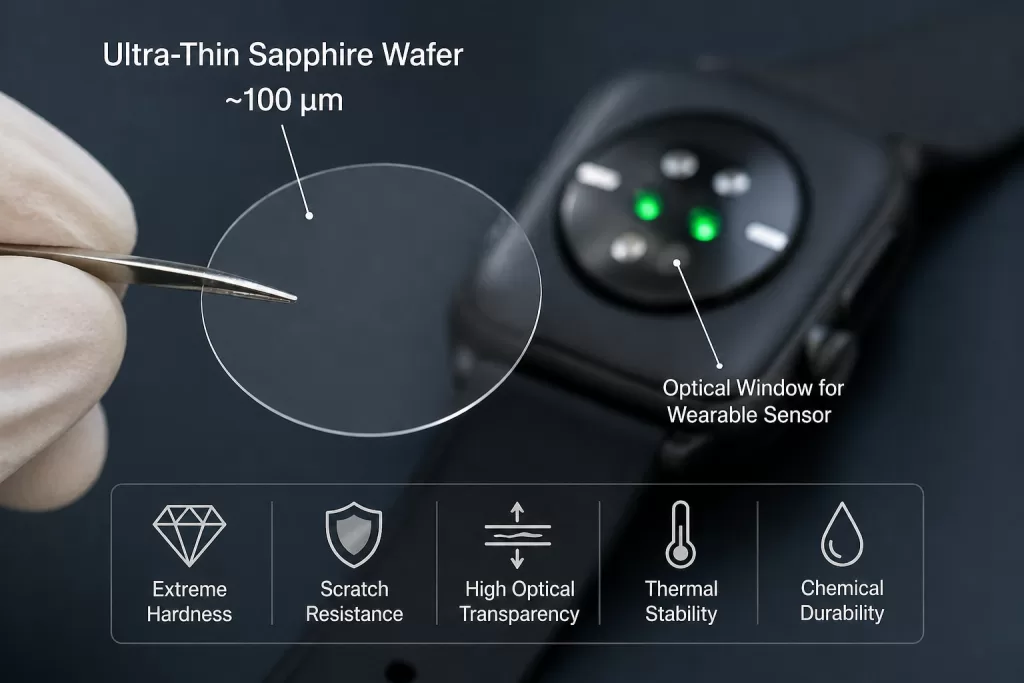
Ultra-thin płytki szafirowe are emerging as a key material platform for next-generation wearable electronics, where mechanical durability, optical clarity, and miniaturization must coexist within increasingly constrained form factors. This article provides a scientific, engineering-oriented overview of how sapphire can be thinned to extreme limits while still meeting the demanding requirements of wearable devices.
1. Introduction: Why Wearables Need Ultra-Thin, Ultra-Strong Materials
Wearable devices—such as smartwatches, health monitors, and AR/VR systems—require materials that are:
- Thin and lightweight
- Highly scratch-resistant
- Optically transparent across visible and infrared ranges
- Stable under thermal and mechanical stress
Traditional materials like chemically strengthened glass can meet some of these needs but fall short in long-term durability. Sapphire, with its exceptional hardness and chemical stability, offers a compelling alternative—especially when engineered into ultra-thin wafers.
2. Material Fundamentals of Sapphire
Sapphire (single-crystal Al₂O₃) exhibits a combination of properties rarely found in a single material:
| Nieruchomość | Typowa wartość | Relevance to Wearables |
|---|---|---|
| Twardość (Mohs) | 9 | Superior scratch resistance |
| Moduł Younga | ~345 GPa | High stiffness, low deformation |
| Optical transmission | 150 nm – 5.5 µm | Suitable for sensors and displays |
| Przewodność cieplna | ~25-35 W/m-K | Wydajne rozpraszanie ciepła |
| Chemical stability | Doskonały | Sweat, moisture resistance |
These properties enable sapphire to function as both a protective cover and an optical interface.
3. What Does “Ultra-Thin” Mean in Sapphire?
In wearable applications, sapphire wafers are typically categorized as:
- Standard thickness: 0.5 – 1.0 mm
- Thin wafers: 200 – 500 µm
- Ultra-thin wafers: 50 – 200 µm
At these thicknesses, sapphire transitions from a purely structural material to a functional thin-film-like component, where mechanical reliability becomes strongly dependent on surface quality and defect control.
4. Mechanical Challenges at Reduced Thickness
4.1 Fracture Mechanics Dominance
Unlike metals, sapphire is a brittle material. Its strength is governed not by bulk properties, but by surface and edge defects.
- Micro-cracks (sub-micron scale) act as stress concentrators
- Strength follows a statistical (Weibull) distribution
- Thinner wafers → higher stress sensitivity
👉 Result: Even though sapphire is intrinsically strong, ultra-thin wafers require precision finishing and defect minimization.
4.2 Bending and Impact Resistance
Wearable devices are exposed to:
- Repeated mechanical impacts
- Bending during daily use
- Localized contact stress
Ultra-thin sapphire must be engineered to withstand these loads through:
- Edge chamfering
- Surface polishing (sub-nanometer roughness)
- Residual stress control
5. Optical Advantages in Wearable Sensors
Ultra-thin sapphire wafers are particularly valuable in optical sensing systems, such as:
- Heart rate monitoring (PPG sensors)
- Blood oxygen detection (SpO₂)
- Infrared proximity sensing
Key benefits:
- High transmission in visible and near-IR
- Minimal optical distortion at reduced thickness
- Compatibility with anti-reflective coatings
Thinner sapphire reduces optical path length, improving signal quality in compact sensor designs.
6. Manufacturing Considerations
Producing ultra-thin sapphire wafers involves several advanced processes:
- Crystal growth (Kyropoulos or Czochralski methods)
- Precision slicing (wire sawing)
- Double-side lapping
- Polerowanie chemiczno-mechaniczne (CMP)
- Thinning and stress-relief treatments
Key challenge:
- Yield drops significantly below ~200 µm
- Handling becomes increasingly difficult
Manufacturing capability is often the limiting factor—not material performance.
7. Integration in Wearable Systems
Ultra-thin sapphire wafers are used in:
- Smartwatch display covers
- Camera lens protection
- Biometric sensor windows
- Transparent protective layers
System-level advantages:
- Longer device lifespan
- Reduced maintenance and replacement
- Improved premium perception (high-end devices)
8. Trade-Offs and Design Considerations
| Factor | Ultra-Thin Sapphire | Glass Alternative |
|---|---|---|
| Odporność na zarysowania | Doskonały | Umiarkowany |
| Weight | Lower | Lower |
| Impact resistance | Moderate (brittle) | Better (ductile behavior) |
| Koszt | Higher | Lower |
| Optical performance | Superior | Dobry |
👉 Designers must balance durability vs. cost vs. manufacturability.
9. Future Outlook
Research is ongoing to further enhance sapphire performance through:
- Surface coatings (anti-reflective, anti-smudge)
- Composite layering (sapphire + polymers)
- Nano-structuring for improved toughness
These developments aim to overcome sapphire’s inherent brittleness while preserving its superior hardness.
10. Wnioski
Ultra-thin sapphire wafers represent a critical advancement in wearable device engineering. By combining extreme hardness, optical clarity, and thermal stability, sapphire enables durable, high-performance components in increasingly compact devices.
However, their successful application depends on:
- Precision manufacturing
- Defect control
- Careful mechanical design