
1. Introdução
In aerospace engineering, sensor performance is critical to navigation, environmental monitoring, and system control. Sensors deployed in aircraft, satellites, and spacecraft often operate under extreme conditions, including high vibration, temperature fluctuations, and exposure to radiation. Protecting these sensors while maintaining optical and mechanical performance requires the use of advanced materials.
Sapphire (α-Al₂O₃), a single-crystal form of aluminum oxide, has emerged as a material of choice for aerospace sensor components due to its exceptional hardness, thermal stability, chemical inertness, and optical transparency. These properties make sapphire ideal for optical windows, sensor covers, and other protective components.
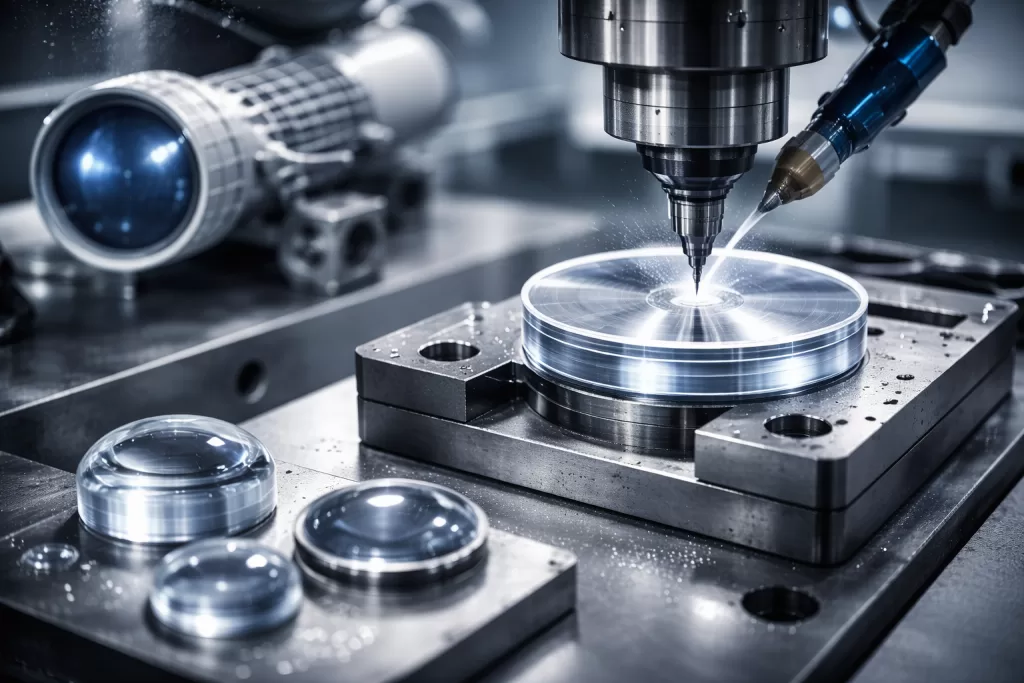
However, sapphire’s very hardness and brittleness present unique challenges during fabrication. Precision machining techniques must balance surface quality, dimensional accuracy, and cost while avoiding cracks or subsurface damage. This article explores the challenges and state-of-the-art solutions for machining sapphire components in aerospace sensor applications.
2. Material Properties of Sapphire Relevant to Machining
Understanding sapphire’s properties is essential to appreciate the difficulties in its processing:
- Mohs hardness: 9, second only to diamond. This makes conventional cutting or grinding ineffective.
- Brittleness: Sapphire is prone to cracking under localized stress, particularly at edges or thin sections.
- Thermal stability: Melting point ~2050°C, low thermal expansion (~5 × 10⁻⁶ /°C), and high thermal conductivity (~35 W/m·K).
- Optical transparency: Transmits UV to near-infrared (approximately 150 nm–5 μm).
- Chemical inertness: Resistant to acids, alkalis, and many solvents.
These properties make sapphire highly suitable for aerospace optics but simultaneously complicate manufacturing.
3. Applications of Sapphire Components in Aerospace Sensors
3.1 Optical Windows for Environmental Sensors
Sapphire windows protect photodetectors and cameras in:
- Satellites monitoring atmospheric conditions
- High-altitude aircraft sensors
- UAV sensors for thermal or optical imaging
Their hardness ensures resistance to micro-meteorite impacts, airborne particulate abrasion, and long-term wear.
3.2 Protective Covers for Laser and Lidar Sensors
Lidar and laser-based navigation systems require:
- High transparency at specific wavelengths
- Resistance to thermal fluctuations caused by solar radiation or engine heat
- Mechanical stability to prevent beam distortion
Sapphire provides both optical clarity and structural robustness.
3.3 Pressure and Temperature Sensor Encapsulation
Sapphire is employed in housings for:
- High-pressure probes in aerospace propulsion systems
- Thermocouples in engines or environmental monitoring devices
Its chemical inertness ensures reliability in chemically aggressive or high-temperature environments.
4. Challenges in Machining Sapphire
4.1 Hardness and Tool Wear
Sapphire’s extreme hardness limits machining options to diamond-based tools. Conventional carbide tools rapidly wear, causing poor surface finish and dimensional errors.
- Impact: High tooling costs and frequent replacement
- Mitigation: Use polycrystalline diamond (PCD) or single-crystal diamond (SCD) tooling with proper cooling
4.2 Brittleness and Crack Formation
Brittleness can lead to chipping, microcracks, and catastrophic fracture, especially during:
- Drilling or hole making
- Edge chamfering
- Thin component machining
- Solution: Low feed rates, high-precision CNC control, and ultrasonic-assisted machining to reduce localized stress
4.3 Surface Finish and Optical Requirements
Aerospace sensor components demand extremely smooth surfaces:
- Surface roughness Ra ≤ 10 nm for optical windows
- Subsurface damage must be minimized to prevent scattering or optical distortion
- Solution: Combination of grinding and chemical-mechanical polishing (CMP) to achieve high optical quality
4.4 Dimensional Accuracy
Tight tolerances are often required:
- ±5–10 μm for lens covers
- Complex geometries in housings or mounting interfaces
Achieving such precision is difficult due to elastic recovery, tool deflection, and thermal expansion, even in hard sapphire. Precision CNC machines with in-situ measurement help maintain dimensional fidelity.
5. Advanced Machining Techniques
5.1 Diamond Turning and Grinding
Diamond turning allows:
- High-precision shaping
- Minimal subsurface damage
- Smooth surfaces suitable for optical applications
Diamond grinding wheels with controlled feed rates are used for preliminary shaping.
5.2 Ultrasonic-Assisted Machining (UAM)
UAM superimposes high-frequency vibrations onto the tool or workpiece:
- Reduces cutting forces
- Minimizes crack formation
- Improves tool life
This method is particularly effective for thin or delicate components.
5.3 Laser-Assisted Machining
Laser-assisted machining locally heats the sapphire to slightly reduce hardness:
- Easier material removal
- Lower risk of micro-cracks
- Requires careful thermal control to avoid optical distortion
5.4 Chemical-Mechanical Polishing (CMP)
CMP is essential for:
- Achieving nanometer-scale surface roughness
- Removing subsurface damage from previous machining
- Producing optically transparent surfaces
It combines chemical etching and mechanical polishing using nanoscale abrasives.
5.5 Hybrid Techniques
For complex geometries, aerospace manufacturers often combine:
- Diamond grinding for rough shaping
- Ultrasonic-assisted finishing for precision features
- CMP for optical surface quality
This integrated approach balances efficiency, precision, and surface integrity.
6. Quality Control and Testing
Machined sapphire components undergo strict inspection:
- Optical interferometry to measure surface flatness
- Scanning electron microscopy (SEM) for subsurface cracks
- Laser transmission tests to verify optical clarity
- Mechanical tests for hardness and fracture resistance
Quality control ensures that components can withstand high-stress aerospace environments without failure.
7. Future Trends
Advances in sapphire machining for aerospace sensors include:
- Automation and AI-driven CNC machining to reduce human error and optimize tool paths
- Improved diamond tooling materials for longer life and cost reduction
- Additive manufacturing hybridization, potentially combining sapphire with other ceramics for complex multi-material components
- Surface functionalization, e.g., anti-reflective coatings or hydrophobic layers for sensor windows
These developments aim to reduce cost, improve throughput, and enhance the performance of sapphire components.
8. Conclusão
Sapphire components are critical for aerospace sensor performance due to their hardness, thermal stability, chemical inertness, and optical clarity. However, these same properties pose significant challenges for precision machining, including tool wear, brittleness, surface finish, and dimensional accuracy.
Modern solutions—diamond machining, ultrasonic assistance, laser-assisted processing, and chemical-mechanical polishing—have enabled manufacturers to produce high-quality sapphire components that meet the rigorous demands of aerospace applications. As machining technologies continue to advance, sapphire will remain a cornerstone material in the design of durable, high-performance aerospace sensors.