
Sapphire (Al₂O₃) is one of the most widely used single-crystal materials in advanced optics, semiconductors, and precision instrumentation. Its exceptional mechanical strength, chemical inertness, and optical transparency make it a cornerstone for high-performance devices. However, a surprisingly frequent source of performance loss in sapphire-based components arises not from material defects, but from improper selection of crystal orientation. This article explores the common misconceptions in sapphire crystal orientation selection and offers insights into scientifically informed decision-making.
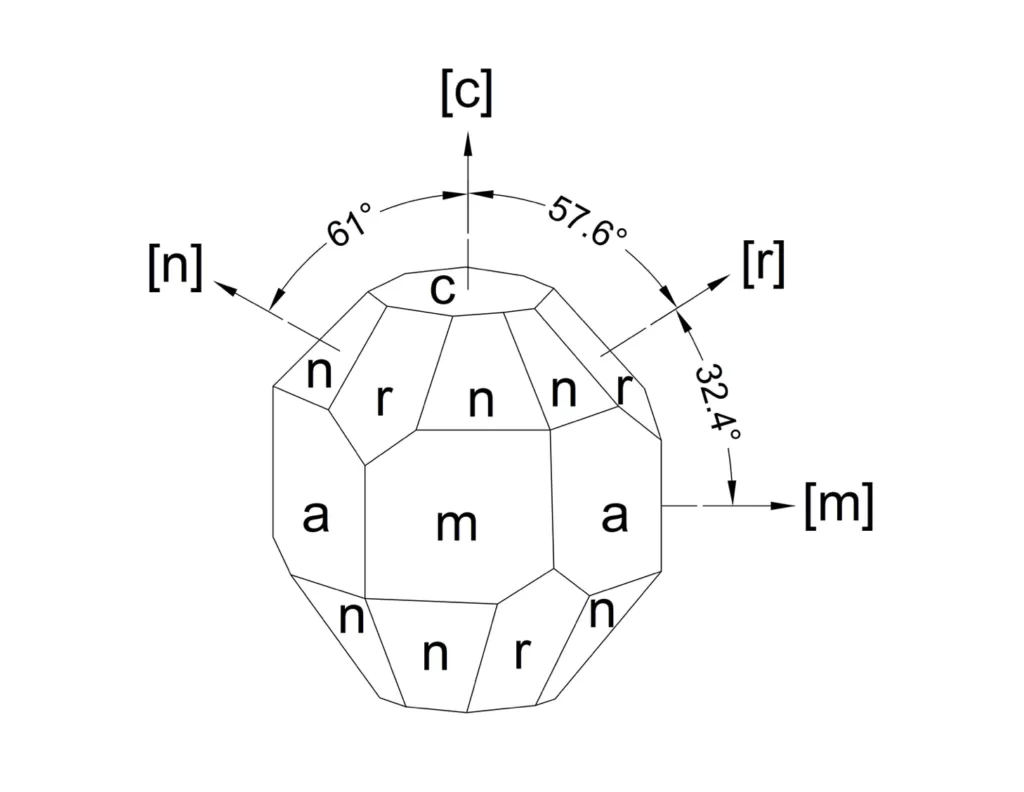
Understanding Sapphire Crystal Orientations
แซฟไฟร์ has a hexagonal crystal structure, commonly referred to in the Miller-Bravais index system as c-plane (0001), a-plane (11-20), and r-plane (1-102). Each orientation exhibits distinct physical and optical properties:
- c-plane (0001): Known for its high optical transparency and uniform birefringence, ideal for optical windows, LED substrates, and semiconductor wafers.
- a-plane (11-20): Exhibits anisotropic thermal expansion, preferred for devices requiring lateral heat dissipation.
- r-plane (1-102): Offers unique mechanical properties and reduced birefringence along certain axes, commonly used in laser systems.
The correct choice depends on the device application, expected stress conditions, and optical requirements.
Misconception 1: “c-plane is Always the Best Choice”
A prevalent but misleading belief is that the c-plane orientation is universally optimal. While the c-plane indeed provides uniform optical clarity, it is mechanically more susceptible to anisotropic fracture along basal planes under high-stress conditions. For example, in high-power laser applications, a- or r-plane sapphire may outperform c-plane due to reduced thermally induced stress.
Misconception 2: “Any Orientation Works for Epitaxial Growth”
In semiconductor fabrication, the epitaxial growth of GaN or AlN on sapphire wafers requires precise lattice matching. Misalignment between the crystal orientation of the substrate and the epitaxial layer can induce dislocations and stacking faults, compromising device efficiency. Assuming that all planes support epitaxy equally can result in catastrophic yield loss, particularly in high-brightness LEDs and power electronics.
Misconception 3: “Optical Properties Are Independent of Orientation”
Sapphire’s optical properties, including birefringence and refractive index, are orientation-dependent. A common error is selecting sapphire for optical windows or lenses without considering its anisotropic refractive behavior. For polarized laser applications, even minor misorientation can cause beam distortion, reduced transmission, or uneven thermal focusing, which may degrade system performance.
Misconception 4: “Mechanical Strength Is Uniform Across All Planes”
Contrary to intuition, sapphire is not equally strong in all directions. c-plane sapphire tends to cleave along basal planes under impact, whereas a- and r-planes exhibit higher resistance to lateral fracture. Overlooking this anisotropy can result in premature mechanical failure, especially in high-vibration or aerospace environments.
Towards Rational Crystal Orientation Selection
Addressing these misconceptions requires a systematic approach:
- Application Analysis: Determine whether optical, thermal, or mechanical performance is critical.
- Simulation and Modeling: Use finite element analysis (FEA) to predict stress distribution and fracture behavior based on orientation.
- Orientation-Specific Testing: Conduct empirical testing of prototype components in actual operating conditions.
- Interdisciplinary Design: Combine insights from materials science, optics, and device engineering to select the optimal orientation.
By moving beyond the simplistic “c-plane default” mentality, engineers can unlock the full potential of sapphire, ensuring higher device efficiency, longevity, and reliability.
สรุป
Sapphire is a remarkably versatile material, but its utility hinges on informed crystal orientation selection. Misconceptions—ranging from over-reliance on c-plane, to neglecting anisotropic optical and mechanical behavior—can severely limit performance. Through careful consideration of device requirements, lattice alignment, and stress analysis, one can fully exploit sapphire’s extraordinary properties, driving innovation in photonics, semiconductors, and high-precision instrumentation.