
1. บทนำ
The rapid adoption of electric vehicles (EVs) has intensified the demand for high-power, high-efficiency charging infrastructure. Among various charging technologies, direct current (DC) fast charging stations play a pivotal role by significantly reducing charging time and improving user convenience. However, these systems must handle high voltages, large currents, and substantial thermal loads, all while maintaining efficiency, reliability, and compactness.
Traditional silicon (Si)-based power electronics are approaching their physical performance limits under such demanding conditions. As a result, wide bandgap semiconductor materials—particularly silicon carbide (SiC)—have emerged as transformative solutions. SiC-based devices are now redefining the design and performance boundaries of DC fast charging systems.
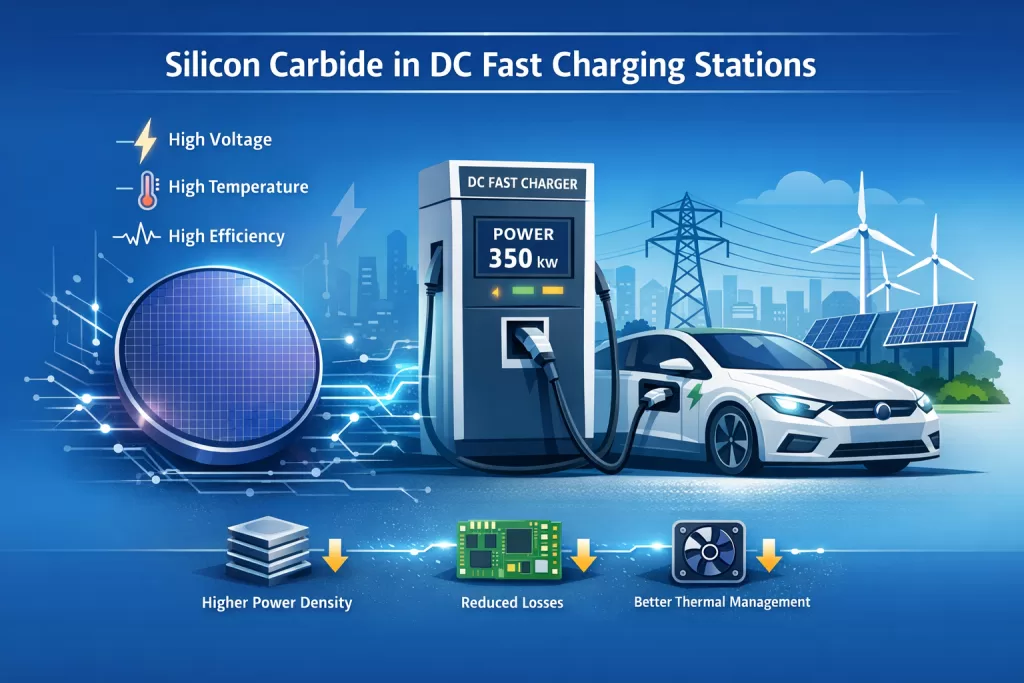
2. Fundamentals of Silicon Carbide
Silicon carbide is a compound semiconductor composed of silicon and carbon atoms arranged in a crystalline lattice. It belongs to the class of wide bandgap (WBG) semiconductors, characterized by a bandgap of approximately 3.26 eV (for 4H-SiC), compared to 1.12 eV for conventional silicon.
Key intrinsic properties include:
- High breakdown electric field (~10× higher than Si)
- High thermal conductivity (~3–4× that of Si)
- Wide bandgap enabling high-temperature operation
- High electron saturation velocity
These characteristics enable SiC devices to operate at higher voltages, frequencies, and temperatures with significantly improved efficiency.
3. Limitations of Silicon-Based Power Devices
Conventional silicon-based power devices, such as IGBTs and MOSFETs, face several constraints in high-power DC fast charging systems:
- Higher switching losses, especially at elevated frequencies
- Significant conduction losses at high currents
- Limited thermal performance, requiring bulky cooling systems
- Lower voltage handling capability, leading to complex circuit designs
These limitations translate into reduced system efficiency, larger physical footprints, and higher operational costs.
4. Advantages of SiC in DC Fast Charging Systems
4.1 Reduced Power Losses
SiC MOSFETs exhibit significantly lower switching and conduction losses compared to silicon IGBTs. This allows:
- Higher efficiency (>95–98% in advanced systems)
- Reduced energy waste
- Lower operating costs over time
4.2 High Voltage Capability
SiC devices can handle higher voltages (e.g., 800 V to >1000 V systems), which:
- Reduces current for the same power level
- Minimizes resistive losses (I²R losses)
- Enables faster charging speeds
This is particularly important for next-generation EV platforms adopting 800 V architectures.
4.3 High-Frequency Operation
SiC devices can switch at much higher frequencies, enabling:
- Smaller passive components (inductors, capacitors)
- Reduced system size and weight
- Faster dynamic response
This contributes to more compact and modular charging station designs.
4.4 Superior Thermal Performance
With high thermal conductivity and the ability to operate at elevated junction temperatures (>200°C), SiC devices:
- Reduce cooling requirements
- Improve system reliability
- Enable higher power density
5. System-Level Impact on DC Fast Charging Stations
5.1 Increased Power Density
By reducing losses and enabling high-frequency operation, ซิก (ซิลิคอนคาร์ไบด์) allows designers to build:
- Smaller, lighter charging modules
- Higher power output per unit volume
- Scalable charging architectures
5.2 Improved Energy Efficiency
Higher efficiency directly translates to:
- Lower electricity consumption
- Reduced heat generation
- Decreased operational costs for charging network operators
5.3 Enhanced Reliability and Lifespan
Lower thermal stress and improved material robustness contribute to:
- Longer component lifetimes
- Reduced maintenance requirements
- Higher system uptime
5.4 Grid Integration and Stability
SiC-based power converters offer improved control and efficiency, which helps:
- Stabilize grid interactions
- Support renewable energy integration
- Reduce harmonic distortion
6. Real-World Applications
SiC technology is already being deployed in:
- Ultra-fast charging stations (150 kW–350 kW and beyond)
- High-power rectifiers and DC-DC converters
- On-board chargers (OBCs) in EVs
- Renewable energy systems integrated with EV charging
Major automotive and power electronics manufacturers are increasingly adopting SiC to meet performance and efficiency targets.
7. Challenges and Considerations
Despite its advantages, SiC technology faces several challenges:
- Higher material and manufacturing costs compared to silicon
- Complex fabrication processes, including crystal growth and wafer processing
- Gate drive and packaging design considerations
- Supply chain constraints, although improving rapidly
However, as production scales and technology matures, costs are expected to decrease.
8. Future Outlook
The transition to wide bandgap semiconductors is accelerating, driven by the global push toward electrification and decarbonization. SiC is expected to play a central role in:
- Next-generation ultra-fast charging infrastructure
- High-efficiency power conversion systems
- Smart grid and energy storage integration
Ongoing research focuses on improving wafer quality, reducing defects, and enhancing device reliability.
9. สรุป
Silicon carbide is fundamentally transforming the design and performance of DC fast charging stations. By enabling higher efficiency, greater power density, and improved thermal management, SiC addresses many of the limitations of traditional silicon-based systems.
As the EV ecosystem continues to expand, SiC-based power electronics will be critical in delivering faster, more efficient, and more reliable charging solutions. Its adoption represents a significant step forward in the evolution of sustainable transportation infrastructure.