
Silicon wafers are essential components in modern electronics, serving as the foundation for devices ranging from smartphones and computers to solar panels and semiconductor devices. The manufacturing of these wafers involves a series of highly precise steps, beginning with the creation of a single crystal silicon ingot and ending with the production of polished wafers suitable for use in integrated circuits (ICs) and other devices. In this article, we will explore each step of the single crystal silicon wafer manufacturing process in detail.
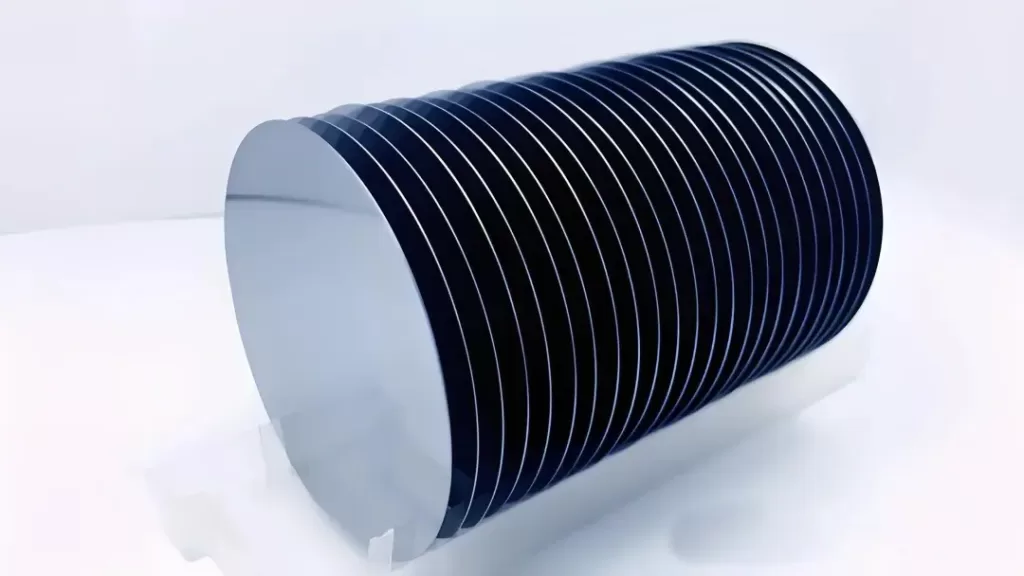
Step 1: Creating the Single Crystal Silicon Ingot
The first step in wafer manufacturing is the production of a single crystal silicon ingot, which will serve as the raw material for the silicon wafers. This process starts with polycrystalline silicon, which consists of many small silicon crystals. The polycrystalline silicon is placed in a single crystal furnace and heated to a temperature of above 1420°C until it melts into a liquid.
During this melting process, dopants (such as boron (B), phosphorus (P), arsenic (As), and antimony (Sb)) are introduced into the molten silicon to control its electrical properties. These dopants determine whether the silicon will be n-type หรือ p-type and control its resistivity, which is crucial for the wafer’s intended electronic applications. The concentration of dopants is carefully controlled to ensure the final wafer has the required electrical characteristics.
Once the molten silicon is stabilized, a seed crystal is slowly lowered into the molten silicon. This seed crystal serves as the foundation for the growth of a single, large crystal of silicon. As the seed crystal is pulled upward at a controlled rate, silicon atoms crystallize onto it, forming a single crystal ingot. This process, known as the Czochralski method, is widely used for growing high-quality single crystals.
Step 2: Necking and Crystal Growth
Once the single crystal has begun to grow, the next step is necking. During necking, the diameter of the crystal is gradually reduced to eliminate any dislocations or defects that may have been introduced during the seed crystal process. The necking step ensures that the crystal will have a uniform structure free from imperfections.
After necking, the crystal enters the growth phase, where its diameter is gradually increased. The pulling speed และ temperature are carefully controlled to maintain a consistent growth rate. This process is known as isodiameter growth, where the diameter of the crystal remains constant along its length while the crystal continues to grow. The growth process continues until the ingot reaches its desired size.
Once the ingot has reached the target length, the growth process is stopped, and the crystal undergoes a finishing process to remove any residual imperfections. The ingot is then allowed to cool, solidifying into a single, uniform crystal of silicon.
Step 3: Slicing the Ingot into Wafers
After the single crystal silicon ingot has cooled and solidified, it is time to slice it into thin wafers. This slicing process requires precision to ensure that the wafers are uniform in thickness and free from cracks or warping. The ingot is typically cut using diamond wire saws or other precision cutting tools to create thin, flat disks.
After slicing, the edges of the wafers are typically beveled to remove any rough edges created during the cutting process. The resulting wafers are still quite rough and require further processing.
Step 4: Lapping, Etching, and Polishing
The next step is to lap the wafers, which involves grinding the wafer surfaces to remove any remaining imperfections from the slicing process. Lapping also helps to ensure that the wafers are flat and smooth, which is essential for the subsequent photolithography process.
Once the wafers are lapped, they undergo etching to remove any contaminants, particles, and unwanted material from the surface. Etching is typically done using a combination of chemical treatments that clean and prepare the wafer surface for subsequent steps.
The wafers then undergo a polishing process to achieve a perfectly smooth, uniform surface. Polishing is critical to ensure that the wafers are suitable for photolithography, a process used to transfer patterns onto the wafer for semiconductor device fabrication. The polished surface must be free of defects and particles to ensure the accuracy of the pattern transfer.
Step 5: Chemical Vapor Deposition (CVD) and Epitaxial Growth
In some cases, the wafers undergo การสะสมไอเคมี (CVD) to deposit thin layers of material onto the wafer surface. CVD is used to apply thin films of materials such as silicon dioxide (SiO₂), silicon nitride (Si₃N₄), or polysilicon. This is crucial for modifying the wafer’s electrical properties and providing a surface suitable for subsequent layers in semiconductor devices.
After CVD, the wafer may undergo an การเจริญเติบโตแบบเอพิแทกเซียล process, where a thin layer of single-crystal silicon is grown on the surface of the wafer. This process, known as epitaxy, is typically carried out using โรคหลอดเลือดหัวใจ หรือ MBE (Molecular Beam Epitaxy) techniques. The epitaxial layer has a specific resistivity and thickness, which is tailored to meet the requirements for device fabrication. This layer is often used to create a high-quality silicon surface for the growth of transistors and other components in semiconductor devices.
Step 6: Final Polishing and Inspection
After the wafer has undergone epitaxial growth and any other necessary treatments, it undergoes a final polishing step to ensure its surface is smooth and free from defects. This final polishing is essential for obtaining the necessary surface quality required for photolithography and other device fabrication processes.
The wafer is then thoroughly cleaned to remove any remaining contaminants or particles. At this point, the wafer undergoes a final inspection to ensure it meets the required specifications in terms of resistivity, geometric parameters, และ คุณภาพผิว. Wafers that pass the inspection are then ready for shipment to semiconductor manufacturers for device production.
Flowchart of the Single Crystal Silicon Ingot Manufacturing Process
Here is a simplified flowchart of the single crystal silicon ingot manufacturing process:
- Ingredient Preparation: Polycrystalline silicon and dopants are prepared.
- Evacuation: The environment is prepared for the melting process.
- Melting: Polycrystalline silicon is heated to above 1420°C to melt.
- Stabilization: The molten silicon is stabilized at a consistent temperature.
- Necking: The crystal diameter is reduced to eliminate dislocations.
- การเจริญเติบโตของคริสตัล: The crystal diameter increases as it grows.
- Shoulder Growth: The shoulder of the ingot forms as the crystal continues to grow.
- Body Growth: The main body of the ingot continues to grow to the desired size.
- Finishing: The crystal is finished to remove any remaining imperfections.
- Cooling: The ingot cools and solidifies into a single crystal.
สรุป
The process of manufacturing single crystal silicon wafers is a highly precise and complex series of steps. Each phase, from the creation of the single crystal ingot to the final polishing and inspection, plays a critical role in ensuring the quality and performance of the finished wafer. As technology advances, the demand for high-quality silicon wafers continues to grow, making this manufacturing process an essential part of the development of modern electronic devices.