
1. Introduction: Why SiC Is a High-Temperature Material of Choice
Silisyum karbür (SiC) is an advanced ceramic material known for its exceptional thermal stability, high strength, low density, and superior heat management capability. Unlike conventional materials, SiC maintains structural integrity at extreme temperatures while forming a protective silicon dioxide (SiO₂) layer in oxidizing environments, which significantly enhances its durability.
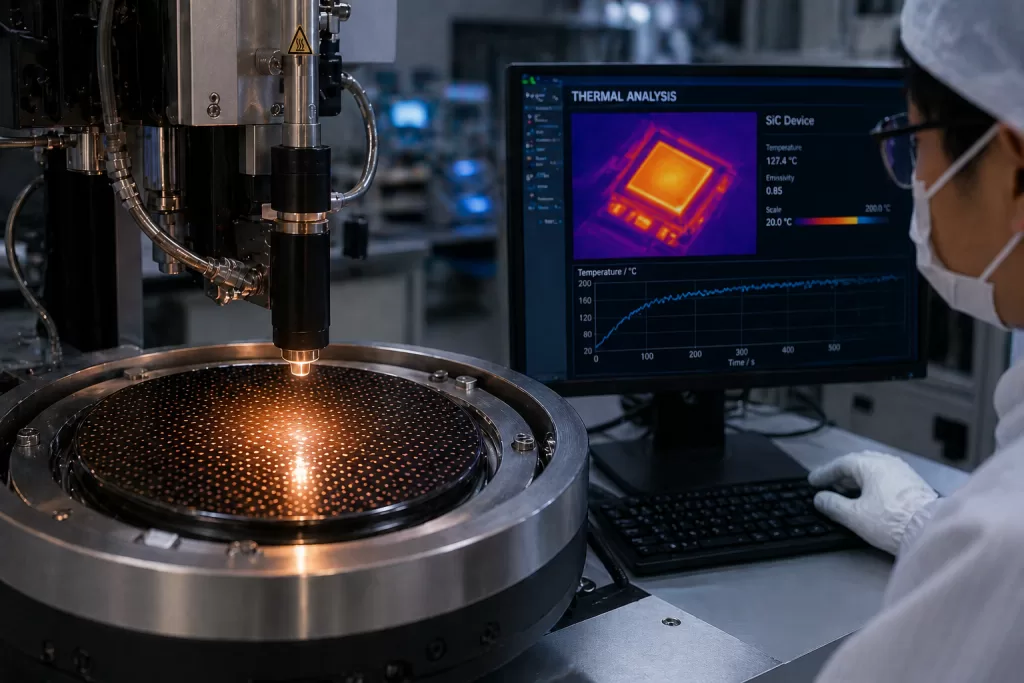
These combined properties make SiC a critical material in:
- Aerospace thermal protection systems (TPS)
- Hypersonic vehicles
- High-power electronic devices
- Renewable energy and power conversion systems
In aerospace applications, such as spacecraft re-entry or hypersonic flight, materials are exposed to extreme thermal loads. Under such conditions, materials must be both lightweight and thermally resilient. Silicon carbide fiber-reinforced ceramic matrix composites (SiC/SiC) meet these requirements and are widely considered a key solution for next-generation thermal protection systems.
2. Core Thermal Property System of SiC
A quantitative understanding of SiC’s thermal performance is essential for engineering design.
| Mülkiyet | Tipik Değer | Engineering Significance |
|---|---|---|
| Decomposition temperature | ~2700°C (at ambient pressure) | Defines upper operating limit |
| Thermal conductivity (κ) | 20–200 W/(m·K) | Enables efficient heat dissipation |
| Termal genleşme katsayısı (CTE) | 4.0–4.5 ×10⁻⁶ /K | Low expansion improves thermal stability |
| Specific heat capacity (Cp) | ~670 J/(kg·K) | Indicates heat storage capability |
| Oxidation behavior | Forms SiO₂ protective layer | Enhances high-temperature durability |
Key Insight:
SiC uniquely combines high thermal conductivity with low thermal expansion, allowing it to dissipate heat quickly while maintaining dimensional stability. This combination is rare among engineering materials and is critical for thermal management systems.
3. Evolution of SiC Fibers and High-Temperature Reliability
The development of SiC fibers has been driven by the need to improve thermal resistance and structural stability at elevated temperatures. This evolution can be understood in three stages:
First Generation (High Oxygen Content)
Early SiC fibers were produced in oxygen-rich environments, resulting in oxygen content exceeding 20%. Their internal structure resembled amorphous Si–C–O glass.
- Performance degradation above ~1200°C
- Rapid strength loss due to phase volatilization
- Low modulus and thermal conductivity
Result: Limited to low-performance applications (≤1200°C)
Second Generation (Low Oxygen Content)
Advances in precursor chemistry reduced oxygen content to below 1%.
- Formation of larger β-SiC grains
- Improved creep resistance
- Better thermal stability
Result: Suitable for higher temperature structural applications
Third Generation (Near-Stoichiometric SiC)
Modern fibers achieve near-ideal SiC composition with minimal impurities.
- Nano-scale β-SiC grains (~200 nm)
- Significantly reduced creep rate
- Improved density and structural integrity
Representative materials include:
- Hi-Nicalon™ S
- Sylramic™ fibers with BN coatings
These fibers can operate:
- At temperatures up to ~1400°C
- With lifetimes exceeding 25,000 hours
Important Limitation
Above ~1600°C, SiC transitions from:
- Passive oxidation (protective SiO₂ layer)
→ to - Active oxidation (rapid degradation)
Therefore, in ultra-high-temperature environments, SiC fibers must be combined with protective coatings or environmental barrier coatings (EBCs).
4. Application Case: SiC in EV Fast Charging Systems
To understand SiC’s thermal advantages in real-world systems, consider electric vehicle (EV) fast chargers.
Traditional Silicon-Based Systems (IGBT)
- High heat generation
- Requires bulky liquid cooling systems
- Increased size, weight, and energy consumption
- Lower system efficiency (~94%)
SiC-Based Systems (MOSFET)
Replacing silicon devices with SiC MOSFETs leads to major improvements:
1. Higher Operating Temperature
- SiC devices: >200°C
- Silicon devices: typically <150°C
Reduced dependence on cooling systems
2. Superior Thermal Conductivity
- Faster heat dissipation
- Reduced thermal hotspots
- More uniform temperature distribution
System-Level Benefits
- Efficiency increases to >97%
- Smaller and lighter cooling systems
- Higher power density (compact design)
- Lower total energy loss
In simple terms, SiC enables systems to operate continuously at high performance without thermal bottlenecks.
5. Summary: The “Thermal Advantage Combination” of SiC
The unique value of SiC lies in its combination of:
- Yüksek sıcaklık dayanımı
- Yüksek ısı iletkenliği
- Low thermal expansion
This “triple advantage” allows SiC to outperform traditional materials like silicon in demanding environments.
As a result, SiC has become a foundational material for:
- Next-generation power electronics
- Aerospace and defense systems
- Renewable energy infrastructure
- High-frequency and high-power devices
6. Future Outlook: Toward Ultra-High Thermal Conductivity Materials
Although SiC already offers excellent performance, research is pushing further toward next-generation thermal materials.
Development Direction:
SiC-based composites with enhanced thermal conductivity
Approach:
Incorporating ultra-high thermal conductivity materials such as:
- Diamond particles
- Graphene
to form SiC-based hybrid composites
Expected Performance:
- Thermal conductivity 2–3× higher than conventional SiC
- Faster heat dissipation for high-power systems
Key Challenge:
- Minimizing interfacial thermal resistance between different materials
Future Applications:
- Advanced semiconductor cooling
- 6G communication systems
- High-performance computing (HPC)
- Fusion energy systems
Final Insight
Silicon carbide is not just a high-temperature material—it is a thermal management platform that enables the next generation of high-efficiency, high-power, and high-reliability technologies.