
In advanced manufacturing systems, the true determinants of yield, stability, and long-term performance are often not the headline machines, but the materials quietly operating under extreme conditions. As of 2026, both the semiconductor and photovoltaic (PV) industries are undergoing rapid technological upgrades, and silicon carbide (SiC) ceramics are emerging as a foundational material—transitioning from a supporting role to a critical enabler of next-generation production.
1. Silicon Carbide Ceramics: Built for Extreme Environments
Silicon carbide (SiC) is a high-performance structural ceramic known for its exceptional thermal, mechanical, and chemical properties. In environments exceeding 1500°C, where conventional materials often fail due to deformation, cracking, or contamination, SiC ceramics maintain structural integrity and functional stability.
Key performance advantages include:
- Độ dẫn nhiệt cao: Significantly better than traditional ceramics such as alumina and zirconia, enabling efficient heat dissipation
- Low thermal expansion coefficient: Ensures dimensional stability under rapid temperature fluctuations
- Khả năng chịu sốc nhiệt tuyệt vời: Withstands repeated heating and cooling cycles
- Outstanding chemical resistance: Stable in corrosive gases, plasma, and reactive environments
- High hardness and wear resistance: Ideal for long-term use in mechanical and load-bearing components
These characteristics make SiC ceramics indispensable in industries requiring high cleanliness, precision, and durability, including semiconductors, photovoltaics, lithium batteries, aerospace, and defense.
2. Replacement Trend: SiC is Redefining Material Standards
The rise of SiC ceramics is closely tied to the limitations of traditional materials such as quartz, graphite, and metals. As manufacturing processes become more demanding, these legacy materials struggle to meet new performance requirements.
2.1 Semiconductor Industry: Enabling Advanced Nodes
As semiconductor fabrication advances toward 7nm nodes and beyond, material requirements have shifted from basic heat resistance to ultra-low contamination and long-term stability.
Traditional materials face several challenges:
- Thạch anh: Susceptible to microcracking and limited thermal durability
- Graphite: Prone to particle shedding and contamination
- Metals: Risk of chemical reactions and ion contamination
SiC ceramics, with their dense structure and chemical inertness, are increasingly used in critical semiconductor equipment, including:
- Epitaxy systems
- Rapid Thermal Processing (RTP) furnaces
- CVD/PECVD deposition equipment
- Etching chamber components
- Ion implantation systems
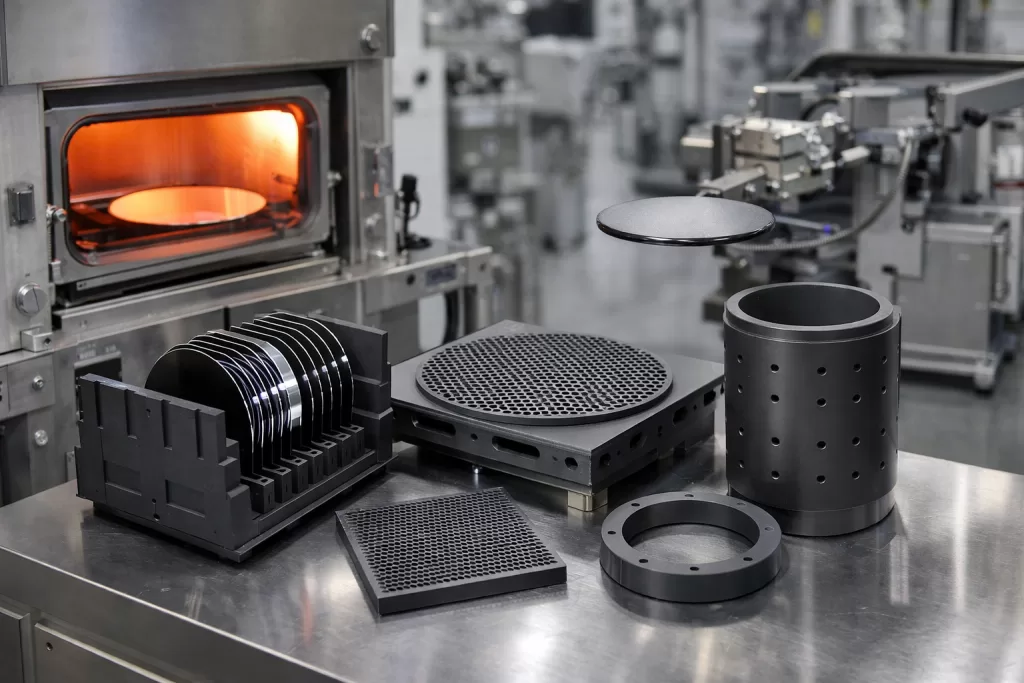
- Wafer handling and support structures (boats, trays, susceptors)
In plasma etching and deposition environments, SiC components significantly improve chamber stability and reduce particle contamination, directly contributing to higher chip yields.
2.2 Photovoltaic Industry: Driving Efficiency and Longevity
In photovoltaic manufacturing, SiC ceramics are rapidly replacing quartz components in high-temperature processes such as diffusion and sintering.
Compared to quartz carriers, SiC ceramic components offer:
- 2–3 times longer service life (often exceeding one year)
- Superior high-temperature stability, reducing breakage and deformation
- Zero particle shedding, ensuring higher cleanliness standards
- Compatibility with continuous processing, improving equipment utilization
As advanced solar cell technologies such as TOPCon and HJT continue scaling in 2026, the demand for high-performance, contamination-free carriers is accelerating the adoption of SiC ceramics across production lines.
3. Market Momentum: High-Growth Industries Fuel Demand
The rapid adoption of SiC ceramics is driven by strong growth across multiple industries:
3.1 Photovoltaics
The global push for renewable energy continues to expand PV production capacity. By 2027, the market for ceramic structural components in PV manufacturing—particularly boats and carriers—is expected to reach tens of billions of RMB, with SiC products accounting for over 80% of the segment.
3.2 Semiconductors
With ongoing localization efforts and increasing demand for advanced chips, semiconductor equipment manufacturers are placing greater emphasis on material reliability and cleanliness. SiC ceramics are becoming a key solution for high-end component substitution.
3.3 Lithium Battery Industry
In lithium battery production, SiC kiln furniture is widely used in cathode and anode material sintering. The continued rise of electric vehicles in 2026 is further driving demand for high-performance thermal processing materials.
4. Future Outlook: From Replacement to Performance Definition
Looking ahead, the role of SiC ceramics will extend beyond simply replacing traditional materials. Instead, they will increasingly influence equipment design and process optimization.
Key development trends include:
- Customized component engineering tailored to specific equipment and processes
- Advanced composite materials, such as SiC-coated graphite and reaction-bonded SiC
- Ultra-precision machining capabilities to meet tighter tolerances
- Improved domestic supply chains, reducing costs and lead times
As manufacturing technologies continue to evolve, materials like SiC will not just support processes—they will help define them.
Kết luận
In the transition toward high-precision, high-efficiency, and high-reliability manufacturing, the importance of materials is being re-evaluated. Silicon carbide ceramics, with their unmatched performance in extreme environments, are becoming the “hidden backbone” of semiconductor and photovoltaic industries.
As of 2026, SiC ceramics are no longer just alternatives—they are rapidly becoming essential. With expanding applications and continuous technological advancement, they are set to play a defining role in the future of advanced manufacturing.