
In modern precision engineering, bearing materials play a decisive role in determining the accuracy, reliability, and service life of equipment. While traditional metallic bearings remain common in many industrial systems, ultra-precision devices increasingly require components with lower friction, greater wear resistance, and superior dimensional stability. Among various advanced materials, sapphire bearings have become a preferred solution for highly demanding applications.
From precision instruments and aerospace devices to medical systems and timekeeping mechanisms, sapphire bearings are widely used where even microscopic mechanical deviations can influence performance. Their unique combination of hardness, chemical stability, and surface quality makes them particularly suitable for environments where conventional materials may experience wear, contamination, or reduced accuracy.
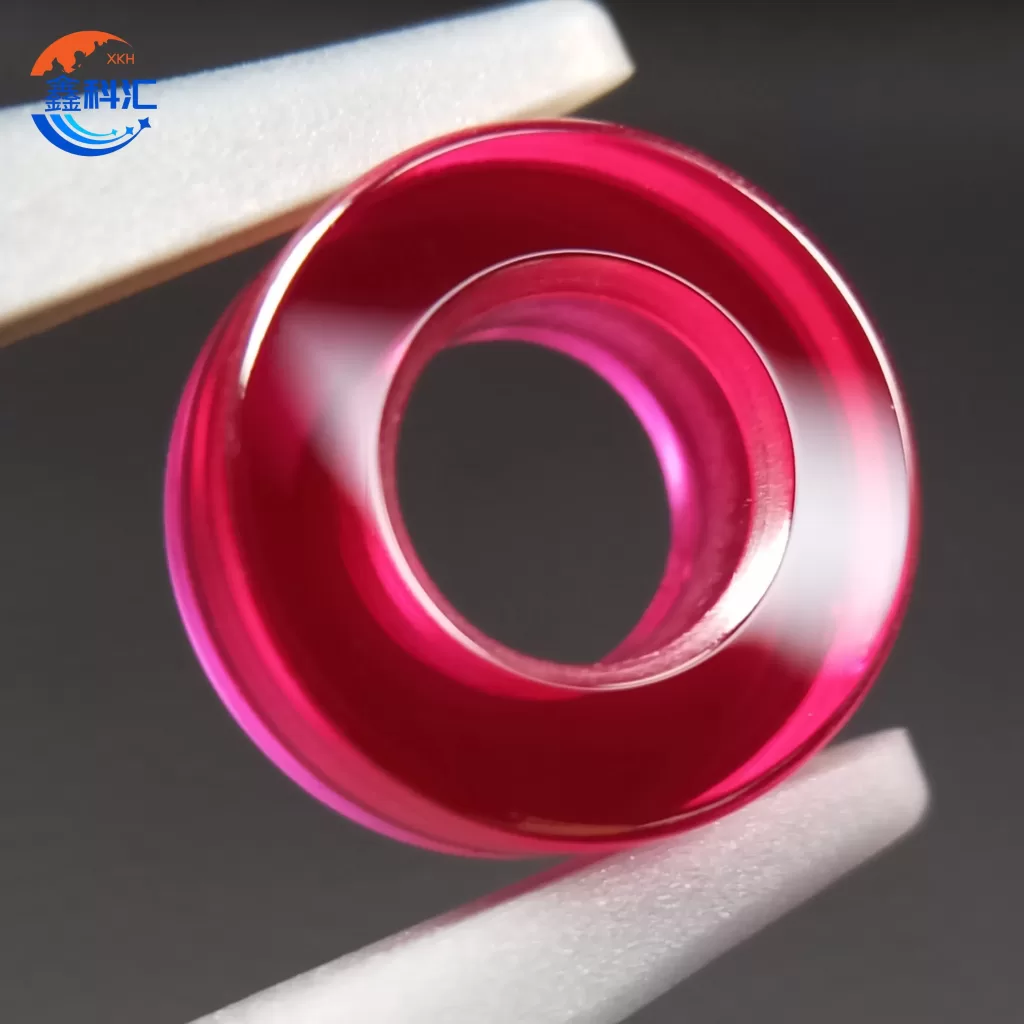
What Are Sapphire Bearings?
Sapphire bearings are precision bearing components manufactured from synthetic single-crystal sapphire. Sapphire is a crystalline form of aluminum oxide (Al₂O₃) and belongs to the corundum family of materials.
Synthetic sapphire used in industrial applications is commonly grown using methods such as:
- Kyropoulos growth
- Czochralski process
- Edge-defined film-fed growth (EFG)
- Heat exchange method (HEM)
Unlike metallic bearing materials, sapphire exhibits exceptional structural uniformity and can be polished to extremely smooth surfaces.
Common sapphire bearing types include:
- Jewel bearings
- Pivot bearings
- Thrust bearings
- V-groove bearings
- Ring bearings
- Custom precision bearing structures
Key Material Properties of Sapphire
The outstanding performance of sapphire bearings originates from the intrinsic properties of single-crystal sapphire.
| Tài sản | Ngọc bích |
|---|---|
| Chemical Formula | Al₂O₃ |
| Độ cứng Mohs | 9 |
| Mật độ | 3,98 g/cm³ |
| Điểm nóng chảy | ~2040°C |
| Young’s Modulus | ~345 GPa |
| Hệ số giãn nở nhiệt | 5.3 ×10⁻⁶/K |
| Độ trong suốt quang học | UV–IR range |
| Cách điện | Tuyệt vời |
Sapphire is second only to diamond in hardness among naturally occurring engineering materials, providing extraordinary resistance to wear and surface damage.
Why Precision Devices Require Sapphire Bearings
Precision devices operate under very different conditions from conventional mechanical systems. In many cases, loads are small, tolerances are extremely tight, and long-term dimensional consistency becomes more important than load-carrying capacity.
Several factors explain why sapphire bearings are preferred.
Extremely Low Wear
Mechanical wear gradually changes bearing geometry. In high-precision systems, even slight dimensional variations can introduce positioning errors.
Due to its exceptional hardness, sapphire exhibits minimal wear over long operating periods.
This enables:
- Stable rotational accuracy
- Longer calibration intervals
- Reduced maintenance requirements
- Extended service life
Superior Surface Finish
Sapphire can be polished to sub-micron surface roughness.
Ultra-smooth surfaces reduce:
- Friction
- Surface adhesion
- Particle generation
- Mechanical vibration
In precision instruments, minimizing microscopic friction fluctuations can significantly improve system repeatability.
Excellent Dimensional Stability
Many precision devices operate under changing temperatures.
Materials with large thermal expansion may distort or alter alignment positions.
Sapphire maintains high dimensional stability because of its relatively low thermal expansion coefficient.
Applications involving:
- optical alignment
- sensors
- timing systems
- micro-positioning devices
benefit significantly from this property.
Outstanding Chemical Resistance
Precision instruments may encounter:
- humidity
- oils
- chemicals
- vacuum environments
- cleaning agents
Sapphire remains highly resistant to corrosion and chemical attack.
Unlike metals, it does not rust or oxidize under normal operating conditions.
Low Particle Generation
Particle contamination is a critical issue in:
- semiconductor equipment
- aerospace systems
- medical instruments
- optical assemblies
Wear debris from conventional bearings can interfere with sensitive systems.
Because sapphire experiences minimal wear, particle generation remains extremely low.
Typical Applications of Sapphire Bearings
Sapphire bearings are found across numerous industries requiring precision and reliability.
Watches and Timekeeping Systems
Traditional mechanical watches frequently use jewel bearings to minimize friction and improve long-term timing accuracy.
The use of synthetic sapphire jewels revolutionized watch durability and precision.
Optical Instruments
Precision optical systems require stable rotational mechanisms.
Ví dụ như:
- microscopes
- telescopes
- laser assemblies
- imaging systems
Sapphire bearings reduce positioning errors while maintaining smooth movement.
Medical Equipment
Medical instruments often operate under strict cleanliness and durability requirements.
Sapphire bearings can be found in:
- surgical devices
- analytical instruments
- flow meters
- precision pumps
Aerospace and Defense Systems
Aircraft and space technologies demand components capable of surviving vibration and extreme environmental conditions.
Sapphire bearings provide:
- high reliability
- low wear
- long service life
Thiết bị bán dẫn
Precision wafer handling and motion systems increasingly use advanced ceramic and sapphire components to reduce contamination risks.
Sapphire Bearings vs Conventional Bearing Materials
A comparison illustrates why sapphire becomes advantageous in precision environments.
| Tài sản | Ngọc bích | Stainless Steel | Ceramic (ZrO₂) |
|---|---|---|---|
| Độ cứng | Rất cao | Trung bình | Cao |
| Wear Resistance | Tuyệt vời | Trung bình | Very Good |
| Corrosion Resistance | Tuyệt vời | Tốt | Tuyệt vời |
| Surface Finish Capability | Tuyệt vời | Tốt | Tốt |
| Particle Generation | Rất thấp | Trung bình | Thấp |
| Dimensional Stability | Tuyệt vời | Trung bình | Tốt |
Although metallic bearings can support heavier loads, sapphire frequently outperforms them in ultra-precision applications.
Limitations of Sapphire Bearings
Despite their advantages, sapphire bearings are not suitable for every application.
Potential limitations include:
Brittleness
Like many hard crystalline materials, sapphire has limited fracture toughness compared with metals.
Impact loading should be minimized.
Chi phí
Synthetic sapphire manufacturing and precision machining involve complex processes.
Production costs are generally higher than standard metallic bearings.
Design Constraints
Certain heavy-load applications may require hybrid bearing structures rather than pure sapphire components.
Proper engineering design remains essential.
Future Trends in Precision Bearing Technology
As precision systems continue evolving toward miniaturization and tighter tolerances, advanced bearing materials are receiving increased attention.
Current research focuses on:
- hybrid sapphire-ceramic systems
- ultra-polished bearing surfaces
- micro-scale bearing structures
- low-friction coatings
- semiconductor-compatible designs
Sapphire is expected to remain a key material for next-generation precision devices.
Kết luận
Sapphire bearings have become indispensable components in precision engineering because they combine exceptional hardness, dimensional stability, low wear characteristics, and excellent surface quality.
Their use extends far beyond traditional watchmaking applications and now includes aerospace systems, semiconductor equipment, medical technologies, and advanced optical devices.
As industries demand greater precision and lower contamination levels, sapphire bearings will continue playing an increasingly important role in high-performance mechanical systems.
Why are sapphire bearings called jewel bearings?
The term “jewel bearing” originated from early watchmaking, where sapphire and ruby materials were used as precision bearing elements.
Are sapphire bearings better than steel bearings?
For ultra-precision and low-load applications, sapphire bearings often outperform steel due to lower wear and improved dimensional stability.
Can sapphire bearings operate at high temperatures?
Yes. Sapphire has excellent thermal stability and can withstand temperatures significantly higher than many conventional bearing materials.