
Sapphire (Al₂O₃) optical windows are widely used in high-power laser systems, aerospace, and harsh industrial environments due to their excellent optical clarity, mechanical hardness, thermal conductivity, and chemical stability. However, while sapphire is inherently strong, determining the appropriate safety factor is essential. An overly conservative design can increase costs, lead times, and material waste, while an insufficient safety factor may risk failure in critical applications. This article explains how to define the safety factor for sapphire windows and optimize procurement without over-engineering.
What Is the Safety Factor?
The safety factor is essentially a margin of safety between the material’s strength and the maximum stress the window is expected to experience during operation. In other words, it measures how much stronger the sapphire is compared to the loads it will face. The higher the safety factor, the more robust the window, but also the higher the cost and thickness.
In practice, the safety factor accounts for several factors:
- Variability in material quality and purity
- Manufacturing imperfections such as surface scratches or micro-cracks
- Operational conditions that may exceed normal use
- Potential misuse or accidental impacts
A balance is needed: the window must be strong enough to ensure safety and longevity but not excessively oversized.
Sources of Stress in Sapphire Windows
Sapphire windows are exposed to multiple sources of stress during their operational life:
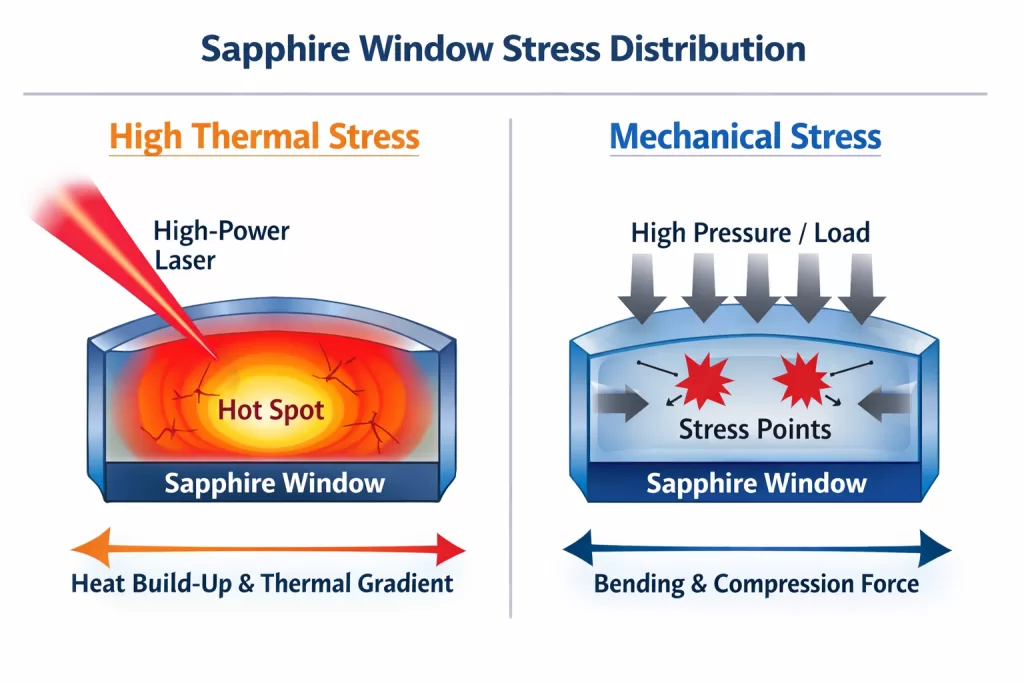
- Mechanical Stress
Even minor impacts, vibration, or pressure from mounting fixtures can create stress points. Sapphire is much harder than glass or quartz, but sharp edges or scratches can still serve as weak points where cracks might initiate. - Thermal Stress
High-power lasers generate intense localized heat on the window. Differences in temperature across the window cause expansion and contraction, producing internal stress. Sapphire’s thermal expansion is slightly different along its crystallographic axes, but its high thermal conductivity helps distribute heat more evenly and reduce peak stress. - Pressure and Vacuum Loads
Windows used in vacuum chambers or pressurized systems must resist bending or bowing caused by pressure differences. Thicker windows increase strength but may reduce optical performance or increase cost unnecessarily. - Chemical and Environmental Factors
While sapphire is chemically resistant, repeated exposure to cleaning agents, sterilization processes, or extreme humidity can produce minor surface defects. These defects, if combined with stress, could potentially propagate into cracks over time.
Determining the Safety Factor Without Formulas
Instead of relying on equations, the safety factor can be defined in practical, stepwise terms:
- Identify Maximum Operational Stress
Estimate the most severe conditions the window will encounter. Consider mechanical loads, thermal gradients, pressure differences, and environmental exposure. Use realistic operational scenarios rather than extreme theoretical cases. - Understand Material Strength
Use sapphire’s known fracture or flexural strength from high-quality, polished samples. Data from suppliers or industry literature can guide these values. Consider reducing the nominal strength slightly to account for defects or mounting constraints. - Calculate Margin of Safety
The safety factor is then conceptually the ratio of the material strength to the maximum expected stress. For example, if the window can withstand a stress three times higher than the anticipated operational stress, the safety factor is three. Typical values range from 2 to 5 for most industrial applications, while critical applications such as high-power lasers or aerospace optics may require higher margins.
Avoiding Over-Engineering
Excessively large safety factors lead to thicker, heavier, and more expensive windows. To optimize procurement:
- Use Accurate Stress Assessment: Employ thermal simulations or mechanical modeling to identify true stress hotspots instead of assuming extreme loads everywhere.
- Select High-Quality Sapphire: Defect-free, polished sapphire maximizes strength and allows lower safety factors without compromising reliability.
- Optimize Mounting Design: Support the window in a way that reduces edge stress and allows thermal expansion. Poor mounting can cause stress concentration and false failure risk.
- Leverage Reliability Data: Use statistical data on sapphire strength to design safety factors based on realistic probabilities of failure rather than arbitrary high margins.
Practical Procurement Recommendations
- Specify Safety Factor Transparently
Clearly define the target safety factor and assumptions in procurement documents. This avoids suppliers quoting unnecessarily thick or oversized windows. - Balance Thickness and Optical Performance
Thicker windows increase strength but may reduce transmission, add weight, or raise costs. A properly calculated safety factor ensures windows are strong yet efficient. - Follow Standard Specifications
Refer to industry standards for surface quality, allowable defects, and optical tolerances. Standards such as ASTM C158 and ISO 10110 provide reliable benchmarks.
Conclusion
Defining a sapphire window’s safety factor is a critical step in engineering and procurement. A scientifically determined safety factor ensures operational reliability without incurring unnecessary cost or complexity. By understanding the sources of stress, using high-quality sapphire, optimizing mounting design, and basing calculations on realistic operational conditions, engineers can achieve a balance between safety and efficiency. Properly specified sapphire windows provide long-term performance in demanding applications—from high-power laser surgery to aerospace optics—while avoiding the pitfalls of over-engineering.