
Sapphire (Al₂O₃) has emerged as one of the most critical materials in modern optical applications, due to its exceptional mechanical, thermal, and optical properties. Unlike conventional optical materials such as glass or fused silica, sapphire offers a combination of high hardness, broad spectral transparency, and chemical inertness, making it ideal for demanding environments, including high-power lasers, aerospace optics, medical devices, and precision instrumentation. Understanding the specifications, tolerances, and customization options of sapphire optical components is essential for engineers and scientists seeking reliable performance in both laboratory and industrial applications.
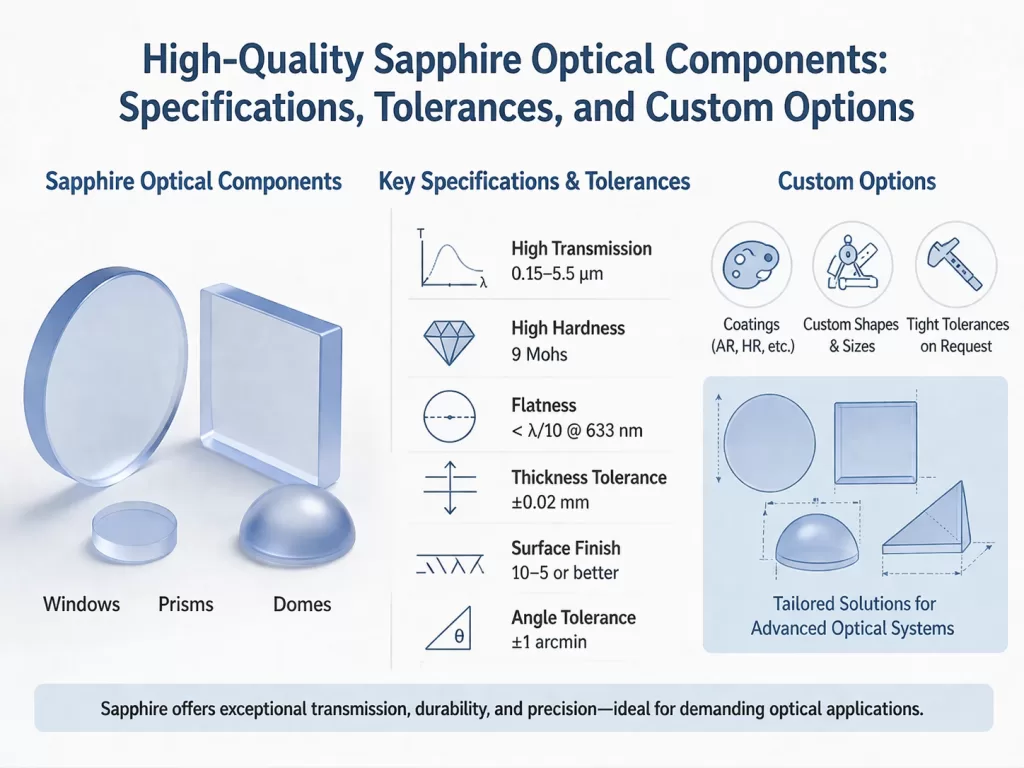
Material Properties of Sapphire
Sapphire is a crystalline form of aluminum oxide (α-Al₂O₃) with a hexagonal crystal structure. Its unique properties include:
- Hardness: Mohs hardness of 9, second only to diamond, providing excellent scratch resistance.
- Thermal Stability: High melting point (~2,030°C) and thermal conductivity (~25 W/m·K), enabling operation under extreme temperatures.
- Chemical Resistance: Stable against acids, alkalis, and many aggressive chemicals, ensuring longevity in harsh environments.
- Optical Transparency: Broad transmission range from ultraviolet (UV, ~150 nm) to mid-infrared (IR, ~5 μm), suitable for diverse optical systems.
- Mechanical Strength: High fracture toughness and tensile strength, enabling thin optical windows and domes to maintain integrity under stress.
These properties make sapphire ideal for applications where conventional optical materials fail, such as high-pressure viewing ports, laser delivery windows, or protective covers for sensitive sensors.
Standard Specifications
High-quality sapphire optical components are manufactured to meet stringent standards. Common specifications include:
- Dimensions:
- Standard diameters: 1 mm to 150 mm for windows; lengths for rods and tubes vary.
- Thickness: typically 0.5 mm to 20 mm, depending on application.
- Custom sizes are possible for unique designs.
- Surface Quality:
- Scratch-dig (MIL-PRF-13830B) ratings often range from 10-5 to 60-40, depending on the required optical performance.
- High-end optical applications demand 10-5 scratch-dig for minimal light scattering.
- Flatness and Parallelism:
- Flatness is usually specified in fractions of a wavelength (λ, typically 632.8 nm).
- Typical flatness: λ/4 to λ/20, with tighter tolerances achievable for interferometry applications.
- Parallelism of windows ensures consistent optical path lengths; standard tolerance is 30 arc seconds to 3 arc minutes.
- Surface Roughness:
- Average roughness (Ra) is a key factor in anti-reflective coating adhesion and optical performance.
- Typical Ra: 3–10 Å for high-precision components.
- Birefringence:
- Due to sapphire’s anisotropic crystal structure, birefringence can affect polarization-sensitive applications.
- Quality components are often cut along the c-axis to minimize birefringence effects.
- Transmission and Absorption:
- UV to IR transmission varies with thickness; standard windows achieve 80–90% transmission in the visible range.
- Absorption in the UV or IR may be specified for laser applications to prevent thermal damage.
Manufacturing Methods
Sapphire optical components are typically produced via synthetic crystal growth methods:
- Kyropoulos (KY) Method:
- Produces large-diameter, high-quality boules with low internal stress.
- Ideal for optical windows requiring minimal birefringence and defects.
- Edge-Defined Film-Fed Growth (EFG):
- Produces rods, tubes, and plates with controlled dimensions.
- Suitable for applications needing specific geometries rather than large discs.
Post-growth, the sapphire is precision-cut, lapped, and polished to achieve optical-grade surfaces. Advanced polishing techniques, including chemical-mechanical polishing (CMP), are used to achieve low surface roughness and high flatness.
Customization Options
Sapphire’s versatility allows for extensive customization:
- Geometry:
- Shapes: windows, domes, lenses, rods, tubes.
- Curvature: convex, concave, or complex optical surfaces.
- Edge chamfering and beveling for handling and integration.
- Coatings:
- Anti-reflective (AR) coatings for visible, UV, or IR applications.
- High-reflective (HR) coatings for mirrors and laser components.
- Protective coatings to reduce abrasion or chemical interaction.
- Thickness and Tolerances:
- Customized thickness for high-pressure or high-power laser environments.
- Tight tolerances for interferometry, laser alignment, or precision metrology.
- Optical Axis Orientation:
- Components can be cut along the c-axis, a-axis, or m-plane, depending on polarization or birefringence requirements.
- Special Processing:
- Drilling or micro-machining for sensor integration.
- Edge polishing and beveling to prevent stress concentrations.
- Integration with mounting assemblies or frames.
Quality Assurance and Testing
High-quality sapphire components undergo rigorous testing:
- Interferometry: Measures flatness and surface figure.
- Spectrophotometry: Confirms transmission and absorption characteristics.
- Microscopy: Detects inclusions, scratches, or defects.
- Mechanical Testing: Evaluates fracture toughness and hardness.
- Environmental Testing: Ensures stability under temperature cycles, chemical exposure, and mechanical stress.
ISO 10110 standards are commonly used to define optical tolerances and surface quality, ensuring compatibility across industries.
Applications
Sapphire optical components are critical in a wide range of fields:
- Aerospace and Defense: Windows for sensors, laser targeting systems, and high-pressure environments.
- Medical Devices: Surgical instruments, endoscopes, and protective covers for imaging systems.
- Industrial Lasers: High-power laser windows, beam delivery systems, and optics for cutting or welding.
- Semiconductor Manufacturing: Transparent plates, domes, and lenses resistant to chemical etchants and high temperatures.
- Scientific Research: Optical elements in spectroscopy, interferometry, and high-precision metrology.
Conclusion
High-quality sapphire optical components combine exceptional mechanical, thermal, and optical properties, making them indispensable in modern technology. By understanding the material properties, manufacturing methods, specifications, tolerances, and available customization options, engineers can select or design sapphire components that meet precise performance requirements. Advances in crystal growth, precision polishing, and coating technologies continue to expand the potential applications for sapphire optics, reinforcing its position as a premier optical material for the most demanding scientific, industrial, and military applications.