
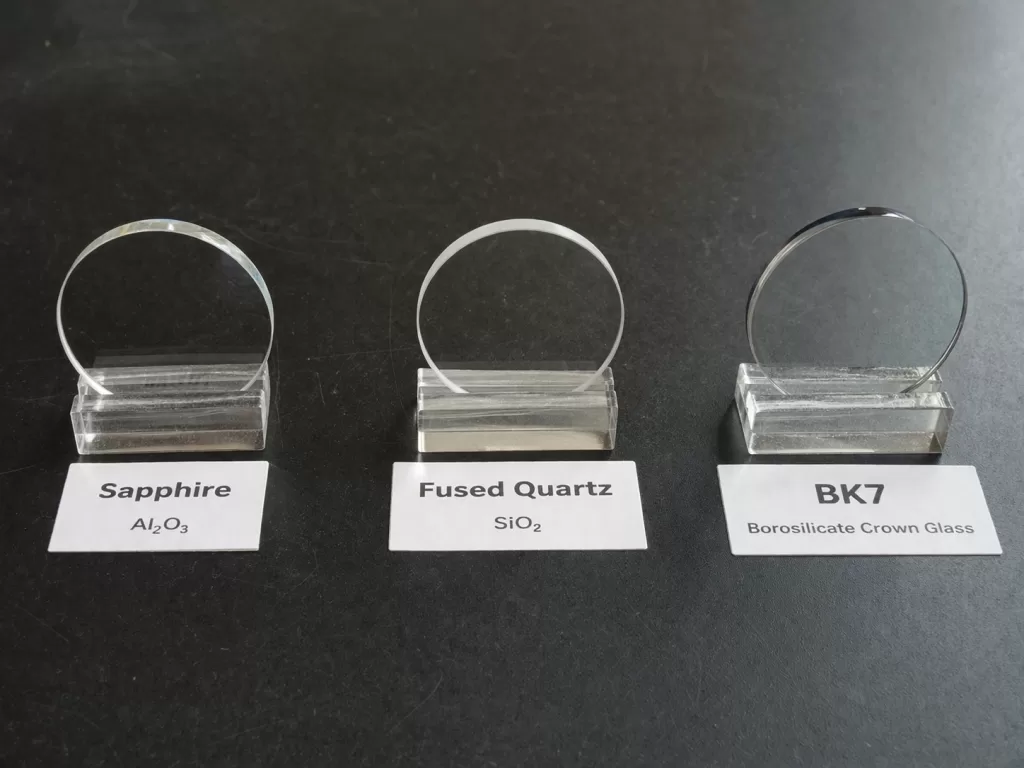
Optical windows are essential components in a wide range of photonic and industrial systems, serving as protective barriers while maintaining high optical transmission. The selection of an appropriate optical window material is critical to system performance, particularly in demanding environments involving high temperature, pressure, or radiation. Among the most commonly used materials are sapphire (single-crystal Al₂O₃), fused quartz (SiO₂), and BK7 optical glass. Each material exhibits distinct physical, thermal, and optical properties that make it suitable for specific applications. This article provides a comprehensive comparison of sapphire, quartz, and BK7, focusing on their material characteristics, manufacturing considerations, and application suitability.
1. Introduction
Optical windows are transparent elements designed to allow the transmission of light without significantly altering its properties. They are widely used in laser systems, imaging devices, semiconductor equipment, aerospace instrumentation, and scientific research.
The performance of an optical window depends largely on the material used. Ideal materials should exhibit:
- High optical transmission across the desired wavelength range
- Mechanical durability
- Thermal stability
- Chemical resistance
- Low optical distortion
Sapphire, quartz, and BK7 represent three major categories of optical materials: crystalline, amorphous, and optical glass, respectively. Understanding their differences is crucial for engineers and designers when selecting materials for specific operational conditions.
2. Material Overview
2.1 Sapphire (Al₂O₃)
Sapphire is a single-crystal form of aluminum oxide known for its exceptional hardness and durability. It is second only to diamond on the Mohs hardness scale (Mohs 9) and exhibits excellent resistance to mechanical wear and chemical corrosion.
Its wide optical transmission range extends from ultraviolet (~150 nm) to mid-infrared (~5.5 μm), making it suitable for multi-spectral applications.
2.2 Fused Quartz (SiO₂)
Fused quartz, also known as fused silica, is a high-purity amorphous form of silicon dioxide. It is widely used in optical systems due to its excellent transparency in the ultraviolet and visible regions.
Quartz offers low thermal expansion, high thermal shock resistance, and good chemical stability. However, its mechanical strength and hardness are significantly lower than sapphire.
2.3 BK7 Optical Glass
BK7 is a borosilicate crown glass widely used in standard optical components such as lenses and windows. It offers good optical clarity, uniformity, and cost-effectiveness.
BK7 is typically used in visible and near-infrared applications but has limited performance in extreme environments due to its relatively low hardness and thermal resistance.
3. Optical Properties Comparison
The optical transmission characteristics of a material determine its suitability for specific wavelength ranges.
| Property | Sapphire | Quartz | BK7 |
|---|---|---|---|
| UV Transmission | Excellent | Excellent | Moderate |
| Visible Transmission | Excellent | Excellent | Excellent |
| Infrared Transmission | Excellent (up to ~5.5 μm) | Limited (~3.5 μm) | Poor |
| Refractive Index (Visible) | ~1.76 | ~1.46 | ~1.52 |
Sapphire stands out for its broad transmission range, particularly in the infrared region. Quartz performs well in UV and visible wavelengths, while BK7 is optimized for visible optics.
4. Mechanical Properties
Mechanical strength is critical in environments involving high pressure, abrasion, or particle impact.
| Property | Sapphire | Quartz | BK7 |
|---|---|---|---|
| Hardness (Mohs) | 9 | ~7 | ~6 |
| Compressive Strength | Very High | Moderate | Low |
| Scratch Resistance | Excellent | Moderate | Low |
Sapphire’s superior hardness and strength make it ideal for harsh environments such as aerospace and defense systems. Quartz provides moderate durability, while BK7 is more suitable for controlled environments.
5. Thermal Properties
Thermal stability is essential in high-temperature or rapidly changing thermal environments.
| Property | Sapphire | Quartz | BK7 |
|---|---|---|---|
| Maximum Operating Temperature | Very High (>1500°C) | High (~1100°C) | Moderate (~500°C) |
| Thermal Expansion | Low | Very Low | Moderate |
| Thermal Shock Resistance | Good | Excellent | Moderate |
Quartz exhibits excellent thermal shock resistance due to its extremely low thermal expansion coefficient. Sapphire, while slightly less resistant to thermal shock, can withstand significantly higher temperatures.
6. Chemical and Environmental Resistance
In chemically aggressive environments, material stability is crucial.
- Sapphire: Highly resistant to acids, alkalis, and erosion
- Quartz: Good resistance but can be affected by hydrofluoric acid
- BK7: Limited chemical resistance, more prone to corrosion
Sapphire is the preferred choice for chemically harsh environments.
7. Manufacturing Considerations
7.1 Sapphire
Manufacturing sapphire optical windows involves crystal growth (e.g., KY method), followed by precision machining, grinding, and polishing. The process is complex and costly due to the material’s hardness.
7.2 Quartz
Quartz is easier to process compared to sapphire. It can be shaped and polished with conventional techniques, making it more cost-effective for many applications.
7.3 BK7
BK7 is the easiest and most economical material to manufacture. It can be mass-produced with high consistency, making it ideal for standard optical components.
8. Application Scenarios
8.1 Sapphire Applications
- Aerospace and defense optical domes
- Infrared sensors and detectors
- High-pressure and high-temperature windows
- Laser systems in harsh environments
8.2 Quartz Applications
- UV optical systems
- Semiconductor processing equipment
- Laboratory and scientific instruments
- Laser optics (low to moderate power)
8.3 BK7 Applications
- Standard lenses and windows
- Imaging systems
- Consumer optical devices
- Low-cost optical assemblies
9. Cost vs Performance Trade-off
Material selection often involves balancing performance and cost:
- Sapphire: Highest performance, highest cost
- Quartz: Moderate performance, moderate cost
- BK7: Lower performance, lowest cost
For high-end applications where reliability and durability are critical, sapphire justifies its higher cost. Quartz offers a balanced solution, while BK7 is suitable for cost-sensitive applications.
10. Conclusion
The selection of optical window materials depends on the specific requirements of the application. Sapphire, quartz, and BK7 each offer unique advantages:
- Sapphire excels in extreme environments requiring high strength and broad spectral transmission
- Quartz provides excellent UV performance and thermal stability
- BK7 offers a cost-effective solution for standard optical applications
Understanding these differences enables engineers and designers to make informed decisions, optimizing both performance and cost in optical system design.