
1. What Is Silicon Carbide (SiC)?
Silicon carbide (SiC), also known as carborundum, is a high-performance non-metallic material composed of silicon (Si) and carbon (C). It is widely used in:
- Semiconductor devices (wide-bandgap materials)
- High-temperature industrial furnaces
- Abrasives and cutting tools
- Aerospace and energy systems
SiC is considered a next-generation advanced material due to its exceptional thermal, mechanical, and electrical properties.
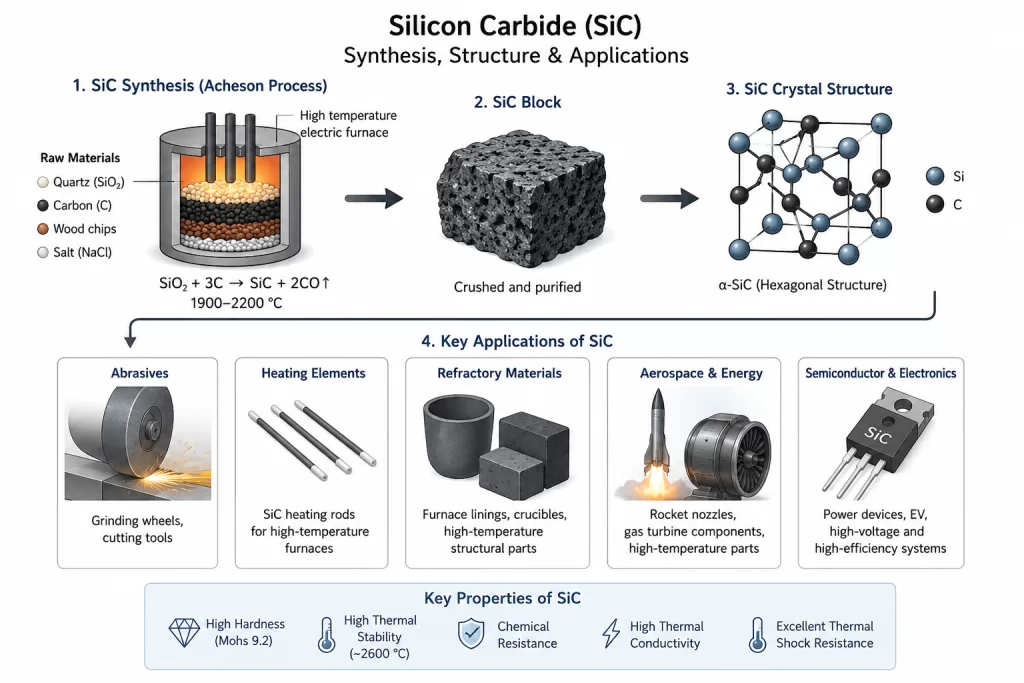
2. Industrial Synthesis of Silicon Carbide
2.1 Acheson Process (Carbothermal Reduction Method)
The most widely used industrial method for SiC production is the high-temperature carbothermal reduction process:
SiO₂ + 3C → SiC + 2CO↑
Raw Materials:
- Quartz (SiO₂): 52–54%
- Petroleum coke / carbon: ~35%
- Wood chips: ~11%
- Industrial salt (NaCl): 1.5–4%
Function of Each Material:
- Quartz: silicon source
- Carbon: reducing agent
- Wood chips: create porosity for gas release
- Salt: impurity removal (Fe, Al oxides)
Process Conditions:
- Reaction temperature: 1400°C to 2200°C
- Final sintering zone: 1900–2200°C
- Byproduct: large volume of CO gas
Product Form:
- Polycrystalline SiC block (requires crushing and grading)
2.2 Chemical Vapor Deposition (CVD) for High-Purity SiC
For high-purity applications (especially semiconductor-grade SiC), chemical vapor deposition is used:
6SiCl₄ + C₆H₆ + 12H₂ → 6SiC + 24HCl
Advantages:
- Ultra-high purity SiC crystals
- Controlled deposition structure
- Suitable for semiconductor and electronic applications
3. Crystal Structure and Physical Properties of SiC
Silicon carbide exists in multiple polymorphic crystal structures:
- β-SiC (cubic structure, low-temperature phase)
- α-SiC (hexagonal structure, high-temperature phase)
- Over 100 polytypes (polytypism phenomenon)
Key Physical Properties:
- Density: 3.21 g/cm³
- Sublimation point: ~2600°C
- Mohs hardness: 9.2
- Thermal conductivity: very high
- Chemical stability: excellent in acidic environments
4. Chemical Stability and High-Temperature Behavior
4.1 Oxidation Reaction
SiC reacts with oxygen under high temperature:
SiC + 2O₂ → SiO₂ + CO₂
Oxidation Behavior by Temperature Range:
- 800–1140°C: porous oxide layer, weak protection
- 1300–1500°C: dense SiO₂ protective layer improves resistance
- 1500°C: oxide layer may break down, accelerated degradation
4.2 Thermal Stability
- Stable up to 2600°C in inert or reducing atmospheres
- Excellent thermal shock resistance
- High resistance to creep deformation
5. Key Applications of Silicon Carbide
5.1 Abrasives and Grinding Materials
SiC is widely used in:
- Grinding wheels
- Cutting tools
- Precision polishing materials
Advantages:
- Extremely high hardness
- High wear resistance
- Stable cutting performance
5.2 Heating Elements (SiC Heating Rods)
Applications include:
- Industrial furnaces
- High-temperature resistance heating systems
- Kiln heating components
Benefits:
- High temperature resistance
- Long service life
- Stable electrical performance
5.3 Refractory and High-Temperature Structural Materials
SiC is widely used in metallurgy and chemical industries:
- Furnace linings
- Crucibles
- High-temperature pipelines
- Molten metal transport systems
5.4 Aerospace and Energy Systems
Applications include:
- Rocket nozzles
- Gas turbine components
- High-temperature structural parts
5.5 Semiconductor and Electronic Applications (Wide Bandgap Material)
Silicon carbide is a key third-generation semiconductor material used in:
- Power electronic devices
- High-voltage switching systems
- Electric vehicles (EV power modules)
- High-temperature electronics
Key Advantages in Semiconductors:
- Wide bandgap (~3.2 eV)
- High breakdown voltage
- High thermal conductivity
- Low energy loss
6. Manufacturing Processes of Silicon Carbide Components
6.1 Powder Preparation
Typical raw materials include:
- α-SiC (coarse structural particles)
- β-SiC (fine particles for densification)
Powder engineering is critical for final densification.
6.2 Forming Methods
Common shaping techniques:
- Dry pressing (50–70 MPa)
- Isostatic pressing
- Extrusion molding
Binders used include:
- Organic binders (PVA, CMC)
- Sol-gel binders (SiO₂, Al₂O₃ sols)
6.3 Sintering Technologies
(1) Reaction-Bonded SiC (RB-SiC)
Process:
- Si infiltrates carbon-containing preform
- Forms β-SiC bonding phase
Advantages:
- Low cost
- Good dimensional stability
- Industrial scalability
(2) Hot Pressed SiC (HP-SiC)
Process conditions:
- Temperature: 1300–1500°C
- Pressure: 70–90 MPa
Advantages:
- Near-theoretical density
- High mechanical strength (380–500 MPa)
- Excellent thermal shock resistance
Limitations:
- Complex geometry restrictions
- Low production efficiency
6.4 Bonding and Additive Systems
To improve performance, different binders are used:
- Oxide-bonded SiC (cost-effective)
- Silicon nitride-bonded SiC (high oxidation resistance)
- Silicon oxynitride-bonded SiC (balanced performance)
- Self-bonded SiC (high purity and strength)
7. Advantages and Limitations of Silicon Carbide
Advantages:
- Extremely high hardness
- Excellent thermal conductivity
- Outstanding high-temperature stability
- Strong chemical resistance
- High thermal shock resistance
Limitations:
- Difficult sintering behavior
- Limited densification without additives
- Oxidation sensitivity at extreme conditions
- High manufacturing cost for advanced grades
8. Development Trends (2026 Outlook)
The silicon carbide industry is rapidly evolving toward:
8.1 Semiconductor-Grade SiC Materials
- High-purity electronic-grade wafers
- Defect-controlled crystal growth
- Epitaxial layer optimization
8.2 Large-Diameter SiC Wafers
- Expansion to 6-inch and 8-inch wafers
- Higher production efficiency
8.3 Power Electronics Expansion
- EV power modules
- Renewable energy systems
- High-efficiency inverters
8.4 Advanced Ceramic Engineering
- Structural-functional integration
- High-temperature composite systems
- Precision ceramic components
Conclusion
Silicon carbide (SiC) is a critical advanced material combining structural ceramic strength with semiconductor functionality. Its synthesis methods, microstructural control, and manufacturing processes directly determine performance in industrial and electronic applications.
With the rapid expansion of power electronics, electric vehicles, and advanced manufacturing in 2026, silicon carbide is expected to remain a cornerstone material in next-generation high-performance industries.