
When people imagine cutting-edge technology, they think of sleek phones, autonomous vehicles, robots, or AI data centers. Yet almost no one thinks about the thin, mirror-like discs quietly enabling all of these innovations — semiconductor wafers. They rarely appear in consumer videos, they never trend on social media, and most people will never see one in person. But without them, the digital world would stop instantly.
Below is an unconventional, deeper look at what semiconductor wafers are used for — and why they are far more important than most people realize.
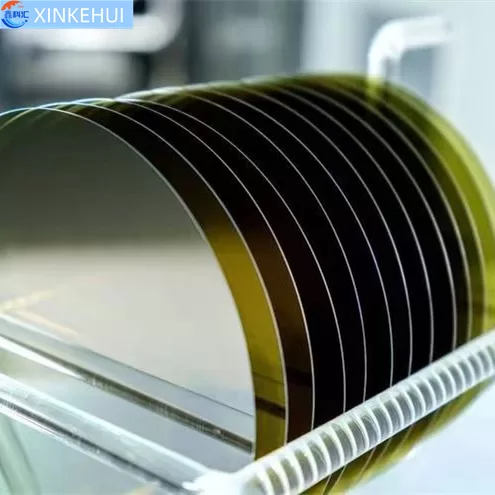
1. A Wafer Is Not Just a Disc — It’s a Micro Factory
A semiconductor wafer is a highly pure slice of silicon, SiC, GaN, GaAs, sapphire, or other advanced crystal materials. On this disc, engineers create microscopic structures to form:
- transistors
- memory cells
- diodes
- optical emitters
- MEMS sensors
- power devices
Each wafer is essentially a factory, producing thousands or even billions of tiny devices in parallel.
2. What Are Semiconductor Wafers Used For?
More Places Than You Think**
Smartphones and Consumer Electronics
Every processor, camera sensor, memory chip, and power IC begins on a wafer. The performance of your phone depends heavily on the wafer it came from.
Artificial Intelligence and Cloud Computing
AI accelerators, GPUs, and CPUs all originate from advanced silicon wafers at 5nm, 3nm, and beyond. A single AI data center may consume thousands of wafers per month.
Electric Vehicles and Charging Systems
This is where SiC and GaN wafers become essential. They are used to create high-efficiency power electronics found in:
- traction inverters
- on-board chargers
- DC fast chargers
- battery management systems
Without semiconductor wafers, EVs would be slow, heavy, and inefficient.
Renewable Energy and the Power Grid
Solar inverters, energy storage systems, and wind turbine controllers use wafer-based power devices to convert and manage energy efficiently.
Aerospace, Defense, and Space Technology
GaAs, InP, and sapphire wafers are used to manufacture radar modules, infrared sensors, and satellite communication devices.
Medical and Healthcare Devices
CT detectors, wearable health sensors, implantable electronics — all fundamentally depend on wafer-based components.
Photonics and Optoelectronics
Wafers also support technologies such as:
- laser diodes
- optical communication chips
- photodetectors
- micro-LED display pixels
As 6G, AR/VR, and high-speed optical networks grow, wafer demand will surge even further.
3. Why Are Wafers Round?
There’s Science Behind the Shape**
Wafers are round not because it “looks nice”, but because:
- Crystal ingots naturally grow as cylinders.
- A circular shape eliminates fragile corners during high-speed rotation.
- Uniform symmetry ensures consistent lithography and heat distribution.
The circle is a result of physics, not design aesthetics.
4. A Single Wafer Can Hold Thousands of Chips
A 300 mm wafer might contain:
- hundreds of high-performance processors
- thousands of image sensors
- tens of thousands of power devices
Each millimeter of wafer surface can be more valuable than gold.
5. New Wafers → New Technologies
Innovation in semiconductor materials directly drives technological revolutions:
- SiC-wafers for EVs and renewable energy
- GaN-skivor for fast charging and RF systems
- GaAs/InP wafers for photonics
- Safirskivor for LEDs and optical devices
- AlN wafers for deep-UV and high-power systems
Every new wafer material opens a new frontier of possibilities.
Slutsats
Semiconductor Wafers Are the Starting Point of the Future**
They look simple: thin, polished discs.
But they are the foundation of smartphones, AI, EVs, satellites, renewable energy, and nearly every modern innovation.
If you use technology — even for a single minute today — you are relying on semiconductor wafers.
They are not just materials.
They are the hidden engine behind the entire digital age.