
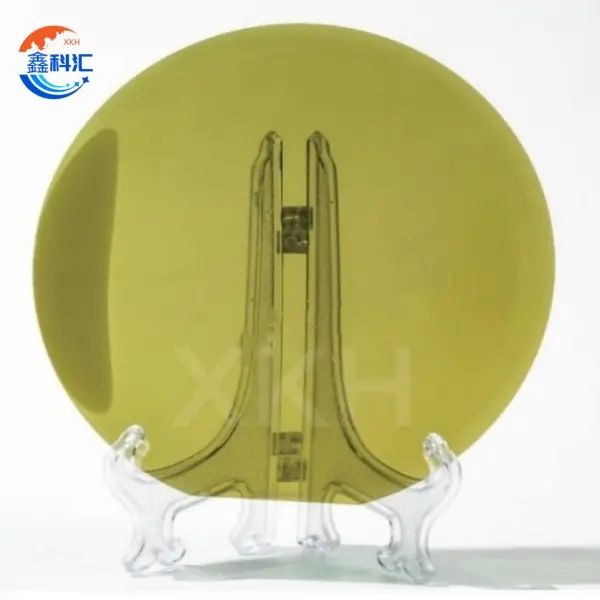
Silicon carbide (SiC) has emerged as a cornerstone material for high-power electronics, electric vehicles, and next-generation semiconductor devices due to its exceptional thermal conductivity, high breakdown voltage, and chemical stability. As the semiconductor industry pushes for larger wafer diameters to reduce production costs and increase throughput, the transition from conventional 150mm and 200mm SiC wafers to 300mm (12-inch) wafers presents a unique set of technical challenges. Understanding these hurdles is critical for manufacturers, engineers, and procurement managers aiming to adopt SiC at scale.
Understanding SiC Crystal Growth Methods
The two dominant methods for producing SiC wafers are Physical Vapor Transport (PVT) and Edge-defined Film-fed Growth (EFG). Each has distinct characteristics, advantages, and limitations.
Physical Vapor Transport (PVT) involves sublimating polycrystalline SiC at high temperatures (~2,400–2,500°C) and transporting the vapor to a cooler seed crystal to facilitate single-crystal growth. PVT is the preferred method for high-quality, low-defect SiC wafers, particularly for power electronics applications. However, as wafer diameter increases to 300mm, controlling thermal gradients and defect formation becomes increasingly complex.
Edge-defined Film-fed Growth (EFG), by contrast, is a method commonly used for lower-cost SiC substrates. It involves shaping molten SiC using a graphite die and pulling it into wafers. While EFG can achieve continuous production and potentially larger diameters, it typically introduces higher defect densities and less uniformity in crystal properties compared to PVT.
Key Challenges in Scaling to 300mm SiC Wafers
1. Thermal Gradient Management
Large-diameter wafers exacerbate thermal stresses. In PVT growth, the temperature difference between the source and seed must be carefully maintained to ensure uniform crystal formation. Any uneven gradient can lead to dislocations, micropipes, or other crystallographic defects. For 300mm wafers, even a small variation in temperature distribution can create stress points, increasing the risk of wafer warpage or cracking during cooling.
2. Defect Control
Defects in SiC wafers, including micropipes, stacking faults, and dislocations, can severely impact device performance, especially in high-voltage power applications. As wafer size increases, the likelihood of defect propagation grows due to longer crystal growth times and more complex thermal dynamics. Achieving a defect density below 1 cm^-2 on a 300mm wafer remains a formidable engineering challenge.
3. Mechanical Stability and Warpage
Larger wafers are mechanically more susceptible to bending, bowing, and warpage. Even slight deviations in thickness or residual stress can compromise wafer flatness, affecting downstream processing such as epitaxial layer deposition, lithography, and dicing. Controlling wafer bow within tight tolerances is critical for maintaining compatibility with standard semiconductor equipment.
4. Surface Uniformity and EPI Layer Quality
Epitaxial (EPI) layers are critical for device performance. Uniform deposition of EPI layers across a 300mm wafer is more difficult than on smaller wafers due to variations in temperature, gas flow, and reactor geometry. Non-uniformity can result in electrical inconsistencies, reduced yield, and increased device failure rates.
5. Cost and Equipment Limitations
Scaling to 300mm SiC wafers requires specialized PVT or EFG reactors capable of handling larger thermal loads. Equipment modification or redesign adds significant capital expenditure. Additionally, process time increases with diameter, which impacts throughput and cost-efficiency. Achieving economically viable production without compromising quality is a delicate balance.
Comparing EFG vs. PVT for 300mm Wafers
| Özellik | PVT | EFG |
|---|---|---|
| Crystal Quality | Yüksek | Orta düzeyde |
| Kusur Yoğunluğu | Düşük | Higher |
| Termal Yönetim | Critical | Less critical, but uniformity issues remain |
| Scalability | Challenging | Easier for continuous growth |
| Maliyet | Higher CAPEX & OPEX | Lower CAPEX, variable yield |
| Suitability | High-performance power devices | Cost-sensitive applications |
While PVT remains the method of choice for high-performance applications due to superior material properties, EFG may find niche use cases where cost is prioritized over ultra-low defect density. The trade-off between quality and scalability is central to 300mm wafer adoption.
Strategies to Overcome 300mm SiC Challenges
- Advanced Thermal Modeling: Utilizing simulation to predict and control thermal gradients during growth reduces defect propagation and wafer warpage.
- Seed Crystal Engineering: Optimizing seed orientation and surface preparation improves crystal stability and reduces micropipe formation.
- Reactor Design Innovations: Larger-diameter reactors with precise temperature control, optimized gas flow, and stress-minimizing crucibles enhance uniformity and yield.
- Process Automation and Monitoring: Real-time monitoring of temperature, pressure, and growth rate allows immediate adjustments, improving reproducibility.
- EPI Layer Optimization: Advanced chemical vapor deposition (CVD) techniques and uniform precursor distribution ensure consistent epitaxial growth across the entire 300mm wafer.
Sonuç
The transition to 300mm SiC wafers represents both an opportunity and a technical challenge for the semiconductor industry. While the benefits of larger wafers—higher throughput, reduced cost per device, and compatibility with advanced high-power and high-voltage applications—are clear, achieving high-quality, defect-free crystals at this scale demands significant expertise in PVT or EFG growth, thermal management, and reactor design.
Companies that successfully navigate these challenges will position themselves as leaders in the rapidly growing SiC market, supplying the next generation of high-performance power electronics, electric vehicle components, and advanced semiconductor devices. By understanding the hurdles and applying cutting-edge engineering strategies, 300mm SiC wafers can become a reliable foundation for the future of high-efficiency, high-power semiconductor applications.