
With the rapid expansion of artificial intelligence workloads, both data centers and advanced semiconductor devices are facing unprecedented challenges in power consumption and thermal management. Leading platforms from companies such as Intel and NVIDIA are pushing system power levels to new extremes. Server racks are moving from tens of kilowatts to over 100 kW, while advanced process nodes like Intel 18A are driving chip power toward kilowatt levels.
Under these conditions, traditional silicon (Si)-based technologies are reaching their physical and engineering limits. Silicon carbide (SiC), as a wide bandgap material, is emerging as a system-level solution that simultaneously addresses power efficiency, thermal performance, and high-voltage operation. It is no longer just a power device material, but a foundational technology for the AI infrastructure era.
SiC in AI Server Power Systems
Traditional silicon-based power devices, including MOSFETs and IGBTs, struggle to meet the requirements of high-power AI servers. Their efficiency typically caps around 94 percent, meaning that a 100 kW system may dissipate approximately 6 kW of heat. This creates significant cooling challenges and reduces overall system efficiency.
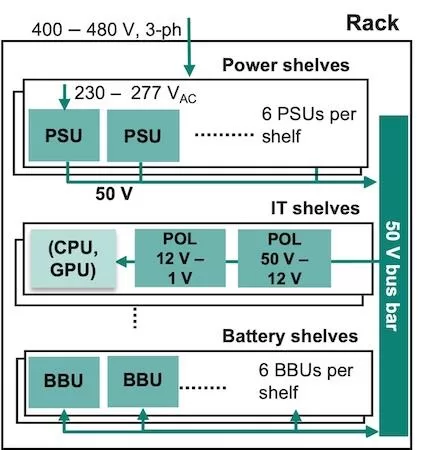
In addition, silicon-based systems have limited power density, generally below 40 W per cubic inch, which consumes valuable rack space that could otherwise be used for compute hardware. Their voltage handling capability is also insufficient for modern architectures that are shifting toward 400 V and 800 V DC distribution.
SiC devices fundamentally change this landscape. SiC MOSFETs enable power conversion efficiencies exceeding 98 to 99 percent at the system level, reducing losses in a 100 kW system to less than 2 kW. Their ability to operate at higher switching frequencies, often above 100 kHz, allows for smaller passive components such as inductors and transformers, significantly increasing power density beyond 100 W per cubic inch.
More importantly, SiC supports advanced power topologies such as totem-pole power factor correction (PFC) and three-level converters. These topologies are essential for achieving ultra-high efficiency and are difficult to implement effectively with silicon devices. SiC also enables compatibility with high-voltage DC architectures and solid-state transformers, which are expected to redefine data center power distribution by reducing conversion stages and improving overall efficiency.
SiC in Advanced Chip Packaging
As AI chips become more powerful, packaging technologies must handle significantly higher thermal loads and signal densities. Advanced packaging approaches such as 2.5D integration and CoWoS are widely used to integrate GPUs with high-bandwidth memory (HBM), but they introduce new material challenges.
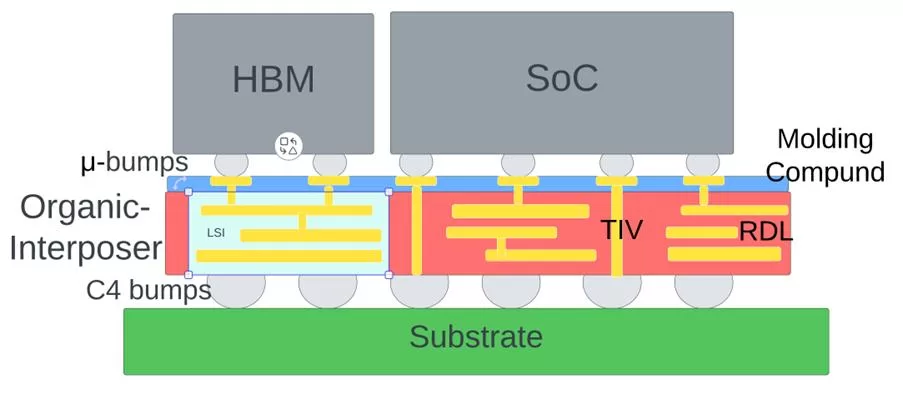
Traditional materials face clear limitations. Silicon has a thermal conductivity of around 150 W per meter-kelvin, which is insufficient for high heat flux scenarios. Organic substrates often suffer from warpage and poor electrical insulation at high frequencies. Glass materials, while offering some advantages, lack the mechanical strength required for large, high-density interposers.
Silicon carbide offers a superior alternative. Its thermal conductivity ranges from 400 to 500 W per meter-kelvin, about three times that of silicon. This significant reduction in thermal resistance lowers chip junction temperatures by 20 to 30 degrees Celsius, which directly enhances device reliability and reduces overall cooling costs in high-power systems.
Electrically, semi-insulating SiC exhibits extremely high resistivity, on the order of 10^8 ohm-centimeters. This property effectively suppresses parasitic capacitance and signal crosstalk, making it highly suitable for high-speed interconnect environments such as GPU and HBM integration.
From a mechanical perspective, SiC has a coefficient of thermal expansion close to that of silicon, approximately 4.3 parts per million per degree Celsius. This compatibility minimizes thermomechanical stress and warpage in large-area interposers, thereby improving manufacturing yield and long-term structural reliability.
Key applications of SiC in advanced packaging include its use as a thermal interface material (TIM2) between chips and heat sinks, as well as a promising candidate for replacing conventional silicon interposers in advanced 2.5D and 3D packaging architectures.
System-Level Synergy: Power and Packaging Integration
The true value of SiC lies in its ability to enable system-level co-optimization rather than isolated performance improvements.
On the power delivery side, SiC enables ultra-high conversion efficiency and supports high-voltage direct current architectures, significantly reducing energy losses and simplifying power infrastructure within data centers. On the packaging side, its superior thermal conductivity and electrical insulation properties allow chips to operate at higher power densities without encountering thermal throttling or signal integrity degradation.
This dual advantage creates a tightly coupled system in which power delivery efficiency and thermal management performance reinforce each other. As a result, AI systems can achieve higher compute density while maintaining stable operation and lower total cost of ownership.
Future Outlook
Looking forward, the role of SiC is expected to expand across multiple layers of the semiconductor and data center ecosystem.
First, data center power architectures are likely to accelerate toward 800 V high-voltage DC distribution, where SiC devices will play a central role due to their high breakdown voltage and efficiency advantages.
Second, advanced packaging technologies will increasingly depend on new material systems to overcome thermal and electrical bottlenecks. SiC is well positioned to become a key structural and functional material in next-generation interposers and thermal solutions.
Third, the integration of power electronics and semiconductor packaging will become more tightly coupled. Instead of being treated as separate domains, power delivery and chip-level thermal design will evolve into a unified engineering discipline, with SiC serving as a common enabling platform.
Driven by leading companies such as Intel and NVIDIA, the demand for high-performance, energy-efficient computing infrastructure will continue to grow, further accelerating the adoption of SiC across the industry.
Conclusion
Silicon carbide has emerged as a critical material for the AI era because it simultaneously addresses two fundamental challenges: efficient power delivery and effective thermal management.
In server power systems, SiC dramatically improves efficiency, power density, and voltage scalability. In advanced chip packaging, it resolves heat dissipation limitations and enhances mechanical and electrical reliability.
As AI workloads continue to scale, SiC is transitioning from a specialized material into a foundational technology that underpins the next generation of computing systems.