
For years, the silicon carbide industry has been closely associated with electric vehicles.
Ask where SiC power devices are used, and the first answers are usually familiar:
traction inverters, onboard chargers, DC fast chargers and high-voltage EV platforms.
That connection remains important.
Global electric car sales exceeded 20 million units in 2025, representing about one-quarter of all new cars sold. Sales are expected to continue increasing in 2026. However, growth is becoming much less uniform across regions. China, the world’s largest EV market, is expected to see electric car sales roughly stagnate in 2026 even as EV penetration continues to rise, while other markets follow very different trajectories.
For the silicon carbide supply chain, this matters.
An industry that spent years expanding around electric mobility increasingly needs additional high-volume applications.
One of the most promising is emerging from an unexpected direction:
artificial intelligence.
More precisely, not the AI processor itself—but the enormous electrical infrastructure required to power AI data centers.
As computing clusters become larger and rack power rises, AI infrastructure is creating a new engineering problem:
How can enormous quantities of electricity be converted and delivered efficiently?
That is where silicon carbide may find its next major customer.
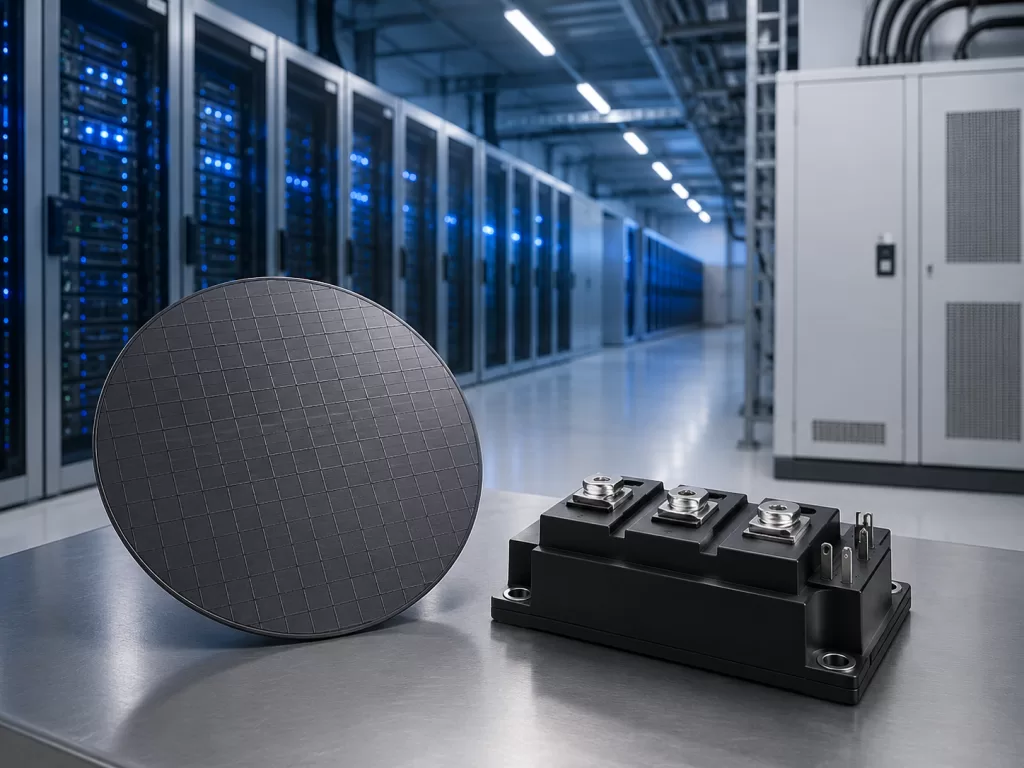
AI Is Becoming an Electricity Industry
Most conversations about artificial intelligence focus on GPUs, processors, high-bandwidth memory and networking.
But none of those components work without electricity.
And AI requires a lot of it.
Global data centers consumed around 415 TWh of electricity in 2024, approximately 1.5% of global electricity consumption. The International Energy Agency expects data-center electricity demand to more than double to around 945 TWh by 2030, with AI being the most important driver of that increase.
To put the scale into perspective, a typical AI-focused data center can consume as much electricity as around 100,000 households, while some of the largest facilities currently under development could consume many times that amount.
AI is therefore no longer only a semiconductor-computing story.
It is becoming a:
power generation + grid connection + energy storage + power conversion + cooling + computing
story.
That dramatically increases the importance of power semiconductors.
Why AI Data Centers Need Better Power Electronics
Electricity does not travel directly from a utility transmission line into an AI processor.
Before reaching the computing hardware, electrical energy may pass through several conversion stages.
A simplified path could look like:
Utility Grid → Medium-Voltage Distribution → Transformer → UPS / Energy Storage → AC/DC Conversion → High-Voltage DC Bus → Rack Power Conversion → Server → Processor
Every stage matters.
Every conversion stage also generates losses.
If a small server consumes only a few kilowatts, a fraction of a percent in power-conversion efficiency may not seem dramatic.
But once facilities move toward hundreds of megawatts—or eventually gigawatt-scale campuses—the economics change completely.
For example, at extremely high facility power levels, even a small percentage of additional electrical loss can translate into enormous amounts of waste heat.
That lost electricity must also be removed by the cooling system.
So reducing power-conversion losses can potentially create a double benefit:
less electricity wasted + less heat that needs to be removed.
This is one reason wide-bandgap semiconductors such as SiC are receiving increasing attention in data-center power architectures.
The Key Change: Data Centers Are Moving Toward Higher Voltage
One of the most important trends in AI power architecture is the move toward higher-voltage DC distribution.
Why increase voltage?
Because for the same amount of electrical power:
higher voltage means lower current.
And lower current can reduce resistive losses in cables, busbars, connectors and distribution equipment.
This becomes increasingly important as individual AI racks require more power.
Traditional low-voltage architectures become difficult to scale when rack-level power rises dramatically.
As a result, the industry is investigating architectures based around higher-voltage DC buses, including approximately 800 V DC systems.
That creates a particularly interesting opportunity for SiC.
Why 800V AI Data Centers Are Important for SiC
This number should sound familiar to anyone following electric vehicles.
The automotive industry has already been transitioning from approximately 400 V systems toward 800 V platforms.
Higher-voltage EV systems can enable:
- faster charging;
- lower current;
- reduced conductor losses;
- smaller cable requirements;
- and more efficient high-power operation.
AI data centers are now moving through a somewhat similar electrical transition—but at a dramatically larger power scale.
A 2026 high-voltage battery-backup reference design demonstrated direct conversion between a battery stack and an 800 V DC bus using 650 V and 1200 V SiC devices. The design reported efficiency above 99% and a power density of 450 W/in³, illustrating why SiC is being considered for increasingly dense AI power systems.
That does not mean every data-center power stage will use silicon carbide.
Silicon, SiC and GaN each have different advantages.
But as voltage and power increase, SiC becomes especially attractive.
Where Can SiC Be Used Inside an AI Data Center?
The easiest mistake is to imagine that SiC is going inside the AI processor.
That is generally not the primary opportunity.
The more important SiC market lies between the grid and the computing hardware.
There are several potential application areas.
1. AC/DC Power Conversion
Data centers require enormous amounts of electricity to be converted from AC grid power into DC power used by electronic systems.
High-power power-factor-correction stages and rectifiers must achieve extremely high efficiency.
SiC MOSFETs and SiC diodes can support high-voltage switching with relatively low losses.
At large power levels, this can make them attractive for front-end power conversion.
2. High-Voltage DC Distribution
Higher-voltage DC architectures can reduce current throughout the facility.
This becomes increasingly attractive as rack density rises.
SiC devices may be used in converters connecting different DC voltage levels.
This could include stages such as:
800 V DC → intermediate DC bus
or
battery system → 800 V DC bus
The higher the voltage, the more valuable high-performance power semiconductor characteristics become.
3. Battery Backup Units
AI servers cannot simply shut down every time the grid experiences a disturbance.
Data centers therefore require backup power.
Battery backup units are increasingly being integrated closer to rack-level power systems.
In high-voltage architectures, SiC can be used in bidirectional DC/DC converters that:
charge the battery during normal operation
and
discharge the battery during grid disturbances.
The 2026 24 kW SiC-based BBU reference architecture is an example of this transition toward high-voltage, high-density backup power.
4. UPS Systems
Uninterruptible power supplies are one of the traditional power-electronics systems used in data centers.
The UPS must maintain reliable power while minimizing conversion losses.
For a large data center, UPS efficiency matters because the system may continuously process enormous amounts of electrical energy.
SiC devices can potentially help increase switching frequency and efficiency while reducing system size.
5. Solid-State Transformers
This could become one of the more interesting long-term SiC applications.
Traditional transformers rely heavily on large magnetic components.
Solid-state transformers replace or supplement conventional approaches with semiconductor-based high-frequency power conversion.
In March 2026, a SiC-based solid-state-transformer program specifically targeting AI data-center power infrastructure highlighted the technology’s potential to improve efficiency, power density and controllability between the public grid and high-power computing facilities.
The concept is particularly interesting because a future system could perform several functions simultaneously:
voltage conversion + power-quality control + DC distribution + energy-storage integration
Instead of treating the transformer simply as passive electrical equipment, power semiconductors could make it an active part of the data-center energy-management system.
AI May Actually Be an Excellent Market for SiC
At first glance, electric vehicles seem like the perfect SiC application.
But AI data centers have several characteristics that may also suit SiC extremely well.
Extremely High Power
AI facilities process enormous amounts of electricity.
Higher system power makes small efficiency improvements more economically valuable.
Continuous Operation
Many data centers operate around the clock.
A semiconductor device with higher efficiency can therefore reduce losses for thousands of operating hours every year.
High Power Density
Land, racks and electrical rooms all have physical limitations.
Higher power density can reduce the size of some conversion equipment.
Cooling Is Expensive
Power semiconductor losses ultimately become heat.
Reducing conversion losses therefore potentially reduces cooling requirements.
Reliability Is Critical
Power interruption in an AI cluster can have significant operational consequences.
Power electronics must therefore combine efficiency with reliability.
These characteristics make AI data centers particularly suitable for premium power semiconductor technologies when system-level savings justify their higher component cost.
The Opportunity Is Larger Than the Data Center Itself
There is another reason AI may become important for the SiC industry.
AI data centers do not exist independently from the electrical grid.
As data-center electricity demand rises, additional infrastructure must be built around them.
The IEA estimates that data-center electricity consumption could reach approximately 945 TWh globally by 2030, while grid constraints may delay around 20% of planned projects if power infrastructure does not expand fast enough.
This means AI growth can create SiC opportunities beyond the building itself.
Potential applications include:
- grid-connected converters;
- energy-storage systems;
- renewable-energy inverters;
- microgrids;
- high-voltage DC distribution;
- solid-state transformers;
- power-quality equipment;
- backup power;
- and high-power cooling systems.
In other words, AI may drive demand for SiC indirectly throughout the entire electricity infrastructure surrounding data centers.
AI, Energy Storage and the Grid Are Beginning to Converge
A future AI data center may increasingly look like an energy system of its own.
Consider this simplified architecture:
Grid
↓
Renewable Energy
↓
Energy Storage
↓
Power Conversion
↓
High-Voltage DC Distribution
↓
AI Servers
A facility may have utility-grid connections, battery storage, backup generation, solar or other renewable power, and sophisticated energy-management systems.
The IEA expects renewables to meet roughly half of the global increase in data-center electricity demand through 2035, supported by energy storage and wider grid infrastructure.
This creates a very interesting situation for SiC.
The same material platform can potentially serve:
AI data centers + battery storage + renewable energy + grid infrastructure + EV charging
Rather than being tied to one industry, SiC becomes part of a much larger high-efficiency electricity-conversion ecosystem.
Does This Mean AI Will Replace EV Demand for SiC?
No.
“AI replacing EVs” would be an exaggeration.
Electric vehicles remain a major and growing global market. Global EV sales grew around 20% in 2025, and electric cars are expected to represent around 29% of global new-car sales in 2026.
The important change is diversification.
For years, the SiC industry’s growth expectations were heavily linked to EV production.
That concentration creates risk.
If automotive demand weakens in one region, SiC suppliers can experience pricing pressure and excess capacity.
AI infrastructure creates another potential demand curve.
So do energy storage, renewable energy and grid modernization.
The future SiC market could therefore become significantly less dependent on a single end-use industry.
What Does AI Demand Mean for SiC Wafer Suppliers?
For SiC substrate manufacturers, the rise of AI infrastructure does not necessarily create a completely new type of wafer.
Many high-power applications still rely on conductive 4H-SiC substrates followed by epitaxial growth.
However, data-center applications may influence the type of devices required.
Higher-voltage power systems can increase demand for devices using:
- thicker epitaxial layers;
- carefully controlled doping;
- lower defect density;
- high-voltage termination structures;
- and high-reliability qualification.
At the wafer level, buyers therefore need to pay close attention to several specifications.
Polytype
4H-SiC remains the primary crystal structure used for modern SiC power devices.
Conductivity Type
Conductive n-type substrates are commonly used for vertical power devices.
Resistivity
Resistivity must match the device and epitaxial design requirements.
Off-Axis Orientation
Off-axis orientation can influence subsequent epitaxial growth quality.
Crystal Defects
Specifications may include:
- micropipe density;
- basal plane dislocations;
- threading screw dislocations;
- threading edge dislocations.
Wafer Geometry
Important parameters include:
- thickness;
- TTV;
- bow;
- warp;
- diameter;
- edge geometry.
Surface Quality
Epi-ready wafers require carefully controlled surface preparation.
Scratches, particles, subsurface damage and polishing defects may influence epitaxy and downstream device yield.
200mm SiC Could Benefit From AI Demand
The transition from 150 mm to 200 mm SiC is fundamentally about manufacturing economics.
A 200 mm wafer provides approximately 1.78 times the geometric area of a 150 mm wafer.
If defect density and process yield can be controlled, larger wafers can allow significantly more devices to be processed during each manufacturing cycle.
AI infrastructure could help support this transition.
Why?
Because large-scale data-center demand may require huge numbers of high-voltage power devices.
Higher manufacturing volume creates stronger economic incentives for:
- 200 mm SiC substrates;
- automated wafer processing;
- higher-yield epitaxy;
- more efficient device fabrication;
- and eventually still larger wafer platforms.
Therefore, AI may not only create another application for SiC.
It could also contribute to the industry’s broader effort to lower cost per device.
AI Could Change What “SiC Demand” Means
The automotive industry tends to measure SiC demand through vehicles.
For example:
SiC content per EV × number of EVs sold
AI infrastructure requires a different way of thinking.
Demand may increasingly be measured through:
SiC content per megawatt of power infrastructure × installed data-center capacity
That changes the market logic.
One very large AI campus can require an enormous amount of electrical infrastructure.
This includes not only server power supplies but also:
- transformers;
- rectifiers;
- UPS systems;
- BBU systems;
- energy storage;
- motor drives;
- cooling equipment;
- grid interfaces;
- renewable-energy systems.
As AI campuses scale from tens of megawatts toward hundreds of megawatts and beyond, the semiconductor content associated with power delivery could become substantial.
The Next SiC Race May Be “Grid to GPU”
One phrase increasingly summarizes the challenge:
from grid to processor.
The AI industry has spent enormous resources optimizing computation.
Now power delivery is becoming another optimization target.
Electricity must move from the transmission system all the way to the processor with:
- minimal losses;
- high reliability;
- high power density;
- fast transient response;
- and manageable thermal load.
This creates a chain:
Grid → Transformer → Power Converter → Energy Storage → DC Bus → Rack → GPU
SiC will not dominate every link.
But it is particularly well positioned in the higher-voltage portions of that chain.
And as rack power increases, those portions become increasingly important.
Conclusion: SiC Is Becoming More Than an Automotive Semiconductor
The electric vehicle revolution helped bring silicon carbide into mass-market power electronics.
But AI may help take it somewhere larger.
Global EV sales continue to grow, but the market is becoming more mature and increasingly uneven across regions. Meanwhile, AI data centers are creating a new class of enormous, concentrated electrical loads.
These facilities need:
higher voltage, higher efficiency, greater power density and more sophisticated energy management.
Those requirements align closely with the strengths of SiC power devices.
The most important opportunity may therefore not be inside the AI processor itself.
It may be everything surrounding it:
the power conversion infrastructure that keeps AI running.
Battery backup systems, 800 V DC architectures, high-power AC/DC converters, solid-state transformers, renewable-energy integration and grid connections are all areas where SiC is beginning to appear. Recent 2026 demonstrations of 800 V SiC battery backup systems and SiC-based solid-state-transformer platforms show that this transition is already moving beyond theory.
For the silicon carbide industry, this could represent an important strategic shift.
Yesterday, the key question was:
How many EVs will use SiC?
Tomorrow, a second question may become just as important:
How many megawatts of AI infrastructure will be powered through SiC?
If AI electricity demand continues along its current trajectory, the answer could reshape the next phase of the SiC wafer, epitaxy and power-device markets.
FAQ
Why are AI data centers using silicon carbide?
SiC is attractive for high-voltage, high-power conversion because it can support efficient switching, high power density and lower conversion losses. Potential applications include AC/DC converters, UPS systems, battery backup units, high-voltage DC distribution and solid-state transformers.
Why is 800V DC important for AI data centers?
Higher-voltage DC distribution can deliver the same amount of power at lower current, reducing resistive losses and conductor requirements. A 2026 SiC-based battery backup reference design demonstrated direct operation with an 800 V DC data-center bus.
Will AI data centers replace EVs as the largest SiC market?
Not necessarily. EVs remain a major SiC application. AI should instead be viewed as an additional growth market that can diversify SiC demand beyond automotive applications.
What SiC wafers are commonly used for power devices?
Conductive 4H-SiC substrates are commonly used for vertical SiC power devices, followed by epitaxial growth. Wafer diameter, resistivity, orientation, thickness, defect density, TTV, bow, warp and surface quality should be specified according to the device process.
Could AI increase demand for 200mm SiC wafers?
Potentially yes. If AI infrastructure significantly increases demand for high-voltage SiC devices, higher device volumes could support the industry’s transition toward 200 mm manufacturing, provided wafer quality and downstream yield remain competitive.