
For much of the past decade, the silicon carbide industry has been discussed primarily through one application: electric vehicles.
That association makes sense. SiC MOSFETs and diodes have become important components in high-voltage traction inverters, onboard chargers, and fast-charging systems because silicon carbide can reduce power losses while supporting higher operating voltages and switching frequencies.
But the next stage of the SiC market may be much broader.
Three rapidly developing areas—AI data centers, battery energy storage systems, and modern power grids—are creating new demand for high-efficiency power conversion. In each case, electricity must be converted, controlled, transmitted, or stored with lower losses and higher power density.
That is exactly where silicon carbide has technical advantages.
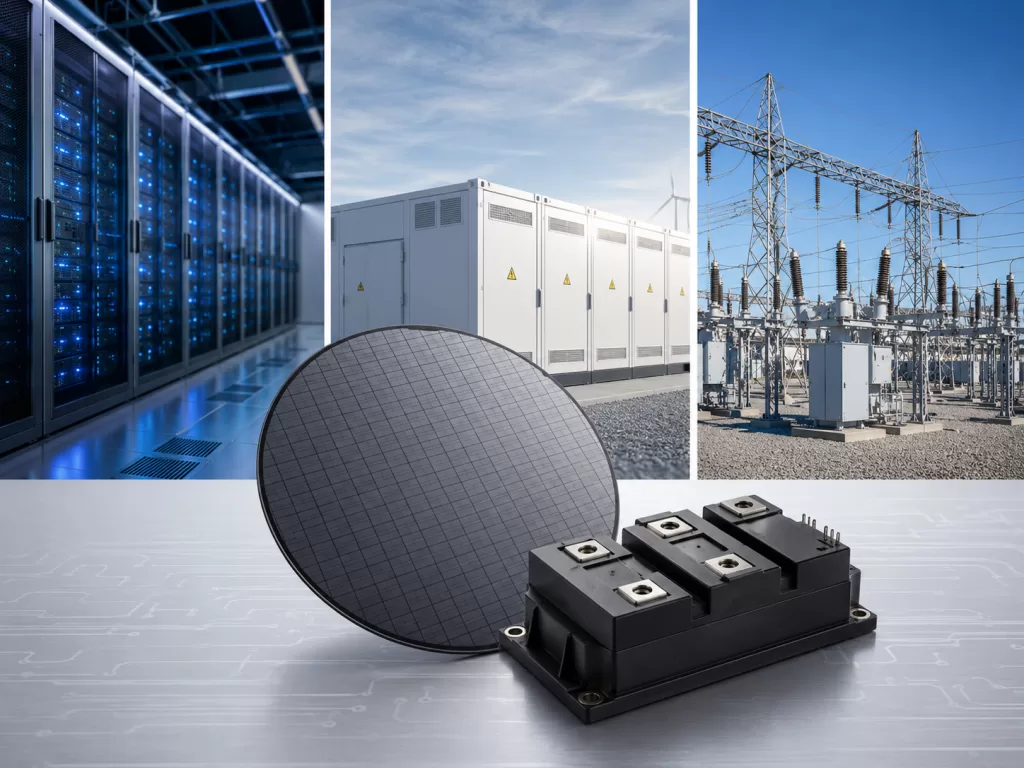
The change does not mean electric vehicles are becoming unimportant. Instead, it suggests that the SiC industry is moving from an EV-centered growth story toward a much wider electrification and energy-efficiency market.
Why Silicon Carbide Is Moving Beyond Automotive Applications
Traditional silicon power semiconductors remain highly competitive in many applications. They are mature, inexpensive, and supported by an enormous manufacturing ecosystem.
However, power systems are moving toward several conditions that make wide-bandgap semiconductors more attractive:
- higher DC bus voltages;
- higher switching frequencies;
- greater power density;
- smaller converter size;
- lower cooling requirements;
- higher system efficiency;
- and higher operating temperatures.
Silicon carbide has a wider bandgap and a much higher critical electric field than conventional silicon. These material properties allow SiC power devices to operate efficiently at higher voltages and switching frequencies while potentially reducing switching and conduction losses.
Government energy programs have therefore investigated SiC and other wide-bandgap semiconductors for solar inverters, energy storage, grid conversion, charging infrastructure, and other high-power applications.
The important question is no longer simply:
Can SiC replace silicon in an electric vehicle?
A more useful question is:
Where else is electricity becoming valuable enough that reducing conversion losses justifies the cost of SiC?
Three markets stand out.
1. AI Data Centers: Power Conversion Is Becoming Part of the AI Bottleneck
AI is usually discussed in terms of processors, memory, networking, and cooling.
But behind every accelerator cluster is another critical system:
power delivery.
Electricity may pass through multiple conversion stages before reaching computing hardware.
A simplified path may include:
Grid AC → transformer → UPS → rectifier/PFC → DC bus → server power supply → board-level DC conversion
Every conversion stage introduces some loss.
When the facility consumes tens or hundreds of megawatts, even small improvements in conversion efficiency can become significant.
This is why power electronics are becoming increasingly important to the economics of AI infrastructure.
Global electricity consumption from data centers was around 460 TWh in 2024, and the International Energy Agency projects it could exceed 1,000 TWh by 2030 under its base case.
A 2025 update from Lawrence Berkeley National Laboratory also estimated that U.S. data centers could account for roughly 9.5% to 15.3% of national electricity use by 2030, depending on the growth scenario.
That scale changes how power conversion is evaluated.
Where Could SiC Be Used in AI Infrastructure?
Silicon carbide is not necessarily the best semiconductor for every power stage inside an AI server.
At very low voltages and extremely high switching frequencies near processors, silicon or GaN technologies may sometimes be more appropriate.
The stronger opportunity for SiC is generally farther upstream, where voltage and power levels are higher.
Potential applications include:
High-Power AC/DC Conversion
Large data centers require efficient rectification and power-factor-correction stages.
SiC devices can support high-voltage, high-frequency switching, allowing designers to reduce losses and potentially reduce the size of magnetic components.
UPS Systems
Uninterruptible power supplies must handle large amounts of power while minimizing conversion losses during normal operation and battery backup.
Wide-bandgap devices are being investigated for UPS and other high-density power-conversion systems.
High-Voltage DC Distribution
Future data-center architectures may increasingly use higher-voltage DC buses to reduce current and distribution losses.
Higher DC voltage increases the importance of devices capable of efficient high-voltage switching.
Cooling Infrastructure
AI data centers also require large cooling systems, including pumps, fans, chillers, and motor drives.
Higher-efficiency power electronics can therefore contribute indirectly to reducing total facility energy consumption.
The opportunity for SiC in AI is therefore not necessarily inside the AI processor.
It is in the power infrastructure required to keep increasingly dense computing systems running.
2. Energy Storage: Every Battery Needs Power Electronics
Battery energy storage is sometimes viewed primarily as a battery-cell industry.
From an electrical engineering perspective, however, the battery is only one part of the system.
A grid-scale battery cannot simply be connected directly to an AC power network.
Electricity must repeatedly move between:
Grid AC ↔ DC power conversion ↔ battery
That requires a power conversion system, typically involving bidirectional inverters and DC/DC conversion.
Every time electricity enters or leaves the battery system, conversion losses matter.
Why SiC Fits Energy Storage Systems
Energy storage systems increasingly operate at higher power and higher DC voltages.
SiC can offer several advantages in these conditions.
Higher Conversion Efficiency
Lower switching losses can improve the efficiency of bidirectional power conversion.
This becomes particularly relevant because storage systems repeatedly charge and discharge over their operating lifetime.
A small efficiency improvement during each cycle can accumulate over thousands of cycles.
Higher Power Density
Higher switching frequencies can allow smaller inductors, transformers, and other passive components.
That can help reduce converter volume and potentially simplify system integration.
Reduced Thermal Management
Every watt lost during power conversion eventually becomes heat.
Reducing semiconductor losses can therefore reduce the thermal load placed on cooling systems.
Support for Higher-Voltage Architectures
As storage systems move toward larger installations and higher DC bus voltages, high-voltage semiconductor performance becomes increasingly important.
Research into SiC-based energy-storage converters and bidirectional power conversion has been underway for years, reflecting the technology’s potential in high-power storage interfaces.
The Real Opportunity Is Not Only Grid-Scale Batteries
The storage market is also becoming more diverse.
Potential SiC applications include:
- utility-scale battery energy storage;
- solar-plus-storage systems;
- commercial and industrial storage;
- microgrids;
- fast-charging stations with integrated batteries;
- renewable-energy buffering;
- backup power systems;
- and high-voltage DC energy storage.
This creates an important connection between multiple markets.
A single SiC power-device platform could potentially serve electric vehicles, charging stations, renewable generation, energy storage, and grid infrastructure.
That makes storage strategically important even if it does not immediately match automotive volumes.
3. The Power Grid: SiC Could Move From Kilovolts Toward Medium-Voltage Systems
Perhaps the most technically significant long-term SiC opportunity is the electrical grid itself.
Traditional power grids were designed around centralized generation:
Power plant → transmission → substation → distribution → consumer
The modern grid is becoming far more complicated.
Electricity now increasingly moves between:
- solar farms;
- wind farms;
- battery systems;
- electric vehicle chargers;
- industrial loads;
- microgrids;
- data centers;
- distributed generation;
- and conventional power stations.
Managing these flows requires much more power electronics.
Why Conventional Grid Hardware Is Changing
Many grid components still rely on electromechanical switching, large transformers, and relatively low-frequency conversion.
Power-electronic systems can provide faster and more precise control.
However, moving power electronics from hundreds of volts into multi-kilovolt systems creates demanding semiconductor requirements.
This is an area where SiC becomes especially interesting.
The U.S. Department of Energy has identified wide-bandgap power electronics as a technology relevant to future grid modernization because higher-voltage semiconductor devices can enable new converter architectures and more compact power-electronic systems.
Potential applications include:
Medium-Voltage Power Conversion
Higher-voltage SiC devices may reduce the number of semiconductor devices that must be connected in series in certain converter designs.
This could simplify some medium-voltage power conversion architectures.
Renewable Energy Integration
Solar and wind power require conversion before electricity can be delivered to the grid.
SiC can improve the efficiency and power density of renewable-energy inverters.
DOE programs have specifically explored silicon carbide for photovoltaic power electronics and solar-energy conversion.
Solid-State Transformers
Traditional transformers operate at grid frequency and can be extremely large.
Future solid-state or hybrid transformer architectures use high-frequency power electronics to provide more controllable power conversion.
Higher switching frequencies can allow smaller magnetic components, although commercial deployment still faces significant cost, reliability, and system-design challenges.
STATCOM and Power-Quality Systems
Modern grids require rapid control of reactive power, voltage, and power quality.
High-voltage power semiconductors can help increase the power density of these systems.
DC Grids and Microgrids
Data centers, renewable-energy systems, batteries, and EV chargers are fundamentally DC-oriented technologies.
This is increasing interest in DC distribution and hybrid AC/DC microgrids.
Efficient high-voltage DC conversion could create another long-term application for SiC.
AI, Storage, and the Grid Are Actually One Market Trend
At first glance, AI data centers, battery storage, and electrical grids appear to be completely different industries.
But electrically, they are closely connected.
Consider a future AI data center powered partly by renewable energy:
Solar / Wind → Grid → Energy Storage → Data Center → AI Servers
Every arrow represents electricity flowing through conversion equipment.
And nearly every conversion stage requires power semiconductors.
This explains why the future SiC market may be better understood as an energy conversion market rather than an automotive semiconductor market.
Electric vehicles were simply one of the first high-volume industries where the advantages of silicon carbide became economically compelling.
AI infrastructure, storage, renewable generation, and grid modernization could expand that logic.
What Does This Mean for the SiC Wafer Market?
Growing application diversity can also change requirements upstream at the wafer level.
Most high-voltage power devices use 4H-SiC conductive substrates, commonly followed by epitaxial growth before MOSFET, diode, or other device fabrication.
As device manufacturers move toward higher production volumes, wafer buyers increasingly focus not only on whether a substrate is available, but on whether its quality is sufficiently consistent for high-yield device manufacturing.
Important purchasing parameters can include:
Wafer Diameter
Common commercial platforms include 150 mm and 200 mm wafers, while development of larger substrates continues.
Larger wafers can increase the number of devices processed in each manufacturing cycle, but only when crystal quality and fabrication yield remain acceptable.
Conductivity and Resistivity
Power-device substrates typically require controlled n-type conductivity and resistivity.
Uniformity across the wafer is also important.
Crystal Orientation and Off-Axis Angle
4H-SiC wafers are normally supplied with tightly controlled crystal orientation.
Off-axis specifications can affect subsequent epitaxial growth.
Micropipe and Crystal Defect Density
Defects such as micropipes, basal plane dislocations, threading screw dislocations, and threading edge dislocations can influence device yield or reliability.
The acceptable defect level depends on device design and target voltage class.
Thickness and Dimensional Control
Important parameters include:
- wafer thickness;
- total thickness variation;
- bow;
- warp;
- edge geometry;
- and diameter tolerance.
These become increasingly important as wafer diameter increases.
Surface Quality
Epitaxy-ready wafers require precise polishing.
Surface scratches, subsurface damage, particles, contamination, and polishing defects can affect subsequent epitaxial growth and device processing.
For purchasing teams, this means wafer qualification should increasingly focus on repeatability across production lots, rather than evaluating only a single sample wafer.
Will SiC Replace Silicon Everywhere?
No.
That is an important distinction.
Silicon remains extremely cost-effective for many low- and medium-voltage applications.
GaN also has advantages in certain high-frequency, lower-voltage power conversion systems.
The future power semiconductor market will therefore probably not be dominated by one material.
Instead, engineers will select devices according to:
voltage + current + switching frequency + efficiency + thermal requirements + reliability + cost
SiC is particularly attractive when voltage and power increase enough that system-level efficiency and power density become more important than the semiconductor’s initial device cost.
This is why AI infrastructure, energy storage, and grid applications deserve attention.
All three are moving toward higher power.
The Next SiC Competition May Be About Cost per Converted Kilowatt
The first phase of silicon carbide commercialization focused heavily on proving that SiC devices could outperform traditional silicon in demanding power applications.
The next phase is different.
The industry now has to prove that those performance advantages translate into better economics at scale.
That depends on much more than the electrical characteristics of a MOSFET.
The complete cost structure includes:
SiC crystal growth → wafer processing → epitaxy → device fabrication → packaging → power module → converter → cooling system → lifetime energy losses
Improvement at each stage can change the final system economics.
This is also why developments such as 200 mm SiC wafers, improved crystal growth, lower defect density, higher fabrication yield, and eventually even larger wafer platforms matter.
They are all aimed at the same fundamental objective:
producing more usable power devices at a lower cost.
Conclusion
Electric vehicles introduced silicon carbide to the mass power-electronics market.
They are unlikely to be the end of the story.
AI data centers are consuming increasing amounts of electricity and creating demand for more efficient high-power conversion. Battery energy storage systems require bidirectional converters capable of handling large amounts of energy efficiently. Modern electrical grids need faster, more flexible power electronics to integrate renewable generation, storage, EV charging, and new high-power loads.
Together, these trends could create a much broader application base for silicon carbide.
The key question for the SiC industry is therefore changing.
It is no longer only:
How many electric vehicles will use SiC?
Increasingly, it is:
How much of the world’s future electricity will pass through a SiC power device?
If the cost of SiC substrates, epitaxy, device fabrication, and packaging continues to decline while manufacturing yields improve, AI infrastructure, energy storage, and grid modernization could become major long-term demand drivers for the silicon carbide supply chain.
And that would transform SiC from an automotive growth material into something much larger:
a fundamental material for the next generation of electrical infrastructure.
FAQ
Why is silicon carbide useful for AI data centers?
SiC is suitable for high-voltage and high-power conversion stages such as AC/DC converters, UPS systems, high-voltage DC distribution, and some cooling-system drives. Its main advantages include high switching capability, lower power losses, and high power density.
How is SiC used in battery energy storage systems?
SiC power devices can be used in bidirectional inverters and DC/DC converters that control electricity flowing between batteries and the electrical grid. Higher conversion efficiency can reduce losses during repeated charging and discharging.
Can silicon carbide be used in power-grid equipment?
Yes. SiC is being developed for renewable-energy inverters, medium-voltage converters, grid-connected energy storage, power-quality equipment, and other advanced grid power-electronics applications.
What type of SiC wafer is typically used for power devices?
Many power MOSFETs and Schottky diodes use conductive 4H-SiC substrates, typically followed by epitaxial layer growth. Exact wafer specifications depend on device voltage, structure, fabrication process, and qualification requirements.
What specifications should buyers check when sourcing SiC wafers?
Important parameters include wafer diameter, polytype, conductivity type, resistivity, crystal orientation, off-axis angle, thickness, TTV, bow, warp, defect density, surface roughness, edge condition, and epi-ready surface quality.